Shilajit has a steeper practical learning curve than most supplements, and that's not a complaint about the product, it's just the nature of what it is. A synthesized creatine powder dissolves in water and you take the same amount the same way every day. Shilajit, especially in its more authentic resin or powder form, involves a few more variables, and the experience of taking it for the first time is genuinely different from scooping protein into a blender bottle.
This post covers the practical reality of dosing, what the research used, how to work up to it, what to expect in the first few weeks, and the handful of things worth watching for. If you've already read our posts on the testosterone research behind shilajit and on what makes one batch better than another, this is the practical companion to both.
What the research actually used
Before getting into what works practically for most people, it's worth knowing what the most meaningful human research actually tested.
The Pandit 2016 trial, the study most often cited for shilajit's effects on testosterone and vitality markers, used 250 milligrams of purified shilajit twice daily, for a total of 500 milligrams per day, over 90 days in men between 45 and 55 years old. That's the dose at which statistically significant improvements in total testosterone, free testosterone, and DHEA were found. It's also the dose most subsequent researchers and practitioners have used as a reference point.
The important qualifier is that the study used purified, standardized shilajit, not the raw, unprocessed resin collected off a mountainside. The composition of what participants were taking was controlled and known. For a supplement category with as much variation in product quality as shilajit, "the research used 500mg a day" doesn't transfer cleanly to any product unless you know something specific about what's in the product you're taking.
For our shilajit, the batch analysis confirmed 72 percent fulvic acid content, which is at the higher end of what quality products test at. That gives a reasonable basis for using 500mg daily as a reference point for the research dose, while acknowledging that no one has run a head-to-head comparison of exactly our formulation against exactly the research preparation.
Starting lower and building up
Despite the research using 500mg from day one, there are practical reasons to start at half that dose for the first week or two, and they have more to do with how your body adjusts to a novel compound than with any safety concern.
Shilajit contains a significant concentration of fulvic acid, humic acid, and a wide range of trace minerals, none of which are typical in large amounts in most modern diets. Some people introduce it without any issues from the first day. Others notice some digestive adjustment, usually mild and short-lived, that's easier to get through at a lower starting dose. Starting at around 250mg daily for the first week, then moving to 500mg, lets you gauge your individual response before committing to the full amount.
If your shilajit is in powder form, 250mg is a fairly small quantity, a portion that in many products represents a rounded quarter teaspoon or slightly less. Getting a consistent measurement matters more than people usually expect, since shilajit is dense and a heaped versus leveled measure can vary meaningfully. With our product specifically, the COA verified the mineral and fulvic acid content at the batch level, so you're working from a known composition, which makes measuring more meaningful.
When to take it
This is one of the more debated practical questions in shilajit supplementation, and the honest answer is that the timing recommendations you'll find online vary considerably and there isn't strong human evidence favoring one approach over another.
The most common traditional and contemporary guidance leans toward taking shilajit in the morning, sometimes on an empty stomach, on the rationale that you're setting a baseline for the day's energy and hormonal activity. Some practitioners suggest taking it with warm water, which also helps with the dissolution issue if you're using a form that hardens in cooler temperatures. There's a plausible physiological case for morning use given shilajit's proposed effects on mitochondrial energy production, but "plausible case" and "proven superiority over taking it at noon" are different things.
The most practical advice is to take it at a time you'll actually remember to take it consistently. Consistency over a 90-day period, which is the duration the meaningful human trial ran, matters considerably more than whether you take it at 7am or with lunch. If mornings are chaotic and evenings are calmer, take it in the evening. The adaptations being studied are gradual and systemic, not dependent on a specific time-of-day window.
What has more reason behind it is taking it with warm liquid rather than cold. Shilajit dissolves more readily in warm water than cold, and avoiding mixing it into anything cold helps prevent the hardening behavior that some customers have found frustrating.
Dealing with the hardening issue directly
Several customers have reached out confused or concerned when their shilajit arrives hardened, or hardens after sitting in a cool environment. This bears repeating clearly because it's one of the most common practical points of confusion: hardening in cold and softening in warmth is a sign of authentic resin-based shilajit, not a defect.
The resinous compounds in genuine shilajit are naturally thermoplastic, they become firm in cold and pliable in warmth. A product that stays uniformly soft regardless of temperature is more likely to contain additives or processing that modify this behavior. The hardness is the product working as it should.
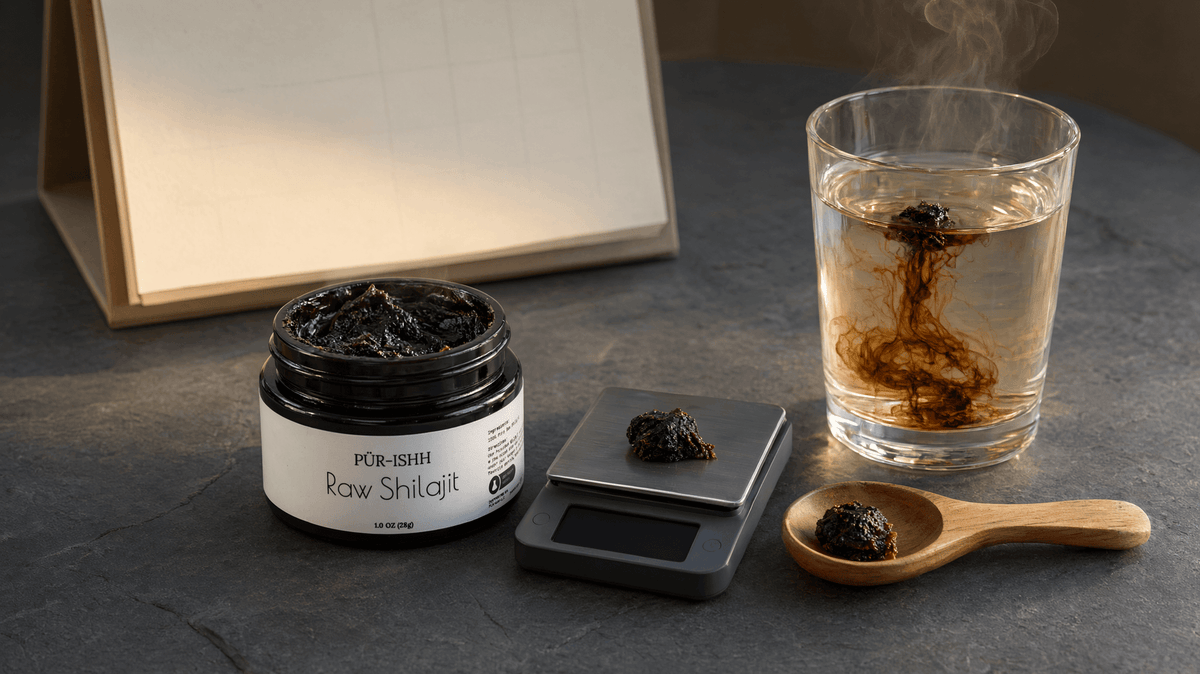
If your jar has hardened significantly: place it in a cup of warm water (not boiling, not in a microwave) for a few minutes. The material will soften, and you can then measure and use it normally. Some people keep their shilajit in a slightly warmer area of their home, away from refrigerators or cool windows, to minimize how often this adjustment is needed. You can also dissolve your daily dose directly into warm water or warm tea and drink it, which bypasses the consistency issue entirely and is arguably the simplest daily routine.
The COA on our shilajit noted taste as conforming to its expected bitter-tart profile, which is exactly what the material should taste like and is also a real authenticity indicator. If your shilajit is tasteless, or tastes primarily sweet, those are flags worth noting.
What not to mix it with
A few practical mixing notes worth having.
Warm water, warm milk (if that fits your diet), or warm herbal tea are the most commonly used and most compatible vehicles. Shilajit dissolves reasonably well in all of these, and the warmth makes the process faster and more complete.
Avoid mixing shilajit with very hot liquids, close to boiling, because very high heat can degrade some of the active compounds, particularly the more heat-sensitive fulvic acid fractions. Warm rather than hot is the practical standard.
Avoid mixing it into acidic beverages like citrus juices, which may interfere with the mineral complexes. Coffee isn't specifically contraindicated but the combination tastes unusual and there's a mild theoretical basis for thinking caffeine's effect on mineral absorption might be relevant, though this hasn't been studied specifically for shilajit.
What to actually expect, and when
This is the section most shilajit content gets wrong, either by implying dramatic changes happen in the first few days, or by being so vague that readers have no frame of reference for whether something is working.
Here's an honest timeline.
Days one through seven: possibly nothing notable, or mild digestive adjustment if you're sensitive. Some people report slightly more energy or mental clarity in the first week. Most don't notice much. This is normal and not a sign the product is doing nothing.
Weeks two through four: a portion of people begin to notice something, typically described as steadier energy across the day, less afternoon fatigue, or slightly improved mood and motivation. These effects are subtle rather than dramatic. Shilajit is not a stimulant and doesn't produce the kind of perceptible acute shift that caffeine does. If you're expecting to feel it the way you feel an energy drink, you'll be disappointed. If you're paying attention to patterns across your day over several weeks, this is where signals start to emerge for some people.
Weeks five through twelve: the Pandit trial measured outcomes at 90 days. The hormone-related changes that study found were measured at the end of that period, not at week two. If you're specifically interested in the testosterone and vitality markers studied there, evaluating before 12 weeks hasn't given the supplement the time the research was built around. This is a common mistake with slower-acting, adaptogenic compounds, assuming nothing is happening because nothing feels dramatically different in the first two weeks.
After three months of consistent use, the people with the most to gain from correcting a baseline deficiency in minerals and mitochondrial support tend to have the clearest results. People already in good metabolic health often notice less, for the same reason magnesium supplementation helps people who are low more than people who are already adequate.
Cycling: is it necessary
The question of whether to cycle shilajit comes up often, and the honest answer is that there isn't research-based guidance specific to shilajit that makes cycling clearly necessary or clearly unnecessary.
Some practitioners in the Ayurvedic tradition recommend periods of use followed by breaks, typically something like six to eight weeks on and one to two weeks off, on the rationale that any adaptogenic compound is better used this way. Western sports nutrition and clinical research hasn't really engaged with the cycling question for shilajit specifically, so there's no trial data to point to on either side.
The practical perspective: if you're taking it for hormonal support or longer-term metabolic benefits and you've been using it consistently for several months, a break of one to two weeks likely isn't going to set you back meaningfully, given that the benefits appear to build gradually and dissipate gradually rather than existing in an all-or-nothing state. If you simply prefer the structure of cycling and it makes the habit feel more deliberate, that's a reasonable approach. If you'd rather just take it consistently and not add complexity to your routine, there's no compelling evidence that continuous use creates problems that cycling would prevent.
Signs worth paying attention to
There are a few things worth monitoring, particularly in the early weeks.
Digestive changes are the most common early adjustment, ranging from mild nausea to looser stools, usually resolving within a week or two of consistent use. If GI effects are significant and persistent beyond two weeks, that's worth noting and potentially reducing the dose to see if that helps.
Energy and sleep can shift in either direction in the adjustment period. Most people who report sleep changes describe sleeping more deeply, which is consistent with the mineral and cortisol-regulation aspects of shilajit's proposed mechanisms. Occasional reports of disrupted sleep exist too. If your sleep is noticeably disrupted, moving the dose to morning rather than evening is worth trying before concluding the supplement doesn't agree with you.
Any allergic-type response, skin reactions, difficulty breathing, significant swelling, would warrant stopping immediately and consulting a physician, though these are very rare and more likely related to a contaminant in a poorly sourced product than to shilajit itself at the typical exposure level from quality material.
If you're on medications, particularly blood thinners, diabetes medications, or hormone therapies, shilajit's effects on insulin sensitivity and hormonal markers are plausible enough that discussing it with your prescribing physician before starting is worth the five-minute conversation.
The longer arc
The research suggests shilajit's most meaningful effects are cumulative and gradual. The 90-day mark the Pandit trial used isn't arbitrary, it's roughly the timescale over which mineral repletion and mitochondrial adaptation build to a meaningful level, and at which hormonal changes become statistically measurable in a controlled setting.
Most people who continue past that mark and feel the product is working for them tend to describe a steady baseline improvement rather than a dramatic transformation. Better energy, clearer thinking, reduced fatigue in the afternoons, improvement in things they weren't consciously tracking until they noticed the absence of certain problems. That's the realistic arc for a compound whose mechanism is slow, foundational, and systemic rather than fast, acute, and obvious.
If you're evaluating shilajit against caffeine's standard, you're using the wrong metric. If you're willing to track your own patterns honestly across a 90-day window, you'll have a much better answer to whether it's working for you than you'd get from any amount of reading about someone else's experience.