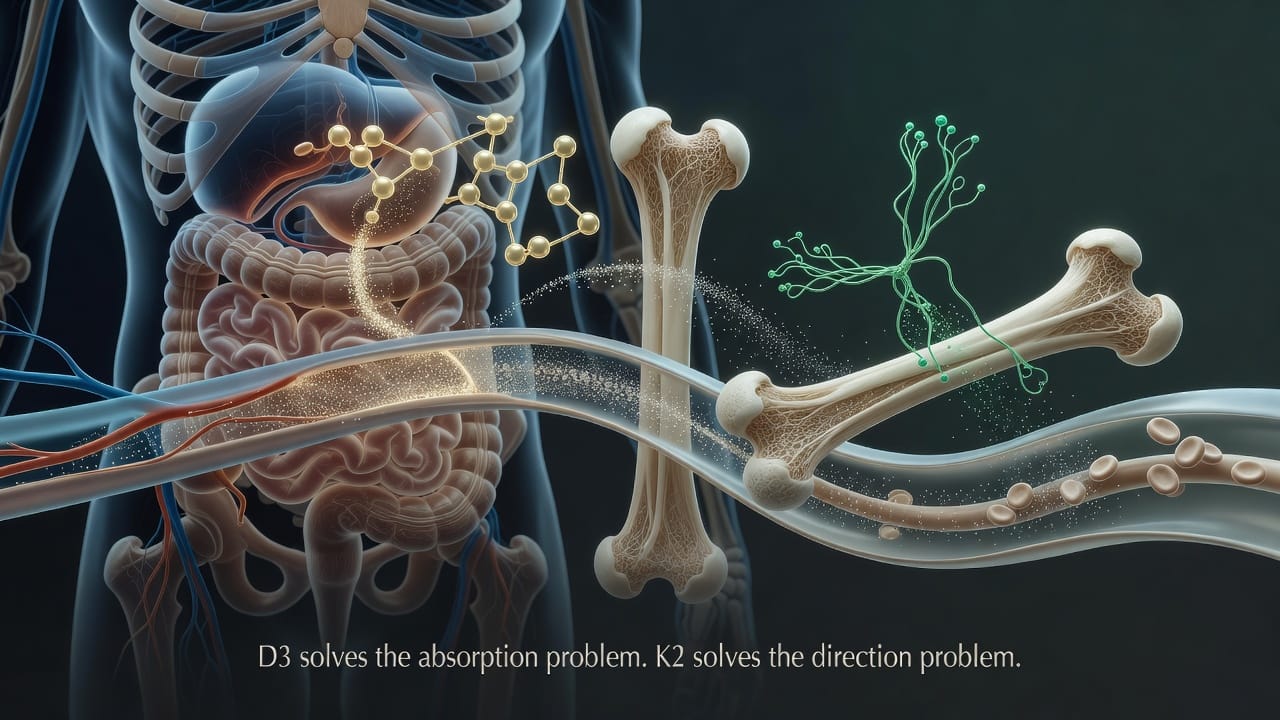
Most people who take vitamin D are taking it alone. They pick up a bottle of D3, read that it supports bone health and immune function, and assume the job is done. It isn't, and the reason has nothing to do with whether the dose is right or the source is quality. It has to do with what vitamin D actually does in the body once it gets there, and what happens when it does that without any traffic control.
The relationship between D3 and K2 is one of the clearest examples in nutrition science of two nutrients that are meaningfully better together than either is alone. It's also a case where a three-year randomized controlled trial, not an eight-week pilot study, not a mechanistic argument, an actual three-year human trial, provides the kind of evidence that's worth paying attention to.
What vitamin D actually does, specifically
Vitamin D3 is a fat-soluble vitamin your skin synthesizes from sunlight exposure, and which most people in the modern world don't get enough of, between spending significant time indoors, living at latitudes where sunlight angle limits year-round synthesis, and the cultural shift away from the sustained outdoor time previous generations had. Conservative estimates suggest that between 40 and 70 percent of adults in the US have suboptimal vitamin D status depending on the threshold used, making it one of the most widespread nutritional gaps in an otherwise well-fed country.
What D3 does when you have enough of it: it dramatically upregulates calcium absorption in your intestines, typically increasing it from somewhere around 10 to 15 percent efficiency in deficiency to 30 to 40 percent with adequate D3. It also plays roles in immune system regulation, cell differentiation, and a range of physiological processes that go considerably beyond bone.
The calcium absorption effect is the part most people know about, and it's genuinely important for bone density. But it's also the part that creates a problem when D3 operates without adequate K2, because absorbing more calcium is only half of what needs to happen. The other half is ensuring that calcium gets deposited in your bones and teeth, where you want it, rather than accumulating in soft tissues and arterial walls, where you emphatically don't.
What K2 does that K1 doesn't
Vitamin K is usually discussed as the clotting vitamin, because K1, found in leafy greens, is primarily involved in blood clotting pathways. K2 is a different form of the same vitamin family with a substantially different functional profile, and the two are not interchangeable.
K2 activates two proteins that K1 doesn't meaningfully reach in the body. The first is osteocalcin, a protein produced by osteoblasts, the cells that build bone. Osteocalcin needs to be carboxylated, chemically activated, to bind calcium and incorporate it into bone matrix. K2 is the cofactor that makes that activation happen. Without adequate K2, osteocalcin is produced but remains undercarboxylated and therefore unable to do its job effectively. You can have a skeleton full of machinery for incorporating calcium into bone, plenty of calcium coming in courtesy of adequate D3, and still deposit it inefficiently because the tool that connects the two isn't working.
The second protein K2 activates is matrix Gla protein, or MGP, which works in arterial walls and soft tissues to prevent calcium from depositing there. MGP is produced by vascular smooth muscle cells and is one of the most potent known inhibitors of vascular calcification. Like osteocalcin, it requires K2-dependent carboxylation to become active. When K2 is insufficient, MGP stays in its inactive form, and the protective barrier against soft tissue calcium deposition is weakened.
Put the two together: D3 increases calcium absorption significantly. K2 activates the proteins that direct calcium to bone via osteocalcin and prevent it from landing in arterial walls via MGP. Take D3 without K2 and you've solved half the problem while potentially making the other half worse.
The three-year trial worth knowing about
Most supplement research runs for eight to twelve weeks. That's long enough to see some changes, short enough to be feasible and affordable. A three-year randomized controlled trial is a different kind of commitment, and its existence for a specific nutrient tells you something about how seriously researchers were taking the question.
The Knapen study, published in 2013 in Osteoporosis International, enrolled 244 postmenopausal women between ages 55 and 65 and randomized them to either 180 micrograms of MK-7, the long-chain form of vitamin K2 known as menaquinone-7, or a placebo daily for three years. Bone mineral density and bone strength indices were measured at multiple timepoints across the trial.
At the end of three years, women in the MK-7 group showed significantly decreased age-related decline in bone mineral density compared to the placebo group, along with improvements in bone strength indices measured by stiffness and ultimate strength scores. The researchers concluded that MK-7 supplementation significantly decreased the age-related decline in bone mineral density and bone strength, specifically in women with initially low K2 status who showed the most pronounced benefits.
Several things make this study more credible than average. The three-year duration is unusual and means you're seeing actual bone health outcomes rather than just biomarker changes over a short period. The population was specifically postmenopausal women, the group at highest risk for bone density loss, so the effect size matters in a clinically relevant context. The dose used, 180 micrograms of MK-7, is achievable through supplementation and is a dose that's been used in subsequent research rather than an unusually high amount designed to produce a dramatic result.
Separately, research on arterial health and K2 has shown that high K2 intake is associated with reduced arterial calcification and improved cardiovascular markers, though this evidence is more observational and epidemiological than the clean interventional design of the Knapen bone trial.
MK-7 versus MK-4: a distinction that matters
Not all K2 is the same, and this distinction affects what you should be looking for on a label.
K2 exists in several forms, differentiated by the length of their side chains. MK-4 is the short-chain form, found naturally in some animal products and historically the form used in high-dose pharmaceutical preparations in Japan for osteoporosis treatment. MK-7 is the longer-chain form, found in natto, a fermented soybean product, and the form most commonly used in supplements today.
The practical difference for a daily supplement: MK-7 has a significantly longer half-life in the body, producing stable, sustained blood levels from a single daily dose. MK-4 is metabolized more quickly and requires either very high doses or multiple doses daily to maintain useful levels. The Knapen trial used MK-7 at 180 micrograms, and most of the meaningful contemporary K2 research has used MK-7 rather than MK-4 at typical supplement doses.
If you're shopping for a D3 and K2 combination product, MK-7 is what you want, and it should ideally be stated clearly on the label rather than just listed as "vitamin K2" with no indication of the form.
How much D3 and K2 to pair together
The pairing question has a practical dose dimension that's worth addressing, because it shapes how much K2 you actually need alongside a given D3 dose.
The more D3 you take, the more calcium absorption is upregulated, and consequently the more important having adequate K2 becomes to direct that calcium appropriately. At low D3 doses, the K2 requirement is modest because you're not dramatically changing how much calcium is coming in. At the higher D3 doses many people now supplement, typically 2,000 to 5,000 IU daily and sometimes more, the stakes for K2 are meaningfully higher because you've substantially increased calcium absorption without necessarily increasing your dietary K2 intake at all.
The Knapen trial used 180 micrograms of MK-7 as a standalone supplement, not paired with a specific D3 dose, so there isn't a clean head-to-head study of different D3 and K2 pairings. The practical consensus from nutrition researchers in this area tends to support somewhere in the range of 90 to 180 micrograms of MK-7 alongside moderate to higher D3 supplementation, with the higher end of that K2 range becoming more relevant as D3 dose increases.
Why most people are also low in K2
Vitamin D deficiency gets most of the attention, but K2 inadequacy is arguably as widespread and considerably less discussed.
Dietary K2 comes primarily from fermented foods and some animal products. Natto provides extremely high amounts, liver and certain cheeses provide moderate amounts, and grass-fed dairy products provide more than grain-fed equivalents. The Western diet, which is low in fermented foods, rarely includes natto, and has moved substantially toward grain-finished animal products and processed dairy, tends to deliver very little K2. Most dietary K assessment doesn't even measure K2 separately from K1, making the true population-level K2 status difficult to estimate, but the dietary patterns suggest widespread inadequacy is likely.
The practical implication is that most people supplementing D3 alone aren't just missing a nutritional pairing for theoretical reasons. They're likely genuinely low in K2 and supplementing D3 in that context is creating exactly the calcium-without-direction situation the research should make you want to avoid.
What to look for in a D3 and K2 product
If you're going to take these together, a few things are worth checking beyond the dose.
The D3 source matters modestly: D3 is cholecalciferol, the same form your skin produces from sunlight, and this is the form you want rather than D2 (ergocalciferol), which is less effective at raising and maintaining blood levels. Most modern D3 supplements use cholecalciferol, but it's worth confirming.
K2 form should be specified as MK-7 on the label, for the reasons above.
Heavy metal testing is worth asking about for this specific product category. Capsules derived from mixed ingredient sources can carry contamination depending on the raw material sourcing, and arsenic in particular is a concern for certain raw material inputs. A brand that can produce batch-specific testing results for arsenic, lead, cadmium, and mercury is doing what this category warrants.
The encapsulation matters for D3 specifically: as a fat-soluble vitamin, D3 absorbs better when taken with a meal containing fat. Products that include a small amount of oil or come in a softgel format rather than a dry tablet tend to provide better bioavailability.
The right way to think about these two together
D3 and K2 aren't just complementary nutrients that happen to have overlapping benefits. They're genuinely interdependent in the calcium metabolism pathway in a way that makes taking one without the other a partial intervention at best.
D3 solves the absorption problem. K2 solves the direction problem. Without the first, calcium doesn't come in efficiently enough to support bone remodeling at the rate your body needs. Without the second, more calcium comes in but has nowhere specific to go, which is a meaningfully different kind of problem than not enough. The three-year Knapen trial showed what K2 specifically does to bone over a meaningful timeframe, in a population where it matters most. That's not a subtle, speculative benefit from a mechanistic argument. It's a real, clinically significant finding from the kind of trial duration that most supplement research never bothers with.
Taking D3 without K2 is a common choice made by a lot of people who think they've covered their bases. They haven't, not fully.