Raw honey occupies an interesting position in the wellness world. On one side you have thousands of years of traditional use across cultures that regarded it as a genuine healing substance. On the other you have the modern instinct to dismiss anything with folk medicine roots as placebo until proven otherwise. The actual science sits somewhere in between, which is a more interesting place than either extreme, and more useful once you understand specifically what mechanisms are real and what claims have traveled further than the evidence supports.
This post is about what honey's antibacterial properties are, where they come from, how strong the evidence actually is, and where the research ends and the marketing begins.
The mechanisms are real, and there are several of them
Honey's antibacterial activity isn't one thing. It's the result of multiple overlapping mechanisms that work simultaneously, and this is part of why honey has been consistently effective against a range of bacteria in laboratory settings across a long history of research.
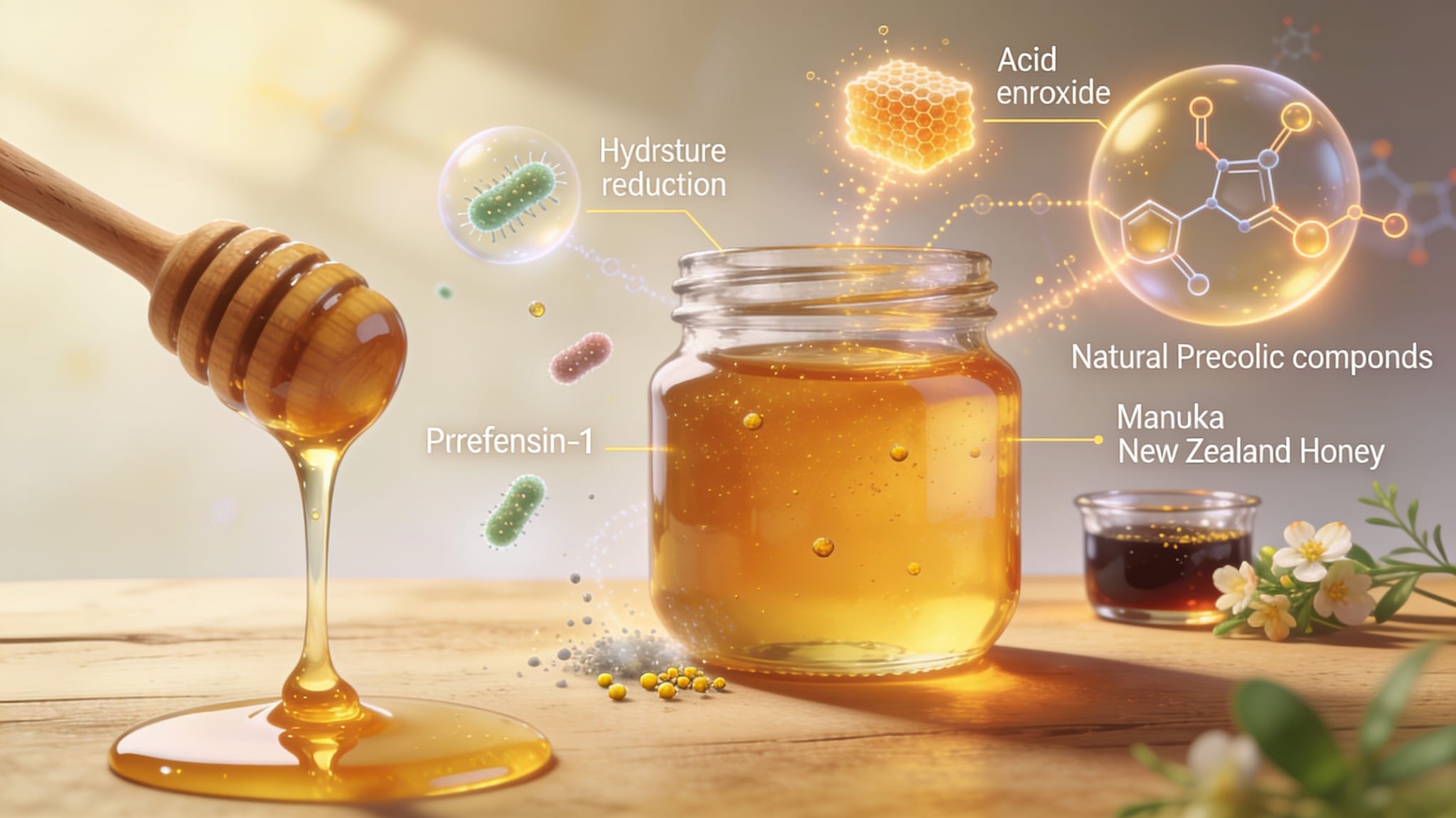
Hydrogen peroxide generation. When honey is diluted with water, an enzyme called glucose oxidase, which bees add during honey production, converts glucose in the honey into gluconolactone and hydrogen peroxide. The hydrogen peroxide produced is in low, sustained concentrations, enough to inhibit bacterial growth without the tissue toxicity that makes pharmaceutical hydrogen peroxide unsuitable for wound care at higher concentrations. This is the primary antibacterial mechanism in most non-Manuka raw honeys, and it's also the mechanism most sensitive to processing, which is why it matters that honey is genuinely raw rather than heat-treated.
Pasteurization and high-heat processing inactivate glucose oxidase. A pasteurized honey that looks identical to raw honey on a label, unless the label specifies otherwise, may have lost most or all of this specific activity. The enzyme is relatively fragile, and temperatures above roughly 40 to 45 degrees Celsius, the temperature at or above which hive conditions don't typically go, begin to degrade it. This is one of the clearest, most mechanistically grounded reasons to distinguish raw from processed honey, not a marketing claim but a specific biochemical consequence of how the product was handled.
Low water activity. Honey is hygroscopic, meaning it draws moisture from its surroundings. Its very low water activity, a measure of available water in a substance, creates an environment where most bacteria struggle to grow simply because there isn't enough free water for them to function. This is a physical rather than chemical mechanism, and it's one reason honey has been used as a preservative historically. This mechanism doesn't require any particular enzyme activity and is largely retained regardless of processing.
Acidity. Honey typically has a pH between 3.2 and 4.5, which is meaningfully acidic. Most pathogenic bacteria prefer a more neutral pH range, and the acidic environment honey creates is hostile to their growth.
Phenolic compounds and flavonoids. Honey contains a range of phenolic acids and flavonoids that contribute antibacterial and antioxidant activity. The specific compounds and their concentrations vary considerably depending on the floral sources the bees foraged from, which is why honeys from different regions and botanical sources have different antibacterial profiles in laboratory testing. Buckwheat honey, for instance, consistently tests with higher phenolic content than clover honey. The diversity of these compounds in raw honey is part of why the research on honey's antibacterial activity is real, even when different studies test different honey types and get somewhat different results.
Defensin-1. Bees add a peptide called defensin-1, part of their own immune system, to honey during production. This protein has demonstrated antibacterial activity in laboratory testing. Like glucose oxidase, it's susceptible to degradation from heat and light, making preservation through minimal processing relevant to retaining it.
What Manuka is specifically about
Manuka honey, produced in New Zealand and Australia from bees foraging on the Leptospermum scoparium plant, has become the most heavily researched and most heavily marketed honey in the world. Understanding what distinguishes it is useful for understanding what raw honey from other sources actually does and doesn't share.
Manuka's distinctive quality is methylglyoxal, or MGO, a compound present in unusually high concentrations compared to virtually all other honey types. MGO is derived from dihydroxyacetone in the nectar of Leptospermum flowers and accumulates in the honey over time. It provides potent antibacterial activity that, crucially, does not depend on hydrogen peroxide, meaning it's heat-stable in a way the glucose oxidase mechanism isn't. This is what gives genuine high-MGO Manuka honey its reputation as particularly effective for topical wound care and as more robust than other honeys.
The rating systems you'll see on Manuka products, UMF (Unique Manuka Factor), MGO numbers, or other certifications, are attempts to provide consumers with a standardized way to assess potency. A genuine UMF 20+ or MGO 800+ Manuka honey has documented, verifiable antibacterial activity at a specific level. The ratings matter because the Manuka market has significant adulteration problems, products claiming to be high-grade Manuka with actual activity levels that don't match the label.
What this means for raw honey from other floral sources: the hydrogen peroxide mechanism, low water activity, acidity, phenolics, and defensin-1 are all still present and all still real. Non-Manuka raw honey has genuine antibacterial activity. It's just a different profile, more dependent on the H2O2 pathway and more variable by floral source, and with a different evidence base than the Manuka-specific research.
What the wound care evidence actually shows
This is where the research is strongest, and it's worth being specific about why.
Laboratory studies showing honey inhibits bacteria in a dish are abundant and consistent. Honey has demonstrated activity against Staphylococcus aureus including MRSA strains, Pseudomonas aeruginosa, Escherichia coli, and a range of other common wound pathogens. These aren't obscure or contested findings. The antibacterial activity of honey in laboratory conditions is well-established.
The clinical evidence for wound care has grown meaningfully over the past two decades, including a Cochrane review that examined honey for acute and chronic wounds and found evidence supporting its use for superficial burns and infected surgical wounds, with honey-impregnated dressings showing faster healing times compared to conventional dressings in several trials. Medihoney, a commercially prepared Manuka honey wound product, is licensed as a medical device in multiple countries, which reflects the regulatory view that the evidence is sufficient for that specific application.
The honest limitations: most wound care research uses specific medical-grade honey preparations, not retail raw honey from a wellness brand. Medical-grade honey is gamma-irradiated to eliminate any risk of Clostridium botulinum spores, which is relevant to wound application on open tissue. Retail raw honey is not. The antibacterial mechanisms are the same, but the research establishing efficacy in wound care was done on preparations that went through a specific sterilization process, and applying those findings directly to applying retail honey to open wounds is a bridge the research doesn't clearly support.
The dietary and internal claims: where it gets weaker
Where honey's antibacterial reputation outpaces its evidence is in internal use as a treatment for infections or as a general internal antibacterial agent.
Consuming honey does not deliver meaningful antibacterial activity to your gut or bloodstream in the way applying it to a wound surface does. The hydrogen peroxide, for instance, is inactivated by catalase enzymes present in blood and tissue when honey is consumed. The antimicrobial compounds are diluted significantly through digestion, and the concentrations reaching gut tissue are far below what inhibits bacteria in laboratory settings where honey is applied directly.
Where there is some reasonable evidence for dietary honey: it has demonstrated modest prebiotic effects, supporting beneficial gut bacteria in some studies, and may have genuine benefits for throat soothing and cough, supported by several trials comparing honey to placebo or common cough medications, particularly in children. These are real, useful findings. They're different from honey being an internal antibiotic or a treatment for systemic bacterial infection, which it isn't.
The "raw honey is antibacterial so eating it supports your immune system" chain of reasoning is one where each step sounds plausible but the conclusion outpaces what the evidence actually tracks. Honey has genuine immunomodulatory and antioxidant properties through its phenolic compounds, but "honey is antibacterial when applied topically" and "eating honey kills bacteria internally" describe two different biological situations with different levels of evidence.
What "raw" means, and what it doesn't
In the United States, "raw honey" has no legal regulatory definition. Any honey producer can call their product raw, and what they mean by that can vary.
The practical, common-usage definition of raw honey: minimally processed, not heated above hive temperature (roughly 35 to 38 degrees Celsius), filtered to remove debris but not ultrafiltered to the point of removing pollen, and retaining its natural enzyme content. This is the version of raw honey where the antibacterial mechanisms described above are most likely to be intact.
Ultrafiltered honey is a different product. It's been processed through very fine filters to remove pollen, which makes it shelf-stable and resistant to crystallization but also removes much of what distinguishes honey as a product of specific geographic and floral origin. Pollen content is one of the markers used to verify honey's authentic origin and to distinguish it from adulterated products.
Crystallization is worth a specific mention: raw honey that hasn't been overprocessed almost always crystallizes over time. The glucose in honey forms crystals at room temperature, and crystallized honey is a sign of a natural product, not a product that's spoiled. Warming it gently in warm water returns it to a liquid state without damaging the enzyme content. Ultra-processed honey is manipulated specifically to prevent crystallization, which makes it look more appealing on a shelf but removes one of the natural characteristics of the real product.
For skin: what it's actually doing
Our soap and conditioner formulations include organic raw honey, and it's worth being specific about what it's contributing there, because topical honey in a cosmetic product is a different context from topical honey in a wound dressing.
In a soap or conditioner, honey functions primarily as a humectant, drawing moisture to the skin and hair, and contributes its mild antimicrobial activity to the overall formulation. It's genuinely an effective humectant, and the research on honey's moisture-binding properties is solid. In a rinse-off product used in the shower, the contact time isn't long enough for wound-care-level antibacterial activity to be the relevant contribution, but the humectant and conditioning properties are relevant.
We include it because it's a functional, well-tolerated natural ingredient with a real role in the product rather than a marketing ingredient added to a formula that doesn't actually use it meaningfully.
The one safety point worth making
Raw honey should not be given to infants under 12 months of age. Honey can contain Clostridium botulinum spores, which are harmless to adults and older children whose digestive systems can handle them, but which can germinate and produce toxin in the immature gut of an infant. This is a real, well-established risk, and it applies to all raw honey regardless of quality or source. The age threshold of 12 months is the consistent guidance from pediatric and public health authorities globally.
The honest summary
Raw honey's antibacterial activity is real, mechanistically well-understood, and backed by meaningful research, particularly for topical wound care. The mechanisms, hydrogen peroxide from glucose oxidase, low water activity, acidity, phenolic compounds, and defensin-1, are all genuine contributors. Manuka honey has an additional, heat-stable mechanism through methylglyoxal that explains its stronger evidence base for wound applications.
Where the evidence thins is in claims about honey as an internal antibacterial, or as a treatment for systemic infection, or as delivering the same activity internally that it does topically. The biology of how these mechanisms work changes significantly depending on whether honey is sitting on a wound surface or passing through your digestive system.
Raw honey from quality sources is a genuinely interesting substance with well-documented activity in specific contexts. The honest position is to be specific about what those contexts are rather than stretching the topical antibacterial evidence across every possible use case. That precision is more useful than a broad claim, and it holds up when examined closely.