This is one of the most searched questions in the entire wellness category, and it rarely gets a straight answer, largely because it sits at the intersection of two things people feel strongly about: wanting to make a healthier choice, and not wanting to be talked into paying more for something that doesn't actually deliver on that promise. Most of what comes up is either a brand insisting organic is obviously superior, since it's selling organic, or a contrarian take insisting the whole thing is a marketing myth designed to justify a higher price tag. Neither is the honest version, and both tend to skip past the actual research in favor of whichever conclusion suits the argument being made.
The honest version requires looking at what the actual research says about organic versus conventional food generally, since that's almost the entire body of evidence that exists, and then asking a question that gets skipped constantly: does any of that research actually apply to a manufactured dietary supplement, a capsule or powder that's been extracted, concentrated, and processed well past the point of being a fresh vegetable in a field. It mostly doesn't, and understanding why is more useful than a yes or no answer would be, because it changes what you should actually be looking for on a label the next time you're standing in front of a shelf trying to decide between two products that both use the word.
What "organic" certification actually verifies
We've made this point before and it's worth repeating here specifically, because it's the foundation everything else in this post rests on. USDA Organic certification is a production-method standard, verified through an accredited certifying body and an ongoing inspection relationship. It governs how a crop was grown or an animal was raised: no synthetic pesticides or fertilizers, no genetically modified inputs, no routine antibiotics or growth hormones for livestock, along with a defined set of soil and land management practices, all verified through an accredited certifying body and an ongoing inspection relationship rather than a single test on a single sample.
What it is not is a nutrient content guarantee, a contamination test, or a potency verification. Organic certification tells you about the method used to produce a raw ingredient. It doesn't test the finished product for what's actually in it once that ingredient has been processed further, which turns out to be the single most important thing to understand before this question can be answered honestly. This distinction sounds technical, but it's the entire hinge this post turns on, so it's worth sitting with before moving to what the research actually shows, because almost every misunderstanding about this topic traces back to skipping past exactly this point.
What the actual research says about organic versus conventional food
Pesticide residue is the clearest, most consistent finding, and it isn't close. A large 2012 systematic review published in the Annals of Internal Medicine, led by Stanford researcher Crystal Smith-Spangler, analyzed 237 studies comparing organic and conventional foods, including 17 human studies and 223 comparisons of nutrient and contaminant levels across fruits, vegetables, grains, meat, milk, and eggs, drawing on decades of published research going back to the 1960s. The review found that organic foods reliably carry lower pesticide residue than conventional ones, and that switching to an organic diet measurably reduces pesticide exposure, detectable in urine testing within days of the switch. That same year, the American Academy of Pediatrics reached a similar conclusion in its own review, confirming that an organic diet reduces pesticide exposure and may reduce exposure to antibiotic-resistant bacteria as well, tied to the restrictions on routine antibiotic use in organic livestock standards. This is the one part of the "organic is better" claim that holds up consistently across the research, and it's a real, meaningful difference for anyone specifically trying to minimize pesticide intake from produce, even though it's worth noting organic doesn't mean zero pesticide exposure, just meaningfully less of it on average.
Nutrient content is a genuinely more contested, evolving area, and it's worth being honest about the disagreement rather than picking whichever finding is more convenient. The Smith-Spangler review found little meaningful difference in overall nutrient content between organic and conventional foods; the one nutrient that came back significantly higher in organic produce was phosphorus, and the researchers themselves noted this has little practical significance since phosphorus deficiency is rare in the first place. A later, larger meta-analysis, published in 2014 in the British Journal of Nutrition by a research team led by Marcin Barański, looked specifically at 343 studies on organic crops, a broader and more recent dataset than the 2012 review drew on, and reached a different conclusion: organic crops showed meaningfully higher concentrations of antioxidant compounds, roughly 18 to 69 percent higher across specific polyphenol groups, with total antioxidant activity averaging about 17 percent higher than conventional crops. That same analysis found organic crops carried substantially lower cadmium levels, averaging around 48 percent lower, a finding the researchers tied to specific organic farming practices, particularly reduced use of certain phosphate fertilizers that can introduce cadmium into soil.
Two well-conducted reviews, two different conclusions on nutrient content specifically, and it's worth knowing that isn't the only pair of studies to disagree here; an earlier 2009 UK Food Standards Agency-commissioned review had also found no substantial nutritional differences, a conclusion the 2014 Barański team explicitly set out to revisit with a larger, more current dataset. That's not evidence of bad science on either side, it's a genuinely evolving area where newer, larger, more specific analyses have shifted the picture somewhat since the earlier reviews, and it's worth knowing this is still an area of real scientific discussion rather than a fully settled question in either direction.
There's one more honest limitation worth naming plainly, because both major reviews agree on it even though they disagree on the antioxidant question: neither one, nor any research we're aware of since, includes a long-term human clinical trial directly comparing health outcomes, actual disease rates, longevity, chronic illness risk, between people eating organic versus conventional diets over years or decades. What exists is shorter-term measurement of the food itself, plus a handful of short human studies looking at biomarkers like pesticide metabolites rather than long-term health outcomes. That's a meaningful gap in the evidence, and it means the strongest, most defensible claims from this research are about what's measurably in the food, pesticide residue, certain nutrient concentrations, not about what eating organic actually does to a person's long-term health, which remains genuinely unproven in either direction.
Why this research mostly can't answer the question people are actually asking
Here's the part that gets skipped almost everywhere this question comes up, and it's the whole reason this post exists rather than just linking to the two studies above and calling it done.
Nearly all of this research, the Smith-Spangler review, the Barański meta-analysis, and most of what preceded them, was conducted on fresh produce, grains, and some animal products like milk and eggs. It tells you about a tomato, a head of lettuce, a carton of milk. It tells you very little about a dietary supplement, which by definition has already been extracted, concentrated, processed, and often blended with other ingredients well past the point where "how was this crop grown" is still the most relevant question about what's actually in the finished product. A capsule of ashwagandha extract has been through solvent extraction, concentration, drying, and encapsulation; a bottle of magnesium capsules involves a mineral that was never a crop to begin with. Neither one is the tomato this research was actually measuring.
Organic certification, when it applies to a supplement ingredient at all, generally covers the raw agricultural input, the ashwagandha root, the turmeric rhizome, the berry, before it becomes a capsule or a powder. It says very little about what happened during extraction, concentration, encapsulation, or blending, which is where a supplement's actual safety and potency questions really live. A raw ingredient grown to organic standards can still end up in a finished product with contamination introduced during processing, with a concentration that doesn't match the label, or blended with other ingredients that were never grown under any organic standard at all, none of which the organic seal on the front of the bottle would ever catch or disclose.
There's also a category problem worth naming directly: a meaningful share of supplement ingredients don't fit the organic framework in any coherent way to begin with. Creatine, one of the most common and well-researched supplement ingredients on the market, is typically produced through chemical synthesis rather than extracted from an organic crop, which makes "organic creatine" a somewhat incoherent claim regardless of how it's marketed, since the molecule is chemically identical no matter how it was made. Minerals like magnesium, zinc, or boron aren't grown at all, they're geological or synthesized compounds, which means "organic magnesium" describes something that doesn't map onto what organic certification was actually built to verify. Shilajit, a mineral-rich resin formed over centuries in mountain rock, is a geological substance, not an agricultural crop, and applying an "organic" framework to it doesn't really describe anything meaningful about its origin or safety. Electrolyte blends built around mined salt and synthesized mineral compounds run into the same issue: there's no agricultural growing process for the certification to actually verify, since a mineral pulled from a salt deposit or manufactured through a chemical reaction never passed through a field, a growing season, or a harvest in the first place. Even ingredients that do start as real crops, like the black maca sometimes used for flavor in protein blends, only carry a meaningful organic claim if the specific maca used was actually certified, which is a batch-and-supplier-specific fact rather than something you can assume just because the ingredient category itself is capable of being organic.
None of this means these ingredients are lesser or riskier. It means the entire question of "is it organic" was never designed to apply to them, and a brand attaching the word anyway is often reaching for a familiar, trusted-sounding label rather than describing something that's actually true or verifiable about the product. When you see "organic" attached to an ingredient that was never grown as a crop in the first place, that's worth noticing as a marketing choice rather than a meaningful safety or quality claim, and it's a pattern worth watching for across this entire category, not just in our own catalog.
The cadmium finding is worth a second, more careful look
We want to come back to the Barański meta-analysis's cadmium finding specifically, because it's genuinely interesting and it illustrates the exact distinction this whole post is trying to make, maybe more clearly than any other single fact in this research.
Organic crops, on average, across 343 studies, showed meaningfully lower cadmium levels than conventional crops, tied to a real, identifiable agricultural practice, reduced use of certain synthetic phosphate fertilizers that can introduce cadmium into soil. That's a real, statistically meaningful average difference, and it's worth taking seriously rather than waving away as marketing noise, since it's backed by a large, carefully conducted analysis with a plausible causal mechanism behind it.
But notice exactly what kind of claim that is: it's an average tendency across hundreds of studies and thousands of samples, not a measured, verified fact about any single specific batch of any single specific product. Organic certification itself doesn't require testing the finished crop, or a supplement made from it, for cadmium content. The lower average shown in that research is a downstream statistical consequence of certain farming practices, not a guarantee backed by an actual test result on the product in front of you. A specific batch of an organically grown crop could still come back with an elevated cadmium reading, and the certification itself wouldn't catch that, because testing finished cadmium content isn't part of what the certification actually checks. The correlation is real. The guarantee isn't there.
That's the exact distinction we've built this entire month of content around, applied here to organic certification specifically rather than to any of our own ingredients: a general tendency, however real and well-documented, is not the same thing as a batch-specific, laboratory-verified result. One is a statement about a category on average. The other is a measured fact about the specific thing you're about to consume, and only one of those two things is something you can actually hold a document up and check.
When organic certification does apply cleanly to a supplement
To be fair to the concept, there are cases where organic certification maps onto a supplement reasonably well: a single-ingredient product made from an actual certified organic crop with minimal processing, like a straightforward herbal capsule or a whole-food powder, can carry a genuine, meaningful USDA Organic seal, complete with a certificate number you can verify against the USDA's own database. In that case, the certification is doing exactly the job it was designed for, verifying the growing practices behind an ingredient that's still recognizably close to its agricultural origin, and it's a legitimate, checkable claim worth taking at face value.
Where it gets murkier is exactly the territory most of the supplement industry actually operates in: multi-ingredient blends, concentrated extracts, synthesized actives, and mineral compounds, where either only part of the formula could ever qualify, or none of it meaningfully can. A product listing "organic" ingredients without an actual certificate number, or built around ingredients that were never agricultural to begin with, is using the word in its casual, marketing sense rather than its certified, verifiable one. Knowing the difference between those two uses of the same word is worth more than picking a side in the broader organic-versus-conventional debate.
What actually verifies a finished supplement, specifically
If organic certification is built to answer "how was the raw crop grown," the questions that actually matter most for a finished, manufactured supplement are different ones entirely: Does this specific batch contain what the label says, at the amount the label says? Is this specific batch free of heavy metal contamination, tested directly rather than inferred from farming method? Is this specific batch free of microbial contamination? Is the ingredient actually what it claims to be, rather than diluted, substituted, or adulterated?
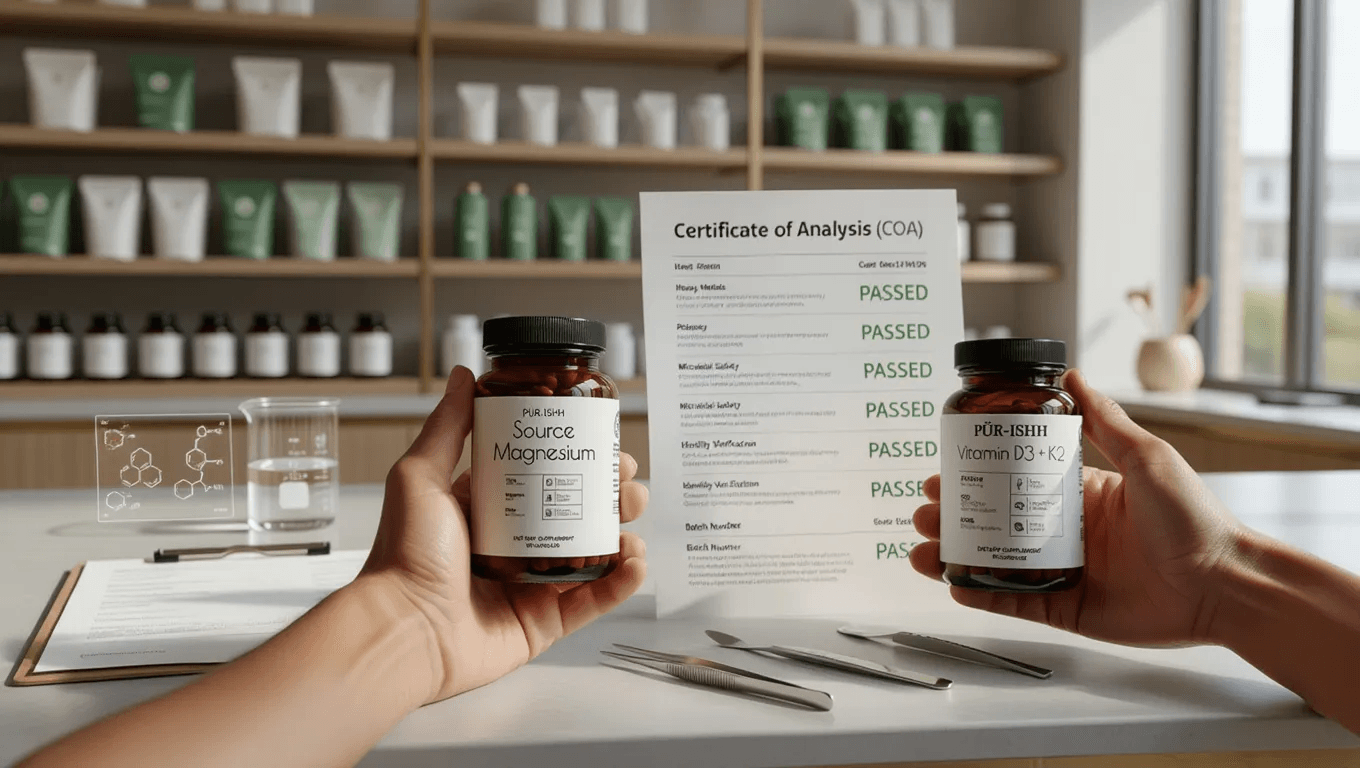
Those are exactly the questions a Certificate of Analysis is built to answer, tested on the actual finished batch, not estimated from how the raw ingredient was farmed three steps upstream. It's a different, and for a manufactured product specifically, more directly relevant kind of verification than organic certification provides, and it's not a lesser standard, it's a standard built to answer a different, more specific question that matters more once an ingredient has left the field and entered a processing facility. A supplement can be organic and untested for heavy metals. A supplement can be non-organic and rigorously tested for exactly the contamination risks that matter most. Neither label alone tells you which situation you're actually looking at, which is why we think the more useful habit is asking for the specific document rather than trusting either word on its own.
Where we actually stand on this
We're not certified organic, and we've been direct about that rather than letting the word do more implying than it's entitled to. What we've built this entire catalog around instead is batch-level testing: verified potency, verified heavy metal panels, verified microbial safety, on the actual finished products we ship, not inferred from the farming method of a raw ingredient several steps upstream. We think that's a more directly useful standard for a manufactured supplement specifically, without dismissing organic certification's real, legitimate value in the categories, like fresh produce, where the research behind it actually applies.
This isn't us arguing that organic certification is worthless, and we want to be clear about that. If you're standing in a grocery store deciding between organic and conventional strawberries, the pesticide-residue research is real and it's a reasonable thing to factor into that decision. The argument here is narrower and more specific: that same research, developed almost entirely on fresh produce and whole foods, doesn't transfer cleanly onto a manufactured capsule or powder, and a supplement brand borrowing the credibility of strawberry research to imply something about its processed, concentrated finished product is stretching the evidence further than it actually goes.
We'd rather make the narrower, more honest claim and back it with an actual document than make the broader, more familiar-sounding one and hope nobody checks where it actually comes from.
So, are organic supplements actually better?
If the question is whether an organic label means lower pesticide residue in the raw agricultural input, the evidence is genuinely solid on that specific point, and it's a real reason to choose organic produce if that's specifically what you're optimizing for. If the question is whether it means a meaningfully more nutritious finished product, the research is real but still evolving, and reasonable scientists looking at different data sets have reached different conclusions, which is a more honest answer than either side of this debate usually offers. If the question is whether it means a safer, more accurately dosed, contamination-free finished supplement, that's not what organic certification was ever built to verify in the first place, and no amount of research on organic tomatoes changes that, however often the word gets stretched to imply otherwise.
The more useful question isn't "is it organic." It's "has the actual finished product I'm about to take been tested for what matters," which is a question organic certification doesn't answer and was never designed to. Asking that second question, and actually checking whether a brand can answer it with a real document rather than a label, will tell you more about what's in your supplement than the word "organic" ever could on its own, on this bottle or on any other one you're ever deciding between.