The word "organic" gets used two different ways, and almost nobody distinguishes between them out loud. There's organic as a casual adjective, meaning something like "natural" or "clean," used loosely in marketing copy across the entire wellness industry, on everything from skincare to snack bars to supplements. And there's organic as a specific, legally defined, federally regulated certification, backed by an actual government program, actual inspections, and an actual certificate number you can look up. Only one of those two things means anything you can verify, and most people encountering the word on a label have no reliable way to tell which one they're looking at, since both versions use the exact same word in the exact same font on the exact same shelf.
This post is about the real one: what USDA Organic certification actually requires, how a product earns it, what it genuinely guarantees, and, just as important, what it doesn't. We think understanding this clearly is worth more than picking a side in the broader organic debate, because a lot of that debate is really an argument about a word people haven't defined the same way to begin with, and a surprising amount of the disagreement disappears once everyone's actually talking about the same specific thing.
Where this standard actually comes from
USDA Organic certification isn't a marketing program or an industry self-regulation scheme. It's a federal regulatory system, created by an act of Congress. The Organic Foods Production Act of 1990 authorized the creation of the National Organic Program, administered by USDA's Agricultural Marketing Service, and set out to establish national standards for what could legally be labeled organic in the United States, replacing what had been, until then, a patchwork of inconsistent state and private certification schemes with no single, enforceable federal definition.
It took over a decade to actually get there. A National Organic Standards Board was seated in 1992 to help develop the details, made up of farmers, handlers, retailers, scientists, and consumer and environmental representatives tasked with recommending which specific substances should be allowed or prohibited, a genuinely broad, multi-stakeholder group rather than a small committee of regulators working in isolation. The first proposed rule came out in December 1997 and drew more than 280,000 public comments, an enormous response, larger than almost any other federal rulemaking of that era, that led to significant revisions before anything was finalized. The regulations that actually govern the label you see today didn't take effect until October 2002, twelve years after the authorizing legislation was signed. That long runway matters context-wise: this wasn't a label a company invented and slapped on a product. It's a genuinely deliberated, publicly debated federal standard that took over a decade of rulemaking, and hundreds of thousands of public comments, to reach the form it exists in now.
Since 2002, it's illegal in the United States to use the word "organic" on a product label if it doesn't meet the specific requirements set out in that regulation, formally codified at 7 CFR Part 205, with real civil penalties attached for violations. That's worth knowing on its own: unlike a lot of the loosely regulated wellness vocabulary we've written about elsewhere, like "natural" or "clean," which carry no enforceable legal definition at all, "organic" genuinely is a protected, legally defined term when used on a product label, at least in principle. Whether that protection is consistently enforced in practice is a separate question we'll come back to.
The four labeling categories, and what each one actually allows
This is the part most people have never seen laid out clearly, and it's genuinely useful once you know it, because the front of a package can say very different things depending on which category a product actually falls into.
100 percent organic. Every ingredient in the product, aside from water and salt, was produced according to organic standards. This is the strictest tier, and it's allowed to carry the full USDA Organic seal. In practice, this tier is most common for single-ingredient or very simply formulated products, since hitting 100 percent gets harder the more separate ingredients a formula includes.
Organic. At least 95 percent of the ingredients, again excluding water and salt, meet organic standards. The remaining up to 5 percent must come from a specific, government-maintained list of approved non-organic substances permitted for use in organic products, generally reserved for things that aren't commercially available in organic form. This tier can also carry the USDA Organic seal, and it's the version most people picture when they think of an organic product.
Made with organic [specific ingredients]. At least 70 percent of the ingredients meet organic standards. This tier cannot display the USDA Organic seal at all, though it can list up to three specific organic ingredients or ingredient categories on the front of the package, something like "made with organic turmeric and organic ginger," a common formulation choice for multi-ingredient products that can't practically reach the 95 percent threshold above it.
Products with less than 70 percent organic ingredients can only mention which specific ingredients are organic within the ingredient list itself, on the back of the package, in small type alongside everything else. No organic claim of any kind is permitted on the front, and no seal applies, no matter how organic-forward the rest of the branding around it looks.
The practical takeaway: seeing the word "organic" somewhere on a package tells you almost nothing on its own. Seeing the actual USDA Organic seal specifically tells you the product falls into one of the top two tiers, at least 95 percent organic content. Seeing "made with organic X" tells you it's a meaningfully lower bar, 70 percent, with no seal attached at all. These are genuinely different claims, dressed in very similar-sounding language, and reading which specific version you're looking at is worth the extra ten seconds.
This distinction matters more in the supplement aisle than almost anywhere else, since a multi-ingredient formula, several herbs, a protein source, flavoring, and a handful of other functional ingredients, is exactly the kind of product where hitting 95 percent organic content is genuinely difficult, and where "made with organic" or no qualifying language at all is a far more common, and considerably less strict, reality than the front-label impression might suggest.
How a product actually earns this certification
Getting certified isn't a matter of a company simply asserting its practices meet the standard, filling out a form, and receiving a badge. It requires working with an accredited third-party certifying agent, either a private certification body or a state-run program, that's itself been accredited by USDA and re-evaluated on a five-year cycle to keep that accreditation current, creating a layer of oversight over the certifiers themselves, not just over the farms and companies they certify.
The process starts with an Organic System Plan, a detailed written description of exactly what practices and substances are used across the entire production or handling operation, from soil management and pest control to recordkeeping procedures and cleaning protocols for shared equipment. The certifying agent reviews that plan, then conducts an on-site inspection, generally at least annually, sometimes unannounced, to verify the plan is actually being followed in practice rather than just on paper. Certified operations also have to maintain detailed records establishing traceability, meaning an inspector can, at least in theory, follow a specific batch of product backward through every stage of production, from a specific field or lot, through processing, to a specific finished package, and confirm organic practices were maintained the whole way through without a gap where conventional material could have quietly entered the supply chain unnoticed.
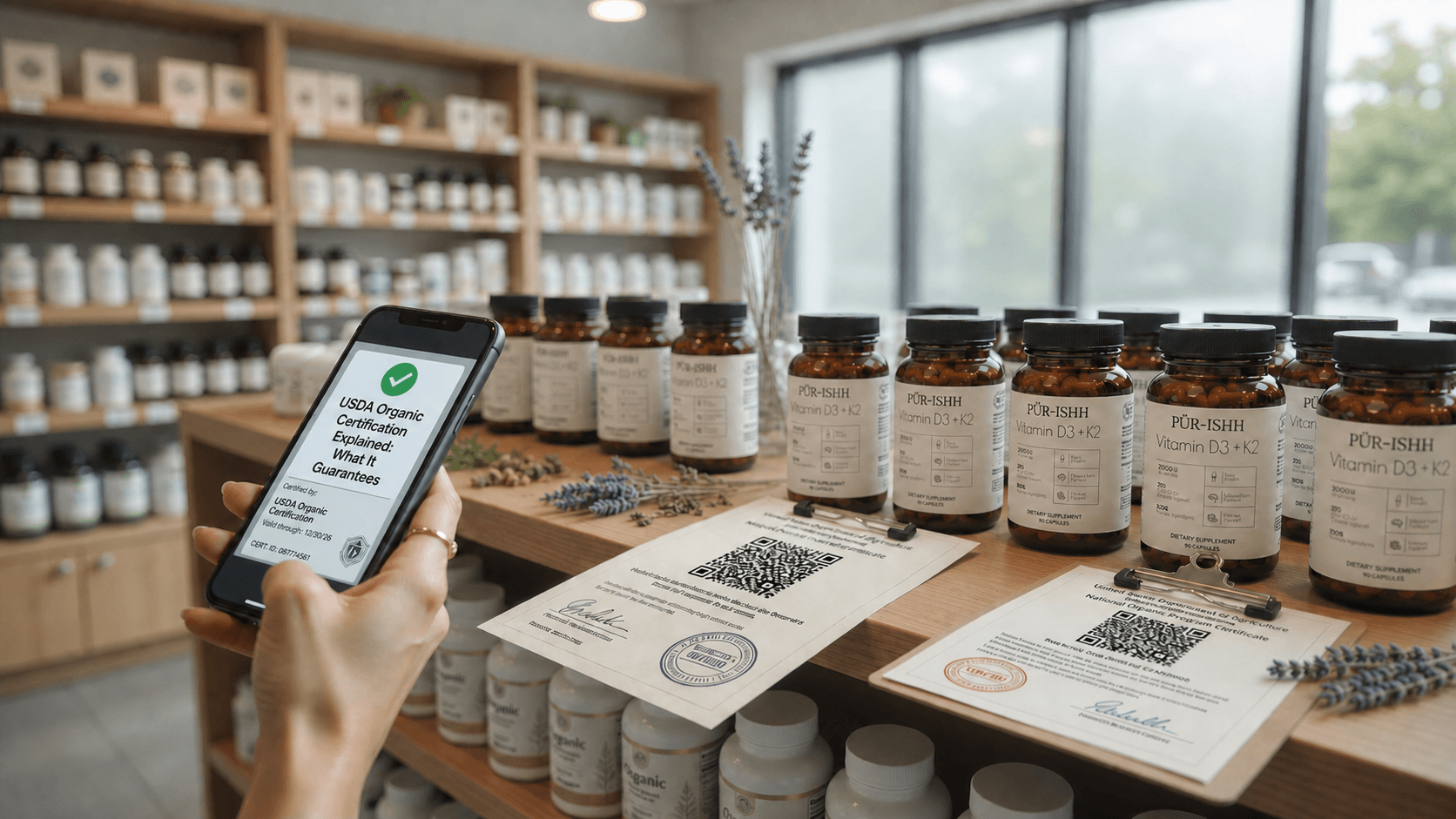
Once certified, an operation receives a specific certificate, tied to a certificate number, which is searchable in USDA's own Organic Integrity Database. That's a genuinely useful, underused tool: if you want to verify a specific organic claim rather than take a label at its word, that database is where you'd actually check it, the same way we've encouraged checking a lab's accreditation number or a batch's lot number elsewhere in things we've written this year. Most people never think to look, which is understandable, but it's worth knowing the option exists the next time a claim seems worth double-checking.
A note on imported organic products
One more nuance worth knowing, since it comes up more than people expect: not every product carrying an organic claim in a US store was certified directly under the USDA's own program. The US maintains organic equivalency arrangements with a number of other countries and trading blocs, including the European Union, Canada, Japan, and the United Kingdom among others, meaning a product certified organic under one of those countries' own recognized standards can generally be sold as organic in the US without a completely separate, duplicate certification process. The underlying practices and oversight differ somewhat between these systems, even though the label ends up looking identical on a US shelf. This isn't a loophole so much as a practical trade arrangement, but it's worth knowing that "USDA Organic" doesn't always mean every single ingredient inside was certified directly through the exact American process described above.
What's actually required and prohibited in production
Organic standards govern a fairly specific, defined set of practices, and it's worth knowing what's actually on that list rather than assuming it covers everything the word might imply.
For crops: no synthetic pesticides or fertilizers, no genetically modified inputs, no sewage sludge, no ionizing radiation, and required practices around crop rotation, soil fertility management, and buffer zones to prevent contamination from adjoining conventionally farmed land, sometimes as simple as a physical strip of untreated land or a natural barrier separating a certified field from a neighboring conventional one. For livestock: no routine antibiotics, no synthetic growth hormones, organic feed, and required access to the outdoors along with specific animal welfare provisions covering things like space allowances and living conditions.
Here's a genuinely common misconception worth correcting directly: organic does not mean pesticide-free. It means no synthetic pesticides, but a specific list of non-synthetic and a small number of specifically approved synthetic substances are permitted under organic standards, things like certain copper-based fungicides or pyrethrin-based insecticides derived from chrysanthemum flowers. Organic farming uses fewer, and different, pest and disease management tools than conventional farming, not zero tools. That distinction gets lost constantly in casual conversation about what the label means, and it's part of why the pesticide-residue research we've written about separately shows organic produce carrying meaningfully lower, but not zero, pesticide residue on average.
That approved-substances list itself, formally called the National List, is worth knowing exists, since it's the actual document that draws the line between what's allowed and what isn't in a given category. It's reviewed and updated periodically by the National Organic Standards Board, the same body seated back in 1992, which means the specific boundaries of what counts as organic aren't frozen in time from 2002. They're revisited on an ongoing basis as new substances are proposed, evaluated, and either added or rejected.
What this certification does not verify
This is the section that matters most for understanding where organic certification actually sits relative to everything else a product label might claim, and it's worth being precise rather than vague about it.
Organic certification is an audit of production practices and paperwork, conducted by people trained to check specific things against a specific written plan. It is not a laboratory test of the finished product. A certifying agent verifies that an operation followed its Organic System Plan and didn't use prohibited substances or methods; that's a meaningfully different thing than a lab measuring what's actually present in a specific batch of finished product once it's left the farm or the processing facility. Certification doesn't test a finished item for heavy metal contamination, microbial safety, or potency. Those are questions a Certificate of Analysis is built to answer, tested directly on a specific batch, and they're not questions the organic certification process is designed to ask at all, since its entire scope is upstream of that point, focused on how something was grown or raised rather than what ends up measurably present in the finished package.
It also doesn't guarantee superior nutrient content. The actual research comparing organic and conventional food on nutritional grounds is more contested and evolving than either side of the debate usually admits, and we've written about that specific evidence separately rather than repeating it here. What organic certification verifies is method, not outcome, and that distinction holds regardless of which way the nutrient research eventually settles.
And it doesn't mean "chemical-free," a phrase that isn't scientifically coherent to begin with, since water itself is a chemical. What organic certification actually restricts is a defined category of synthetic substances, while explicitly permitting a separate list of approved natural and synthetic substances under specific conditions. "Chemical-free" and "USDA Organic" are not the same claim, even though marketing language frequently blurs them together as if they were, and a product can be genuinely, legitimately certified organic while still containing plenty of things a chemist would rightly call a chemical.
A real reminder that certification isn't self-enforcing
It's worth knowing, honestly, that a certification system is only as good as its enforcement, and this one has had real, well-documented failures worth learning from rather than pretending don't exist.
In 2019, federal prosecutors secured convictions in what the U.S. Attorney's Office for the Northern District of Iowa called the largest organic fraud case in American history. A Missouri grain broker named Randy Constant ran a scheme from 2010 to 2017 involving more than $142 million in grain sales, falsely marketed as certified organic, sold to livestock farmers across the Midwest who then sold "organic" meat, eggs, and dairy to consumers under labels that were, several layers removed, built on fraudulent grain. Constant told buyers the grain came from his own certified organic fields when it didn't, sometimes because the fields themselves had been treated with unauthorized substances, sometimes because organic grain was deliberately blended with non-organic grain, a technique investigators described as "salting," mixing a small proportion of legitimate certified product into a much larger fraudulent batch to make the whole thing harder to detect. Constant was sentenced to more than ten years in federal prison, along with several farmers who supplied him. Evidence at sentencing showed his fraudulent sales alone equaled a meaningful single-digit percentage of all organic corn and soybeans reportedly grown in the country that year, which gives some sense of how much a single, sustained scheme can distort an entire supply chain before it's caught.
We're not including this to suggest organic certification is worthless or that fraud is common; the overwhelming majority of certified organic operations follow the standards they've agreed to, year after year, without incident, and cases of this scale are rare precisely because they're unusual enough to draw a multi-year federal investigation once suspicion is raised. A scheme of that size getting investigated, prosecuted, and sentenced is itself evidence the enforcement system functions, even if it functions after the fact, catching and punishing fraud that already happened, rather than a guarantee that prevents every case in advance. We're including it because it's the same lesson we've applied to every other kind of verification we've written about this year: a system that requires real inspection, real accountability, and real consequences for violation is meaningfully different from an honor system, but it's still a system run by people, with real gaps an enforcement agency has to actively close, rather than a guarantee that enforces itself automatically the moment a seal gets printed on a label.
Where we actually stand on all of this
We're not certified organic, and we've said that plainly elsewhere rather than let the word imply something about our own products that isn't true. What we've built instead is direct, batch-level laboratory verification, tested potency, tested heavy metal panels, tested microbial safety, on the actual finished products we ship. That's a genuinely different kind of standard than organic certification, answering a different question, and we think it's a more directly relevant one for a manufactured, processed product specifically, without it being a claim that organic certification is meaningless for the categories it was actually built to cover.
Part of why we've landed here rather than pursuing organic certification itself is the category problem this post has hopefully made clear: a fair share of what we work with, mined minerals, synthesized compounds, a mineral-geological substance like shilajit, doesn't map onto an agricultural growing process the certification was ever designed to verify in the first place. Pursuing a certification built around crop and livestock production for ingredients that were never crops or livestock would be reaching for the word more than reaching for something that actually describes what we do. We'd rather build toward a standard that fits what we're actually making than borrow one that fits a different kind of product.
The honest summary
USDA Organic certification is a real, legally defined, federally enforced standard, genuinely stricter than most of the loosely used wellness vocabulary surrounding it, and it's worth taking seriously as exactly what it is: a verified production method, checked through inspection and paperwork, covering pesticide use, fertilizer use, GMOs, and specific practice requirements. It is not a nutrient content guarantee, not a finished-product safety test, not a "chemical-free" claim, and not something every farmer, processor, or fraudster actually follows just because it exists.
Knowing exactly what that seal does and doesn't promise is worth more than trusting or dismissing it wholesale. The next time you see it, or see the word "organic" without it, on a product from us or from anyone else, you'll know exactly which of the four tiers you're actually looking at, exactly what production practices sit behind it, and exactly what question that tier does and doesn't answer about the specific thing you're about to buy.