Shilajit vs. Ashwagandha: Two Adaptogens, Two Evidence Bases
Shilajit and ashwagandha are often mentioned in the same breath. Both come out of Ayurvedic tradition. Both are sold as "adaptogens." And both show up in the same corners of the internet, usually with similar promises about energy, stress, and vitality.
Look closer and they have very little in common. One is a plant root. The other is a mineral-rich resin that seeps out of mountain rock. They've been studied for different things, in different people, to very different depths. Their main safety concerns are different too. Comparing them is less like comparing two brands of the same thing and more like comparing two separate research files that happen to sit on the same shelf.
This post opens both files. For each one we'll look at what it actually is, what the human trials found and how big those trials were, where the evidence is thin, and what the safety picture looks like.
A disclosure first: we sell shilajit, and we don't sell ashwagandha. That gives us a reason to favor one side, so we've tried to hold shilajit to the same standard as ashwagandha. As you'll see, on some measures ashwagandha's evidence base is actually the larger of the two.
First, what does "adaptogen" mean?
Both products are marketed as adaptogens, so it's worth knowing what that word does and doesn't mean.
The NIH Office of Dietary Supplements (ODS) describes an adaptogen as a compound or product that increases a person's ability to resist, adapt to, or become resilient to stressors. It also notes that this definition is loose.
The European Medicines Agency went further. In a 2008 reflection paper on the adaptogenic concept, its herbal medicines committee concluded that "the term is not accepted in pharmacological and clinical terminology that is commonly used in the EU."
So "adaptogen" is a traditional and marketing category, not a recognized pharmacological class. Calling two products adaptogens tells you very little about whether they work, or whether they work in the same way. For that, you have to look at each one's evidence directly.
What each one actually is
Ashwagandha
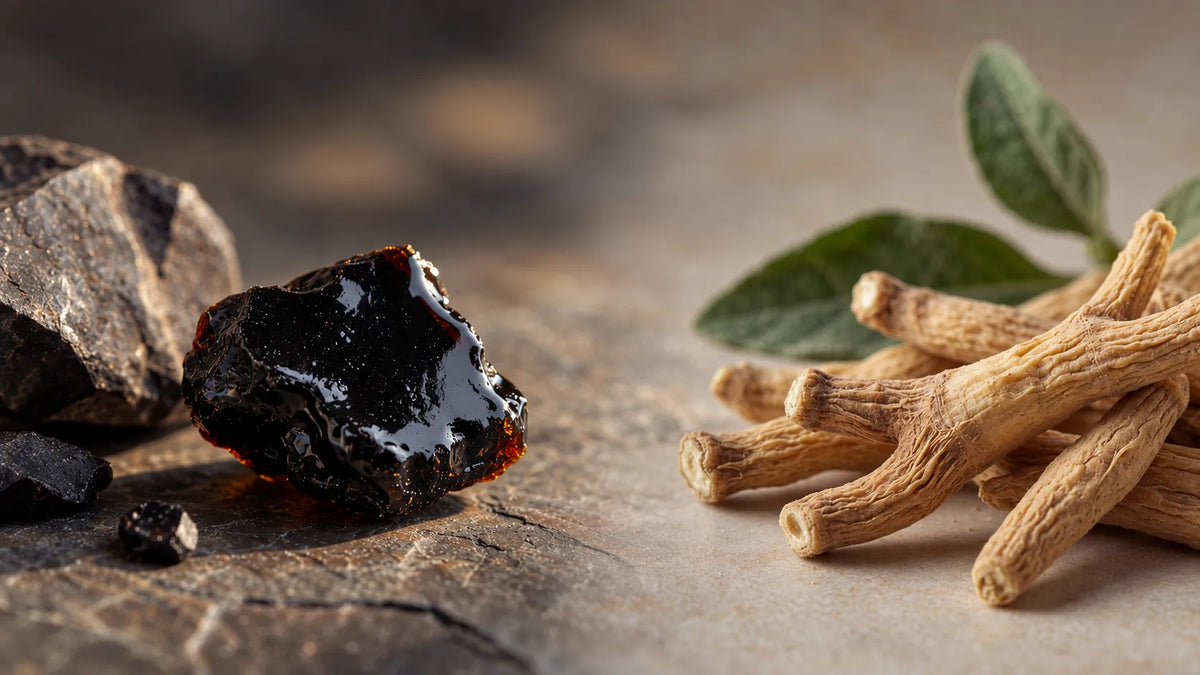
Ashwagandha (Withania somnifera) is, in the words of the ODS, an evergreen shrub cultivated in tropical and subtropical areas of Asia, Africa, and Europe. Most commercial supplements contain extracts from the plant's root. Some also include leaf extract, and the ODS notes that the root and leaf differ chemically. Extracts are often standardized to a group of compounds called withanolides.
Shilajit
Shilajit isn't a plant at all. It's a dark, resin-like substance that forms over long periods as plant material breaks down within rock in high mountain ranges, and it seeps out of cracks in the rock. It's rich in fulvic and humic acids, organic compounds formed as plant matter decomposes, along with a wide range of minerals.
That difference matters for how you judge quality. With ashwagandha, the main questions are which plant part was used, what extract it is, and how it's standardized. With shilajit, the questions are whether it's genuine, whether it has been properly purified, and what it contains, including what it shouldn't. Raw shilajit can carry heavy metals and microbial contamination, so purification and testing aren't optional extras.
The ashwagandha evidence base
Ashwagandha has the larger body of human research of the two. It has been tested in a fair number of randomized controlled trials, and several meta-analyses have pooled those results.
Stress and anxiety
This is ashwagandha's most-studied area. The ODS summarizes it this way: research suggests ashwagandha extracts may lower stress, anxiety, and cortisol levels. It describes a 2021 review of seven trials with 491 adults, lasting six to eight weeks, which found reduced stress and anxiety compared with placebo. The benefits appeared greater at doses of 500 to 600 milligrams a day than at lower doses.
The ODS also notes that a 2022 taskforce of two psychiatric organizations, the World Federation of Societies of Biological Psychiatry (WFSBP) and the Canadian Network for Mood and Anxiety Treatments (CANMAT), provisionally recommended specific daily doses of ashwagandha root extract for generalized anxiety disorder. That recommendation was 300 to 600 milligrams a day of root extract standardized to 5 percent withanolides. The taskforce said stronger recommendations would require more data.
Sleep
The most cited analysis here is a 2021 meta-analysis by Cheah and colleagues (PLoS ONE, 2021, volume 16, issue 9, article e0257843). They pooled five randomized controlled trials with 400 participants. Their findings:
-
Overall sleep: a small but significant effect, with a standardized mean difference of −0.59 (95 percent CI −0.75 to −0.42). The quality of evidence for this outcome was rated moderate.
-
By population: the effect was larger in adults with diagnosed insomnia (−0.84) than in healthy adults (−0.63).
-
By dose: doses of 600 milligrams a day or more showed a larger effect (−0.69) than lower doses (−0.44).
-
By duration: treatment for eight weeks or longer showed a larger effect (−0.68) than shorter treatment (−0.37).
-
Other outcomes: mental alertness on waking and anxiety also improved. Quality of life showed no significant change.
The authors concluded that ashwagandha extract appears to have a beneficial effect on sleep in adults. They added that data on serious adverse effects is limited and that more is needed before judging long-term use.
Testosterone and other areas
The ODS notes that ashwagandha might also increase testosterone levels. It mentions this mainly as a safety point: for that reason, experts say it might not be safe for men with hormone-sensitive prostate cancer. It has also been studied for athletic performance and other areas, but stress, anxiety, and sleep are where the research is most developed.
The limits of the ashwagandha evidence
A larger evidence base isn't the same as a settled one. Several limits are worth knowing.
Many different extracts. The ODS lists a long set of branded ashwagandha extracts used in trials and notes that studies have used various preparations, which makes specific recommendations difficult. A result from one extract doesn't automatically transfer to another, or to a generic root powder.
Wide dose range. Stress and anxiety trials used anywhere from 240 to 1,250 milligrams a day of extract, and one used 12,000 milligrams a day of whole root granules.
Short trials. According to the ODS, trials have lasted from 30 days to 12 weeks, mostly six to 12 weeks. It concludes that ashwagandha appears to be well tolerated for up to about three months, but its long-term safety is not known.
The shilajit evidence base
Shilajit's human research is much smaller. There are no meta-analyses of shilajit that we're aware of. Instead, there are a small number of randomized trials, each studying a specific outcome in a specific group. Two are worth knowing in detail.
Testosterone in middle-aged men
A 2016 randomized, double-blind, placebo-controlled trial by Pandit and colleagues (Andrologia, 2016, volume 48, issue 5, pages 570 to 575) gave healthy men aged 45 to 55 either 250 milligrams of purified shilajit twice a day or placebo for 90 days.
In the shilajit group, total testosterone rose by about 20 percent over the study, from 398.8 to 474.9 ng/dL. Free testosterone rose by about 19 percent. Two other hormones, LH and FSH, which signal the testes to produce testosterone, stayed stable.
That's a real result from a controlled trial. But it's one trial, in one group (healthy men in midlife), with one preparation (purified shilajit). It doesn't tell us what happens in younger men, in women, or with unpurified products. To our knowledge, the testosterone finding hasn't been replicated at a larger scale by independent groups.
Strength retention during fatigue
A 2019 randomized, placebo-controlled trial by Keller and colleagues at the University of Nebraska-Lincoln (Journal of the International Society of Sports Nutrition, 2019, volume 16, article 3) studied 63 recreationally active men. Over eight weeks, they took 250 milligrams a day of shilajit, 500 milligrams a day, or placebo, and then performed a fatiguing exercise protocol.
Among the top half of each group, here's how much maximal strength declined:
-
500 milligrams a day: 8.9 percent
-
250 milligrams a day: 17 percent
-
Placebo: 16 percent
The 500-milligram group also had significantly lower levels of hydroxyproline in the blood. That's an indirect marker of collagen breakdown.
There are three important caveats:
-
Subgroup only. The headline difference appeared in the top half of each group, not across all participants.
-
Indirect marker. Hydroxyproline is a stand-in measure, not a direct measure of tissue health.
-
Manufacturer involvement. The shilajit used was a branded, purified extract supplied by its manufacturer.
The limits of the shilajit evidence
Put plainly, shilajit's human evidence is:
-
Small: a handful of trials with dozens of participants each, not hundreds or thousands.
-
Narrow: mostly men, and mostly specific outcomes like hormones and fatigue.
-
Dependent on purified preparations: the trials used purified, standardized material, which isn't what every product on the market contains.
-
Not pooled: there's no meta-analysis to show how consistent the findings are.
That doesn't make the findings wrong. It means they're early. "Promising, specific, and unreplicated" is the honest description.
Side by side
What it is
-
Ashwagandha: root (sometimes leaf) extract of a shrub.
-
Shilajit: a mineral-rich resin from mountain rock, high in fulvic acid.
Most-studied areas
-
Ashwagandha: stress, anxiety, sleep.
-
Shilajit: testosterone in midlife men, strength retention during fatigue.
Size of evidence
-
Ashwagandha: multiple RCTs and several meta-analyses.
-
Shilajit: a few small RCTs and no meta-analyses.
Best single summary
-
Ashwagandha: sleep meta-analysis, 5 RCTs and 400 people, small but significant effect, moderate-quality evidence for overall sleep.
-
Shilajit: two individual trials, of 63 men and of men aged 45 to 55.
Typical studied doses
-
Ashwagandha: 240 to 1,250 mg/day of extract for stress, and 250 to 600 mg/day for sleep.
-
Shilajit: 250 to 500 mg/day of purified material.
Trial length
-
Ashwagandha: mostly 6 to 12 weeks.
-
Shilajit: 8 to 12 weeks.
Main quality issue
-
Ashwagandha: many different extracts that aren't interchangeable.
-
Shilajit: authenticity, purification, and contamination.
Main safety signals
-
Ashwagandha: rare liver injury reports, possible thyroid effects, pregnancy cautions, and restrictions in some countries.
-
Shilajit: heavy metal and microbial contamination in poorly processed material, and limited formal safety data.
Long-term safety
-
Ashwagandha: "not known" beyond about 3 months, according to the ODS.
-
Shilajit: not established.
Safety: different risks, not more or less
Ashwagandha
The ODS says common side effects of ashwagandha are mild: stomach upset, loose stools, nausea, and drowsiness. But it also lists more serious concerns.
-
Liver. There are a few reports of acute liver injury, some in people who had pre-existing liver disease. The ODS notes that product contents weren't independently verified in all cases.
-
Thyroid. Some research suggests ashwagandha might affect thyroid function, and case reports describe thyrotoxicosis, an excess of thyroid hormone. The ODS notes it might interact with thyroid hormone medications.
-
Pregnancy. Some experts advise against ashwagandha during pregnancy.
-
Regulation. According to the ODS, Denmark banned ashwagandha in 2023 following a risk assessment. France's food safety agency, ANSES, issued a 2024 statement recommending against its use in certain groups, including pregnant and breastfeeding women.
None of this means ashwagandha is dangerous for most people. In trials, it's generally well tolerated over the short term. But its safety profile has specific, documented flags that anyone considering it should know about. Anyone with a liver or thyroid condition, anyone taking medication, and anyone who is pregnant should talk to a clinician first.
Shilajit
Shilajit's main risk is in the product itself. Because it's a natural material collected from rock, raw or poorly processed shilajit can contain heavy metals and microbes. That's why purification and batch testing matter so much. It's also why the trials above, which used purified preparations, can't vouch for every jar sold under the same name.
Formal safety data on shilajit is limited. The trials were short and small, and they don't add up to a long-term safety record. As with any supplement, anyone who is pregnant, has a medical condition, or takes medication should check with a clinician before using it.
What our own batch shows
Since we sell shilajit, here's what our current batch's certificate of analysis reports. This certificate comes through our supplier's lab, not a lab we commissioned directly. We say that every time we share it, so you can weigh it accordingly.
Fulvic and humic acid
-
Fulvic acid: 72 percent
-
Humic acid: 8.3 percent
Heavy metals (result vs. permitted level, mg/kg)
-
Lead: 0.67, against a permitted level of 6
-
Cadmium: 0.12, against 1
-
Arsenic: 0.08, against 12
-
Mercury: below 0.01, against 1
Microbes and authenticity
-
Pathogenic bacteria, including salmonella: absent
-
Authenticity test result: "Authentic"
These numbers tell you about purity and composition. They don't tell you our shilajit will reproduce the trial results above, because those trials used a specific purified preparation, and nobody has tested ours against it head to head.
Can you take them together?
We're not aware of good-quality trials testing shilajit and ashwagandha together. So we can't say whether combining them helps, or whether it changes the safety picture. Ashwagandha's possible effects on thyroid function and hormones, and the general lack of long-term data on both, are good reasons to talk to a clinician before stacking them, especially if you take any medication.
How to think about choosing
This isn't medical advice, but the evidence points to a few sensible principles.
Match the product to the evidence, not the label. "Adaptogen" doesn't tell you what something does. Ashwagandha's research centers on stress, anxiety, and sleep. Shilajit's centers on a narrow set of outcomes in men, such as testosterone in midlife and strength retention under fatigue. If your goal doesn't match either evidence base, neither product has good evidence for it.
Check what was actually studied. With ashwagandha, look for the plant part, the extract, the withanolide standardization, and the dose, and compare them with the trials. With shilajit, look for evidence of purification, a fulvic acid figure, and a batch-specific heavy metal panel with actual numbers rather than just "pass."
Respect the time limits. Most trials of both lasted three months or less. Long-term safety isn't established for either.
Know the specific safety flags. For ashwagandha: liver, thyroid, pregnancy, and hormone-sensitive conditions. For shilajit: contamination and authenticity.
The honest summary
Shilajit and ashwagandha share a label, "adaptogen," that the European Medicines Agency doesn't accept as a pharmacological term. Beyond that label, they're different substances with different evidence bases.
Ashwagandha is a root extract with the larger body of research. A meta-analysis of five trials and 400 people found a small but significant improvement in sleep, larger at 600 milligrams a day or more and over at least eight weeks. Reviews also suggest reduced stress and anxiety. But trials used many different extracts, rarely lasted past 12 weeks, and the safety profile includes rare liver injury reports, possible thyroid effects, and regulatory restrictions in some European countries.
Shilajit is a mineral-rich resin with a much smaller research base. A 90-day trial in men aged 45 to 55 found about a 20 percent rise in total testosterone. An eight-week trial in 63 men found better strength retention under fatigue at 500 milligrams a day, in the top half of each group. Both used purified preparations, neither has been replicated at scale, and the main risk lies in the quality of the product itself.
If you're considering either, start with what you actually want, check whether the research matches it, look for proof of what's in the product, and talk to a clinician if you have a health condition or take medication.
References
-
NIH Office of Dietary Supplements. Ashwagandha: Fact Sheet for Health Professionals.
-
European Medicines Agency, Committee on Herbal Medicinal Products. Reflection paper on the adaptogenic concept. EMEA/HMPC/102655/2007. Adopted 8 May 2008.
-
Cheah KL, Norhayati MN, Husniati Yaacob L, Abdul Rahman R. Effect of Ashwagandha (Withania somnifera) extract on sleep: a systematic review and meta-analysis. PLoS ONE. 2021;16(9):e0257843. doi:10.1371/journal.pone.0257843
-
Pandit S, Biswas S, Jana U, De RK, Mukhopadhyay SC, Biswas TK. Clinical evaluation of purified Shilajit on testosterone levels in healthy volunteers. Andrologia. 2016;48(5):570-575. doi:10.1111/and.12482
-
Keller JL, Housh TJ, Hill EC, Smith CM, Schmidt RJ, Johnson GO. The effects of Shilajit supplementation on fatigue-induced decreases in muscular strength and serum hydroxyproline levels. Journal of the International Society of Sports Nutrition. 2019;16:3. doi:10.1186/s12970-019-0270-2
These statements have not been evaluated by the Food and Drug Administration. This product is not intended to diagnose, treat, cure, or prevent any disease.