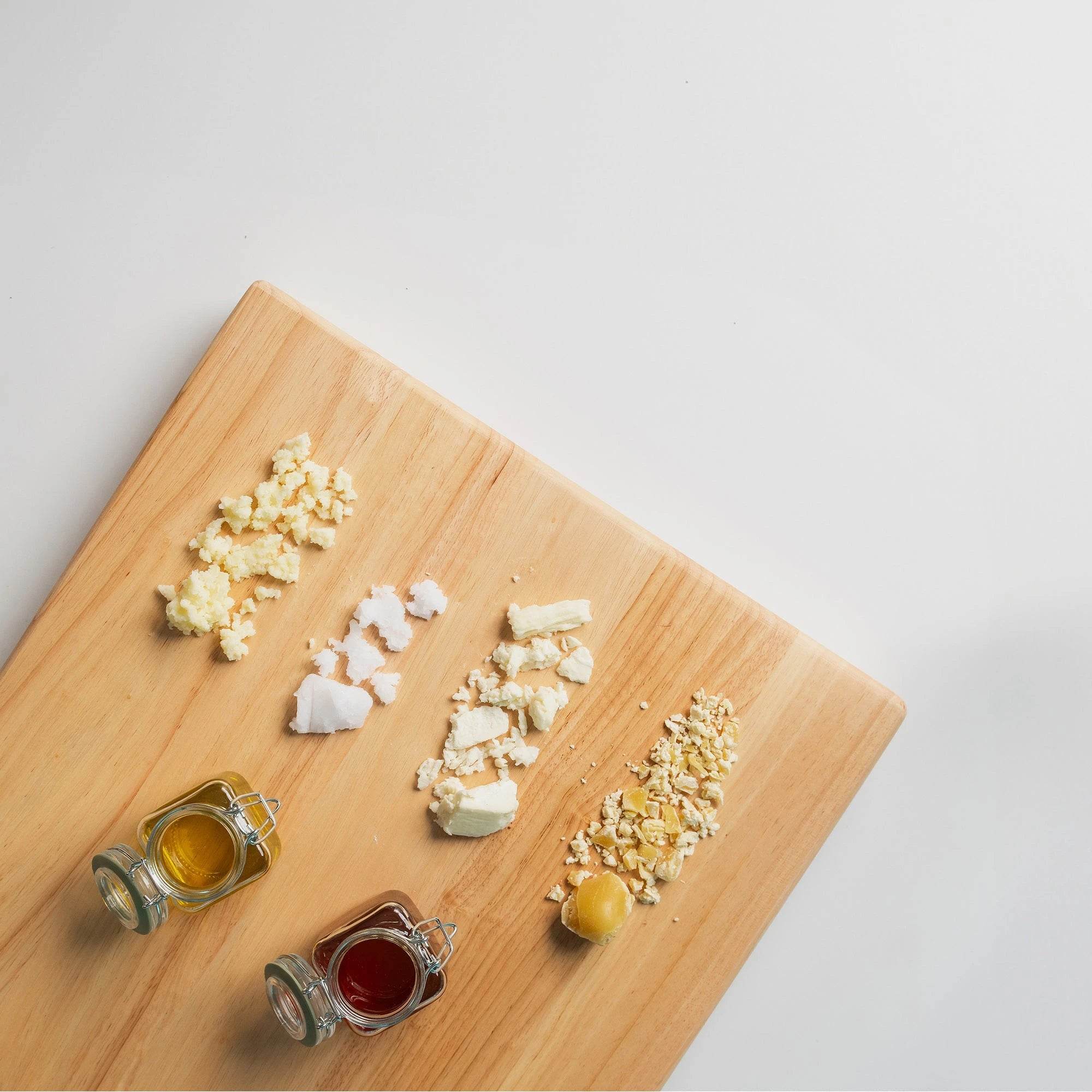
Tallow vs. Shea Butter vs. Petrolatum: An Honest Comparison
Few skincare debates get as heated as this one. Tallow is having a moment, with countless posts calling it the original moisturizer. Shea butter has been the go-to "natural" option for years. And petrolatum, the plain jelly in the tub, gets defended by dermatologists and attacked by the clean-beauty crowd in roughly equal measure.
We make tallow-based products, so you might expect this post to declare tallow the winner. It won't. On the one thing that can be measured most precisely, how well a product stops water escaping from your skin, petrolatum has the strongest data of the three. Tallow's direct clinical evidence is thin. Shea's is somewhere in between, and mostly indirect.
That doesn't mean tallow is a bad choice. It means the reasons to choose any of these three are different from what most marketing claims. This post goes through what each one is, what the evidence actually measures, where each one falls short, and how to choose for your own skin.
A disclosure up front: we sell tallow-based body products, and we don't sell shea butter or petrolatum products. So we have a clear stake in this comparison. We've tried to hold tallow to the same standard as the other two, and in places it doesn't come out ahead.
A quick primer: how moisturizers work
Before comparing ingredients, it helps to know the three jobs a moisturizing ingredient can do. A 2017 review in Clinical Medicine and Research by Purnamawati and colleagues (volume 15, issues 3 and 4, pages 75 to 87) describes them this way:
-
Occlusives are mostly oil-based and form a water-repellent layer on the skin, blocking water from evaporating out of it. This loss is called transepidermal water loss, or TEWL.
-
Emollients are lipid-based. They fill the gaps between skin cells, making the skin feel smoother and more flexible.
-
Humectants are water-attracting substances, such as glycerin or honey, that help the outer layer of skin hold on to water.
All three of the ingredients in this post are fats or oils, so they work mainly as occlusives and emollients. None of them is a humectant. That matters, because it means none of them adds water to your skin. They help keep the water that's already there, which is why they tend to work best on skin that's slightly damp, or alongside a humectant.
With that in mind, here's each ingredient.
Petrolatum: the measured benchmark
What it is
Petrolatum, often called petroleum jelly, is a semi-solid mixture of hydrocarbons refined from petroleum. The grade used in skincare is highly refined. It has no fragrance and no active compounds. It's essentially an inert, water-repellent layer.
What the evidence shows
Petrolatum is the most studied of the three, and the reason is simple: it's what dermatology research often uses as a reference point. The Purnamawati review calls it "the most effective classic occlusive moisturizer." It reports that petrolatum can reduce transepidermal water loss by more than 98 percent, at a concentration of at least 5 percent. That figure comes from a 1992 study by Ghadially and colleagues in the Journal of the American Academy of Dermatology.
Petrolatum also seems to do more than sit on top of the skin. A widely cited review by Lodén (American Journal of Clinical Dermatology, 2003, volume 4, issue 11, pages 771 to 788) notes that petrolatum has an immediate barrier-repairing effect in skin whose natural lipids have been stripped away.
Where it falls short
Petrolatum's weaknesses are mostly about feel and preference, not effectiveness. The Purnamawati review lists greasy consistency and potential allergenicity as drawbacks of occlusives as a group. Petrolatum is heavy and shiny, and many people simply don't like how it feels, especially on the face or over large areas of the body. It also contributes nothing beyond occlusion. It has no fatty acids, no vitamins, and no plant compounds. For some people that's a feature. For others, it's the reason they look elsewhere.
Some people also avoid petrolatum because it's derived from petroleum, for environmental or ingredient-philosophy reasons. That's a legitimate personal preference. But it's a different question from whether petrolatum works, and on that question the data is clear.
Shea butter: a plant fat with indirect evidence
What it is
Shea butter is a fat extracted from the kernels of the shea tree, Vitellaria paradoxa (also known as Butyrospermum parkii), which grows across a band of sub-Saharan Africa. A review by Honfo and colleagues (Critical Reviews in Food Science and Nutrition, 2014, volume 54, issue 5, pages 673 to 686) reports that shea kernels contain between 17.4 and 59.1 grams of fat per 100 grams of dry weight. The fat is traditionally extracted by roasting, pressing, and churning with water.
Shea butter's fat is made up mostly of stearic and oleic acids. It's also notable for a fraction of compounds that aren't fats, including triterpenes. A 2018 review of plant oils in skincare by Lin, Zhong, and Santiago (International Journal of Molecular Sciences, volume 19, issue 1, article 70) notes that triterpenes are abundant in shea butter.
What the evidence shows
Shea's evidence is mostly about its composition and laboratory activity, rather than direct head-to-head trials on human skin. The Honfo review notes that shea butter has shown some antioxidant and anti-inflammatory activity. The Lin review discusses triterpenes as a class of compounds with potentially useful effects on skin. But it's important not to transfer what's known about a compound class directly onto shea butter as a finished product. Laboratory activity is a reason for interest, not proof of a benefit you'd notice.
As a moisturizer, shea behaves the way a plant butter should. It's an emollient and a moderate occlusive, solid at room temperature and softening on contact with skin.
Where it falls short
There are two main limits.
Variable composition. The Honfo review specifically notes wide variation in reported composition values for shea products, and it calls for better analytical methods and work on quality and shelf life. Raw and refined shea butters can differ, as can shea from different regions and processing methods. "Shea butter" on a label doesn't guarantee a consistent product.
Thin direct clinical data. We aren't aware of strong clinical trials showing that shea butter on its own outperforms petrolatum on measured water loss. Its appeal rests mainly on its plant origin, its texture, and its composition.
Tallow: popular, plausible, and thinly studied
What it is
Tallow is rendered animal fat, in skincare usually from beef. Rendering melts the fat and separates it from other tissue, leaving a solid, creamy fat once cooled.
A 2025 review in Dermatology Times describes beef tallow as roughly 50 to 55 percent saturated fatty acids (mainly palmitic and stearic acid), 40 to 45 percent monounsaturated fat (mainly oleic acid), and trace amounts of vitamins A, D, E, and K.
The "just like your skin's own oils" claim
The most common argument for tallow is that it closely resembles human sebum, the oil your skin produces. That claim is partly true, and it's worth being precise about which part.
According to a review of skin surface lipids by Wójcik and colleagues (Advances in Dermatology and Allergology, 2011, volume 28, issue 6, pages 498 to 505), human sebum is made up of roughly:
-
57 percent triglycerides
-
25 percent wax esters
-
15 percent squalene
-
2 percent cholesterol esters
-
1 percent cholesterol
Tallow is essentially a triglyceride fat. So it overlaps with the largest single part of sebum, and some of its fatty acids are also found in sebum. But it doesn't supply the wax esters and squalene that together make up around 40 percent of sebum.
The accurate version of the claim, then: tallow shares some features with sebum, especially its triglycerides. It isn't a replica of it. And sharing features with sebum doesn't by itself prove a skin benefit. That has to be tested directly.
What the evidence shows
This is where tallow's case is weakest, and we'd rather say so than have you find out elsewhere.
A 2025 cross-sectional study by Almatroud and colleagues (Journal of Cosmetic Dermatology, 2025, volume 24, issue 12, article e70544) analyzed 200 beef tallow skincare posts on TikTok, Instagram, and YouTube. The researchers found:
-
Evidence gap: a large gap between online enthusiasm and scientific evidence.
-
Financial bias: frequent financial bias in the posts.
-
Risks: little discussion of risks.
-
Quality standards: 82 different tallow retailers, with no standardized quality or manufacturing guidelines.
They concluded that there was insufficient scientific evidence to determine whether beef tallow is helpful or harmful for acne, psoriasis, or atopic dermatitis.
The Dermatology Times review reached a similar view. It noted that most support for tallow is extrapolated from studies of its individual fatty acids, not from clinical trials of tallow products. It argued that because those fatty acids can have conflicting effects on the skin, it's hard to predict tallow's net effect for any one person.
We aren't aware of randomized controlled trials testing tallow as a skincare product against petrolatum, shea, or a standard moisturizer. That's the honest state of the evidence.
Where it falls short
Beyond the evidence gap, two practical issues stand out.
Acne-prone skin. The Dermatology Times review suggests that people with acne should be cautious with heavy, saturated-fat-rich occlusive products. It says tallow may be tolerated by some people with thicker, non-facial, non-acne-prone skin. If you're prone to breakouts, it's sensible to test any rich balm, tallow included, on a small area before using it on your face.
Quality varies. The Almatroud study's finding of no standardized manufacturing guidelines matters. How the fat is sourced, rendered, filtered, and stored affects the final product, including its smell and how long it stays fresh.
Side by side
What it is
-
Petrolatum: refined petroleum hydrocarbons.
-
Shea butter: plant fat from shea kernels.
-
Tallow: rendered animal fat, usually beef.
Main role
-
Petrolatum: occlusive.
-
Shea butter: emollient and moderate occlusive.
-
Tallow: emollient and occlusive.
Measured water-loss data
-
Petrolatum: the strongest. More than 98 percent reduction in TEWL at 5 percent or more.
-
Shea butter: limited direct data.
-
Tallow: no controlled trials that we're aware of.
Extra compounds
-
Petrolatum: none. It's inert.
-
Shea butter: triterpenes and other non-fat compounds.
-
Tallow: fatty acids and trace fat-soluble vitamins.
Strongest evidence type
-
Petrolatum: clinical and barrier-repair studies.
-
Shea butter: composition and lab activity.
-
Tallow: composition and extrapolation from its fatty acids.
Consistency between products
-
Petrolatum: high, if highly refined.
-
Shea butter: variable by source and processing.
-
Tallow: variable, with no standard guidelines.
Main drawback
-
Petrolatum: heavy and greasy feel. Petroleum-derived.
-
Shea butter: variable quality. Thin clinical data.
-
Tallow: thin clinical data. Caution for acne-prone skin.
Suits people who…
-
Petrolatum: want maximum occlusion and don't mind the feel.
-
Shea butter: prefer plant-based ingredients.
-
Tallow: prefer animal-based, whole-ingredient products.
What none of them should be used for
Two clarifications apply to all three ingredients, and they matter more than any of the differences above.
None of them is a sunscreen. A layer of fat or jelly is not tested sun protection. That includes our own Sun Balm, which is a tallow-based balm and not a sunscreen. If you need sun protection, use a product with a tested SPF and follow its directions.
None of them is a treatment for a skin condition. The Almatroud study found no reliable evidence either way on tallow for acne, psoriasis, or atopic dermatitis. If you have a diagnosed skin condition, choose a moisturizer with your dermatologist rather than switching based on social media.
How to choose, honestly
Since none of the three wins on every measure, the right choice depends on what you care about most.
If you want the most proven occlusion, choose petrolatum. On measured water-loss reduction, it's the clear leader. It's inexpensive and consistent, and it's widely recommended for very dry or compromised skin. If you can live with the feel, it's hard to beat on the numbers.
If you prefer a plant-based option, choose shea butter. It has a pleasant texture and an interesting composition. Its clinical evidence is thinner than petrolatum's, and quality varies, so look for a reputable source.
If you prefer whole, animal-based ingredients, tallow is a reasonable choice. That goes especially for the body, and for skin that isn't acne-prone. Choose it because you like the ingredient and how it feels, not because it's been proven superior, because it hasn't. Patch test first, especially on the face.
For any of them, apply to slightly damp skin. All three hold in water rather than add it. Using them right after a shower, or over a humectant, makes the most of how they actually work.
Why we use tallow anyway
You might reasonably ask why we make tallow products if petrolatum has better data. The honest answer is that we're not claiming tallow outperforms petrolatum. We use it because many of our customers prefer simple, animal-based ingredients over petroleum-derived ones, and like how tallow feels on their skin. That's a preference, and we think it's a legitimate one, as long as it's presented as a preference rather than dressed up as settled science.
What we can control is the quality of what we make and how honestly we describe it. That means telling you what tallow is, what the evidence does and doesn't show, and not calling our balm something it isn't.
The honest summary
Tallow, shea butter, and petrolatum are all fats that help skin hold on to water. None of them adds moisture on its own.
Petrolatum has the strongest measured evidence. It can reduce transepidermal water loss by more than 98 percent, and it has an immediate barrier-repairing effect on lipid-depleted skin. Its downsides are feel and origin, not effectiveness.
Shea butter is a plant fat rich in stearic and oleic acids, with notable triterpenes. Its evidence is mostly about composition and lab activity, and its quality varies.
Tallow shares some features with sebum, mainly its triglycerides, but lacks the wax esters and squalene that make up around 40 percent of sebum. A 2025 analysis found insufficient scientific evidence to say whether it helps or harms skin conditions, alongside frequent financial bias in how it's promoted online.
So choose petrolatum if you want the most proven occlusion. Choose shea if you prefer plant-based ingredients. Choose tallow if you prefer whole, animal-based ingredients and your skin tolerates it. Be skeptical of anyone, including us, who tells you one of them is a miracle.
References
-
Purnamawati S, Indrastuti N, Danarti R, Saefudin T. The role of moisturizers in addressing various kinds of dermatitis: a review. Clinical Medicine and Research. 2017;15(3-4):75-87. doi:10.3121/cmr.2017.1363
-
Ghadially R, Halkier-Sorensen L, Elias PM. Effects of petrolatum on stratum corneum structure and function. Journal of the American Academy of Dermatology. 1992;26(3):387-396. (Cited via reference 1.)
-
Lodén M. Role of topical emollients and moisturizers in the treatment of dry skin barrier disorders. American Journal of Clinical Dermatology. 2003;4(11):771-788. doi:10.2165/00128071-200304110-00005
-
Honfo FG, Akissoe N, Linnemann AR, Soumanou M, van Boekel MAJS. Nutritional composition of shea products and chemical properties of shea butter: a review. Critical Reviews in Food Science and Nutrition. 2014;54(5):673-686. doi:10.1080/10408398.2011.604142
-
Lin TK, Zhong L, Santiago JL. Anti-inflammatory and skin barrier repair effects of topical application of some plant oils. International Journal of Molecular Sciences. 2018;19(1):70. doi:10.3390/ijms19010070
-
Wójcik A, Budzisz E, Rotsztejn H. Skin surface lipids and their measurements. Advances in Dermatology and Allergology. 2011;28(6):498-505.
-
Almatroud L, Choi S, Libson K, Ashack K. Beef tallow-based skincare claims in social media: a cross-sectional analysis. Journal of Cosmetic Dermatology. 2025;24(12):e70544. doi:10.1111/jocd.70544
-
Social Media Mythbusters: Beef Tallow. Dermatology Times. 2025.