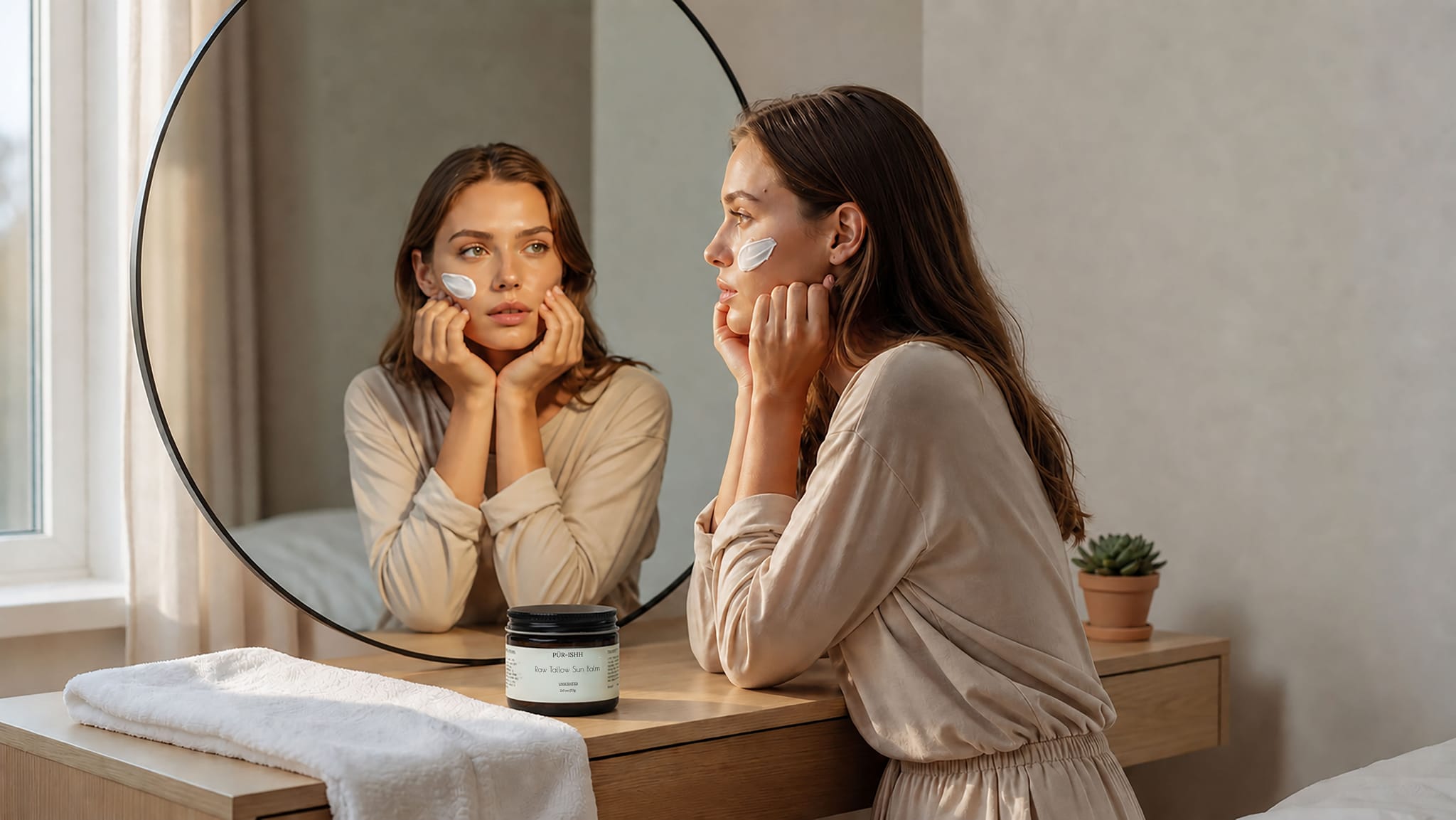
This is the question we get the most, and it's usually asked by someone who already has a reason to ask it: a breakout after trying a tallow balm, a dermatologist who raised an eyebrow, or just a healthy skepticism about a trending ingredient that sounds a little too good in most of the content written about it.
We're not going to dodge it. The honest answer is: it depends, and the factors it depends on are specific enough to actually be useful, rather than a vague "everyone's skin is different" shrug. So let's go through what comedogenic actually means, where the number everyone repeats actually comes from, what the real evidence says about tallow's fatty acids specifically, a condition that gets confused with regular acne but isn't caused by the same thing, and what actually changes your personal risk.
What "comedogenic" actually describes
A comedo is the technical term for a clogged pore, the basic unit of both blackheads and whiteheads, and the earliest stage of most acne. It forms when the lining of a hair follicle sheds skin cells abnormally, those cells build up rather than shedding cleanly, and the buildup combines with sebum and sometimes bacteria to block the follicle opening. "Comedogenic" describes an ingredient's tendency to contribute to that process, either by directly blocking the follicle physically or by influencing the follicle lining's behavior in a way that makes blockage more likely.
That second mechanism matters more than people usually assume. A comedogenic ingredient isn't necessarily just a thick substance sitting in a pore like a cork. In a lot of cases, it's an ingredient that shifts the composition or behavior of the skin's own oils and cells in a direction that makes normal shedding less efficient. This is a slower, more chemical process than the simple "greasy stuff clogs pores" mental model most people carry around, and it's part of why comedogenicity is genuinely harder to test and predict than it sounds.
Where the comedogenicity scale actually comes from
The 0 to 5 comedogenicity scale that gets referenced constantly in skincare content has a specific and somewhat shaky origin worth knowing about. It traces back to research from the 1970s, pioneered by dermatologists Albert Kligman and James Fulton, that used a rabbit ear assay: applying a substance to the inside of a rabbit's ear, a location that develops comedones extremely readily, and observing how much blockage resulted compared to a control.
Rabbit ear skin is considerably more reactive to comedogenic substances than human facial skin, which means a lot of the comedogenicity ratings in wide circulation today were generated using an animal model with limited predictive value for how the same substance behaves on an actual human face. Subsequent human-use testing has found meaningful mismatches for several ingredients that scored high in rabbit models but showed little comedogenic effect in human trials, and vice versa for some ingredients. This isn't a fringe complaint. A 2025 clinical review in JAAD Reviews, the review journal published under the American Academy of Dermatology, examined comedogenicity testing literature going back to 1972 and reached the same conclusion dermatology researchers have been raising for decades: the rabbit ear assay produces results that don't reliably translate to human skin, most comedogenicity claims still rest on testing isolated ingredients rather than finished formulations, and there's no standardized, regulated process governing which products get to call themselves "non-comedogenic" in the first place. The review's own recommendation was that the field needs real, standardized, human-based testing on actual finished products, which is a fairly direct admission that the numbers everyone quotes, including the ones in this post, are working estimates rather than settled measurements.
There's a second problem worth naming: there is no single, universally agreed-upon comedogenicity list. Several different lists circulate online, compiled at different times by different sources, and they don't always agree with each other on the same ingredient. When you see an oil confidently labeled "comedogenic rating: 2" somewhere, that number is doing more work than the underlying research actually supports. It's a rough, directional signal, not a precise, standardized measurement the way a pH reading or a heavy metal test result is.
None of this means the concept is useless. It means it should be treated as a starting hypothesis worth testing on your own skin, not a verdict.
Here's the part most tallow content skips: tallow itself usually isn't the thing being rated
This is the most important thing to understand in this whole conversation, and it rarely gets said plainly. Tallow, as a whole substance, doesn't appear on most standard comedogenicity ingredient lists. It wasn't a common cosmetic ingredient during the era those lists were compiled, and it hasn't been directly run through a rabbit ear assay or an equivalent human comedogenicity trial in any published research we're aware of.
What actually happens when someone says "tallow is comedogenic" is an inference: tallow's fatty acid profile, roughly 40 to 50 percent oleic acid, 25 to 30 percent palmitic acid, and 20 to 25 percent stearic acid, gets compared to the individual comedogenicity ratings of those fatty acids in isolation, and the conclusion gets applied to tallow as a whole. That's a reasonable starting point for a hypothesis. It is not the same as tallow itself having been tested and found comedogenic. The distinction matters because isolated fatty acid ratings don't always translate directly to how that fatty acid behaves within a complex triglyceride structure, alongside the other components present in a real substance rather than a purified, single-molecule test sample.
We think this distinction is important enough to say clearly, even though it complicates a simple answer: most of what you'll read confidently stated about tallow's comedogenicity, in either direction, is extrapolation from component fatty acids rather than direct measurement of the substance people are actually putting on their face.
For a sense of where that estimate lands relative to other common skincare fats: coconut oil is one of the more consistently high-rated oils across most comedogenicity references, generally placed well above where tallow's fatty acid profile lands, driven largely by its lauric and myristic acid content, medium-chain saturated fats more strongly associated with pore blockage than the fatty acids that dominate tallow. Tallow containing very little lauric acid is one of the more consistent points across sources discussing why it tends to be estimated lower than coconut oil despite both being solid, saturated fats at room temperature. That comparison is still built on the same extrapolation logic described above, not a head-to-head human trial, so treat it as directional rather than definitive.
The oleic acid question, specifically
Given that caveat, oleic acid is still the fatty acid worth paying the most attention to, because there's a real, separate body of research behind it that goes beyond the comedogenicity scale entirely.
Dermatology research going back decades has looked at the fatty acid composition of sebum in people with acne compared to people without it. One consistent finding across several studies: acne-prone skin tends to show a relatively lower proportion of linoleic acid in its sebum and epidermal lipids compared to non-acne-prone skin. Linoleic acid is a polyunsaturated fatty acid that appears to support normal follicular cell shedding, and its relative deficiency has been proposed as a contributing factor in comedone formation, alongside the more commonly discussed factors of excess sebum production and inflammation.
This research is about the internal composition of a person's own sebum, not about applying an oleic-acid-rich oil topically. The extrapolation some dermatologists make, that adding more oleic acid to the skin's surface could locally shift that ratio further in the direction associated with acne-prone follicles, is a reasonable hypothesis built on real research, but it's an extrapolation, not a direct experimental finding about topical tallow application. We want to be precise about that gap rather than blur it, because the underlying sebum research is genuinely solid, and the leap to "so don't put oleic acid-containing oils on your face" is a real but separate step that deserves its own honesty.
Palmitic and stearic acid, the other two major fatty acids in tallow, are generally considered lower risk across most of the informal comedogenicity references available, though again, with the same caveats about the quality and consistency of those references.
A different condition entirely: fungal acne
Here's a piece of dermatological nuance that almost never comes up in either the pro-tallow or anti-tallow versions of this conversation, and it's worth knowing because it's specific and it's a genuinely different issue from everything discussed above.
Malassezia folliculitis, more commonly called fungal acne, isn't caused by the same mechanism as typical acne at all. It's an overgrowth of Malassezia yeast within hair follicles, and it's frequently mistaken for regular acne because it can look similar on the surface, small, uniform, often itchy bumps rather than the more varied lesions typical acne produces. The distinction matters here because Malassezia yeast feeds preferentially on fatty acids within a specific carbon chain length range, and both palmitic acid and stearic acid, tallow's two most abundant components, fall within that range.
This doesn't mean tallow causes fungal acne for most people using it. It means that if you have this specific condition, whether it's been diagnosed or you simply suspect it based on small, itchy, uniform bumps that haven't responded to typical acne treatment, that's a meaningfully different consideration than the standard oleic-acid comedogenic conversation, and it's worth raising with a dermatologist directly rather than guessing at the cause yourself.
The lipid tallow doesn't have
Here's a nuance that rarely comes up in either the pro-tallow or anti-tallow versions of this conversation: the skin barrier's lipid matrix is built from three components, not one. Ceramides, fatty acids, and cholesterol, working together in a specific ratio and structural arrangement.
Tallow supplies fatty acids, and rendered tallow's unsaponifiable fraction contains a modest amount of cholesterol. What it doesn't supply is ceramides, which many dermatologists consider the single most important lipid class for barrier integrity specifically, since ceramides make up the largest share of the barrier's lipid structure by weight and play the primary structural role in the lamellar arrangement that keeps water in and irritants out. A moisturizer or balm built entirely around fatty acid content, whatever its source, isn't a complete replica of what the skin barrier actually needs, and framing tallow as a total barrier solution overstates what one component of a three-part system can do on its own.
This isn't a reason to dismiss tallow's fatty acid contribution, which is real and chemically sound. It's a reason to be precise about what it is and isn't providing, and to think of it as one supportive input rather than a comprehensive barrier-repair product.
Why the formulation matters as much as the ingredient
This is the point we think gets the least attention and deserves the most: whether tallow is chemically unmodified or has gone through saponification changes the entire conversation.
Our tallow soap isn't tallow applied directly to skin. Soap-making converts the tallow's triglycerides into soap molecules and glycerol through a reaction with an alkali, a process called saponification. The resulting bar is chemically distinct from the starting fat, a cleansing product that's rinsed off rather than left to sit on the skin. Our batch tested at a pH of 10.6, consistent with genuine saponified soap, and it's on the skin for the duration of a wash before being rinsed away entirely. The comedogenic-risk conversation, which is fundamentally about a substance sitting in a pore over time, applies much less to a product that's in contact with skin for under a minute before being washed off completely.
A leave-on tallow balm is a different situation. Unmodified triglyceride tallow, left on the skin for hours, has considerably more opportunity to interact with a pore than the same fat converted to soap and rinsed away. If you're specifically concerned about comedogenic risk, which product you're using and how it's meant to be used matters as much as the fact that tallow is somewhere in the ingredient list.
Contact time is worth taking seriously as its own variable, separate from the ingredient itself. Two products built around the same raw fat can carry meaningfully different practical risk depending on whether that fat is designed to be worked into a lather and rinsed within a minute, or applied and left to absorb over the following hours while you go about your day. This is part of why a blanket "is tallow comedogenic" question doesn't have one universal answer even before you account for individual skin type: the format the ingredient arrives in changes the exposure your follicles actually experience, sometimes more than the ingredient's underlying chemistry does.
Who's actually at meaningful risk
Oily and acne-prone skin, particularly in the T-zone, is the group where this conversation is most relevant. If you already produce more sebum than average and already experience regular breakouts, adding a fatty-acid-rich oil to the mix, especially a leave-on one, is a reasonable thing to be cautious about, given both the oleic acid research and the general principle that acne-prone skin tends to respond less favorably to additional oil of most kinds.
Dry, normal, and combination skin, particularly away from the T-zone, is a meaningfully lower-risk situation. Skin that's already lipid-deficient has less of the underlying dynamic that makes added oleic acid a theoretical concern, and dry skin types are generally the population most likely to report a positive experience with fat-based emollients in the first place.
Body use versus facial use matters too. Facial skin, with its higher concentration of sebaceous glands and its visibility, is where comedogenic concerns actually matter in practice. Tallow-based products used on the body, where sebaceous gland density is lower and breakouts are less commonly reported, carry meaningfully less of this specific risk, independent of the same ingredient's behavior on facial skin. This is part of why a soap that's used all over the body, rather than a facial-specific leave-on product, tends to raise fewer of these concerns even before the saponification point comes into play.
How to actually patch test this, properly
If you want to find out how your own skin responds rather than relying on any general answer, a real patch test takes a specific, unhurried process, not a single application and a next-morning check.
Pick a small, discreet area, behind the ear, along the jawline, or the inside of the forearm, and apply a small amount once daily for at least a week. Comedones don't usually form overnight; they develop over days as the follicle lining changes behavior, so a single-day test tells you about irritation, not about comedogenic response. Watch specifically for small, skin-colored or slightly raised bumps developing in the test area, not just redness or itching, which are signs of irritation rather than comedone formation and mean something different.
If you want to test facial tolerance specifically, since forearm skin and facial skin don't always respond identically due to differences in sebaceous gland density, a reasonable second step after a clean forearm test is applying to one small area of the face, like along the jaw, for another week or two before using it more broadly across your whole face. This staged approach costs you some patience and saves you from a face full of new breakouts if your skin turns out to react.
What to do if it doesn't agree with you
If breakouts do show up during or after a patch test, that's useful information, not a failure on your part or evidence the product is defective. It just means your skin's individual chemistry falls on the more sensitive end of how oleic-acid-containing oils interact with acne-prone follicles, which is a real, known variation between people rather than an unusual or embarrassing reaction to have.
Stopping use and allowing a few weeks for your skin to return to baseline is the straightforward response. If breakouts are persistent, severe, or significantly affecting your confidence or wellbeing regardless of what's causing them, that's worth bringing to a dermatologist rather than working through by trial and error with different skincare products. That's true whether the underlying cause turns out to be typical acne, the fungal variant discussed above, or something else entirely that a patch test on its own was never going to identify. We're not going to pretend a blog post is a substitute for that kind of care when it's actually needed.
The honest bottom line
Tallow, as a whole substance, hasn't been directly tested for comedogenicity in the rigorous way some other cosmetic ingredients have. What gets called its comedogenic rating is really an inference from its component fatty acids, primarily oleic acid, which does have a real, if indirect, connection to acne research through the sebum composition studies. Palmitic and stearic acid, tallow's other major components, carry less of that concern under most comedogenicity references, though they're relevant to a separate condition entirely, fungal acne, which is worth ruling out on its own terms if your bumps look more uniform and itchy than typical breakouts. The skin barrier's full lipid needs include ceramides, which tallow doesn't supply. And whether tallow is chemically unmodified in a leave-on balm or converted through saponification into a rinse-off soap changes the practical risk more than almost any other factor in this whole discussion.
If you have oily or acne-prone skin, particularly on your face, we think a careful patch test before regular use is a genuinely sensible precaution, not an overreaction. If you have dry or normal skin, or you're using a tallow-based soap rather than a leave-on product, the concern is considerably smaller. Neither of those is us hedging to avoid a real answer. It's the real answer, because the honest one was never going to be a single word either way, and we'd rather you go in knowing exactly what you're weighing than find out by trial and error on your own face.