There's a version of the tallow-and-skin conversation that goes like this: beef tallow is an ancient skincare secret, packed with vitamins, deeply nourishing, perfectly biocompatible, and responsible for glowing ancestral skin before modern cosmetics ruined everything. And then there's the dermatologist counterpoint: it's comedogenic, it's trending for the wrong reasons, and the science doesn't support the hype.
Neither version is complete. The first one overstates the evidence considerably, and the second one sometimes dismisses the legitimate lipid science underneath the hype without really addressing it. The actual conversation worth having sits between those two poles, and it starts with how your skin barrier actually works.
A brief history that's worth knowing
Before getting into the chemistry, a little context that's relevant without being mystical about it. Animal fats, including tallow, have been used on skin for most of recorded human history. Not because ancient people had perfect health routines, but because rendered animal fat was available, stable at room temperature, and empirically found to help with dry or cracked skin in the way that plant oils also found use across different regions and climates.
What changed the conversation wasn't that we discovered something better and left tallow behind. It's that industrial cosmetic chemistry created a range of cheaper, more stable, more easily standardized alternatives, petrolatum, silicones, synthetic emollients, that performed well enough at scale and cost far less to produce. Tallow fell off the ingredient list not because science determined it didn't work, but because it was replaced on economic grounds. That matters when evaluating the "but where are the studies" question: the absence of robust clinical trials on tallow isn't evidence that it doesn't work, it's largely evidence that there was no commercial incentive to run them once the industry had moved on.
That's not the same as saying the clinical evidence is strong, because it isn't. It's just important context for why the gap between anecdotal support and formal clinical validation is particularly wide for an ingredient like this, in a way that it wouldn't be for a purpose-designed pharmaceutical active where clinical trials are built into the development process.
What the skin barrier is and why it matters
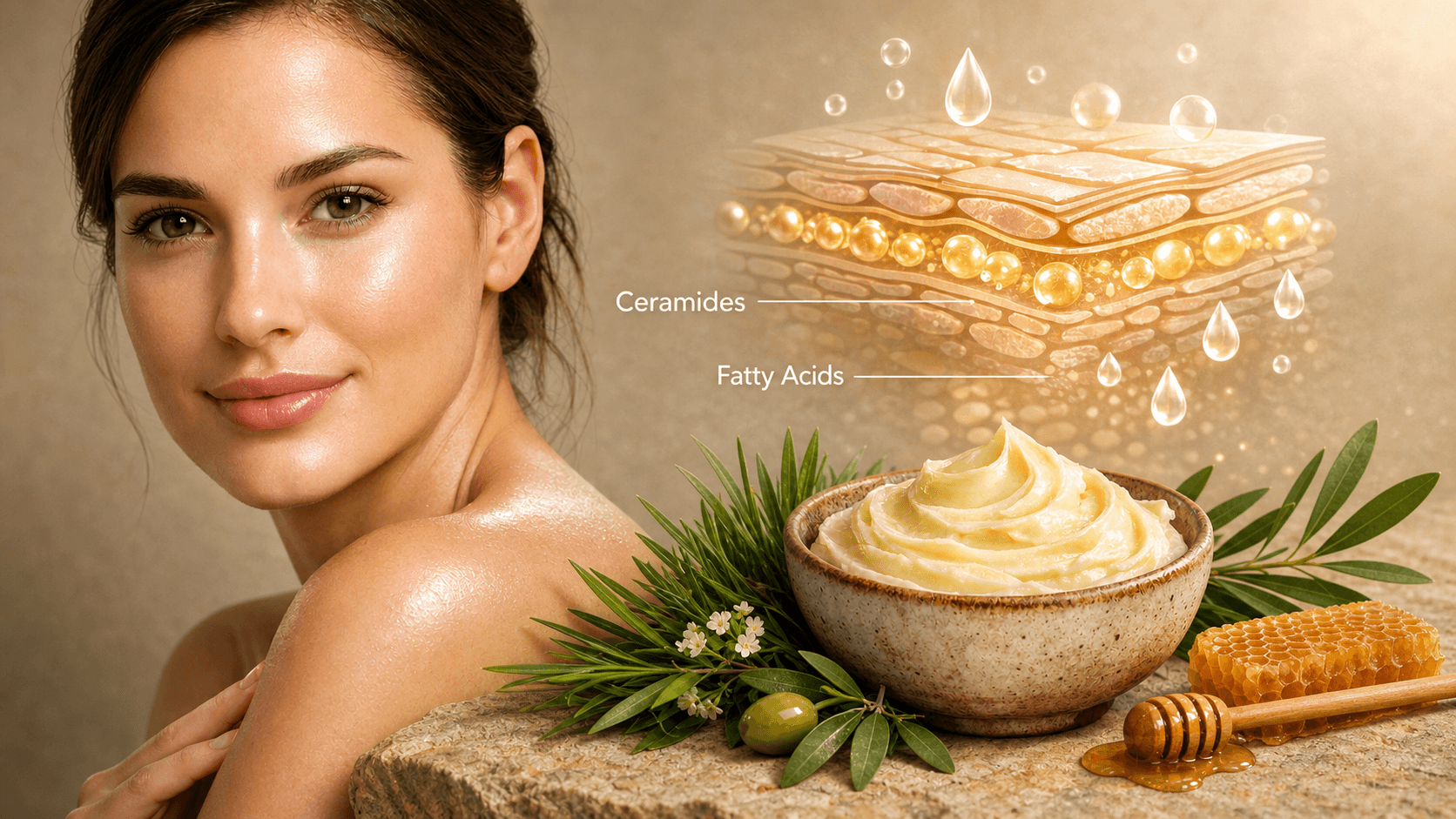
Your skin's outermost layer, the stratum corneum, isn't just a passive wall between you and the environment. It's an active, dynamic structure made up of flattened dead cells held together by a specific mixture of lipids: ceramides, fatty acids, and cholesterol, arranged in a precise lamellar organization that regulates what gets in and what stays out. This lipid matrix is the skin barrier. When it's intact, skin holds moisture efficiently, resists environmental irritants, and maintains a stable pH and microbial environment. When it's disrupted, you get dryness, sensitivity, irritation, and a faster rate of transepidermal water loss through the skin itself, which is the technical term for moisture evaporating through the skin rather than from the surface.
Sebum, the oil your skin produces naturally, plays a related but distinct role. It's secreted by sebaceous glands onto the skin surface and contributes to the acid mantle, a slightly acidic film that works alongside the barrier to regulate both microbial ecology and surface hydration. Sebum is a complex mix of lipids, including triglycerides, wax esters, squalene, and fatty acids, with a composition that shifts with age, hormones, diet, and overall skin health, which is part of why the same skin can behave very differently at different life stages.
These two things together, the lipid matrix of the barrier and the sebum covering the surface, are what most moisturizing and cleansing products are either trying to support, supplement, replace, or avoid stripping. The specific approach matters, because a product that replenishes surface lipids is doing something different from one that forms an occlusive layer to prevent water loss, and both of those are doing something different from one that actively disrupts or strips those lipids as part of cleansing. Understanding which category a tallow-based product falls into is the starting point for evaluating what it's actually doing and for whom.
The lipid science behind why tallow gets discussed
Tallow, rendered from beef fat, is primarily a triglyceride, meaning its structure is a glycerol backbone with three fatty acid chains attached. The fatty acid composition of grass-fed beef tallow typically runs roughly 40 to 50 percent oleic acid, 25 to 30 percent palmitic acid, and 20 to 25 percent stearic acid, with smaller amounts of other fatty acids rounding out the profile.
Oleic acid is a monounsaturated fatty acid and the same fatty acid that makes olive oil what it is. It's present in human sebum, it penetrates the upper layers of the skin reasonably well, and it plays a role in maintaining skin flexibility and barrier function. Palmitic acid is a saturated fatty acid that's one of the most abundant in human sebum, found naturally in the skin's lipid layer, and present in the ceramide precursors that help build the lamellar structure of the barrier. Stearic acid is another saturated fatty acid that converts in the skin to oleic acid through a natural desaturation process, and it's also found in sebum.
This is the legitimate core of the tallow-for-skin argument: the fatty acid profile of beef tallow is genuinely similar to the fatty acid composition of human sebum, and "similar to sebum" is a meaningful starting point for discussing whether a topical oil will interact productively with the skin's own lipid environment. It's not a proven outcome, it's a plausible mechanism, and there's a difference.
How tallow compares to common skincare alternatives
Understanding tallow's place means understanding what it's being compared to, because "is tallow good for skin" is a different question than "is tallow better than the specific alternative I'm currently using."
Petrolatum, the main ingredient in products like Vaseline, is an occlusive emollient: it works by forming a physical barrier on the skin's surface that reduces water loss. It's not absorbed and it doesn't add lipids to the skin itself, it just slows the rate at which moisture escapes. Highly effective at that specific job, chemically inert, and unlikely to cause reactions. What it doesn't do is mimic or supplement the skin's own lipid chemistry in any direct way.
Silicones, common in many moisturizers and serums, provide slip and a smooth feel and some surface-level barrier function, but similarly don't become part of the skin's lipid structure and can actually interfere with the skin's natural moisture regulation at higher concentrations over time, which is why some people who switch away from silicone-heavy products notice their skin feeling more balanced after an adjustment period.
Plant oils like jojoba, rosehip, and squalane have gotten significant attention in the clean-beauty space because of their fatty acid profiles and their skin-feel. Jojoba is technically a liquid wax ester that closely mimics the structure of sebum's waxy components. Squalane is derived from squalene, a compound that's naturally present in human sebum. Rosehip seed oil is high in linoleic acid, a fatty acid that tends to be lower in the sebum of acne-prone individuals. All of these have reasonable scientific rationales behind their use.
Where tallow sits in this picture is as a fat whose triglyceride-based composition has more overlap with human sebum than a wax ester like jojoba does, while being less specialized than a single-fatty-acid focus like rosehip. It's a broad-base emollient with genuine lipid compatibility rather than a targeted active. That's a reasonable position for a soap or barrier-support product, not a position that means tallow outperforms every alternative for every purpose.
What the research actually shows
Here's where we want to be straight with you, because this is where a lot of tallow marketing parts ways with the actual evidence.
In 2025, researchers at Michigan State University published a review in the Journal of Cosmetic Dermatology looking specifically at the evidence base for beef tallow in skincare. They analyzed 200 social media posts, the scientific literature available on tallow's skin-relevant compounds, and the broader dermatological evidence. Their conclusion was direct: the evidence supporting beef tallow's benefits for skincare and dermatologic conditions remains insufficient, and many promotions of tallow for skin care are associated with financial bias. Dermatologists interviewed in related coverage from MD Anderson and similar sources consistently flagged the comedogenic concern and the absence of clinical trials. That's a peer-reviewed finding from a credible institution, published last year, and we're not going to pretend it doesn't exist just because we make a tallow-based product.
What that review was specifically responding to was the wave of social media content claiming tallow cures eczema, acne, and various skin conditions, which was going well beyond what the evidence supports and in some cases into outright disease-claim territory. The review's "insufficient evidence" verdict is aimed squarely at those elevated claims, and it's correct. The more modest case, that tallow's fatty acid profile is chemically compatible with the skin's lipid environment and makes it a reasonable emollient for appropriate skin types, wasn't what those social media posts were saying, which is part of why the backlash landed where it did.
The honest takeaway from that review isn't that tallow doesn't work for anyone. It's that the strong anecdotal support hasn't been converted into the kind of rigorous clinical evidence that dermatologists require before making categorical recommendations. The lipid science points toward plausibility. The human trial data is genuinely thin. Those two things can both be true at the same time, and maintaining the distinction between them is exactly what makes "honest" different from "credulous."
It also means "my skin feels better since I started using tallow" is a real, valid experience that's consistent with everything the chemistry suggests, and simultaneously not the same thing as "tallow is clinically proven to improve skin barrier function in controlled trials." Both of those sentences are true. They don't contradict each other, and conflating them is how most of the bad tallow content on both sides of the debate gets made.
The comedogenic question
Dermatologists who raise concerns about tallow are usually raising one of two: the comedogenic risk, and the lack of evidence. The evidence question was covered above. The comedogenic question is real and worth addressing directly rather than deflecting.
Comedogenicity refers to an ingredient's tendency to block pores and contribute to comedone formation, which is the technical term for blackheads and whiteheads. The scale most often used rates ingredients from 0 (non-comedogenic) to 5 (highly comedogenic). Oleic acid, which makes up the largest fraction of tallow, sits toward the higher end of that scale for pore-blocking tendency, particularly in people already prone to clogged pores. Palmitic acid and stearic acid are generally rated lower.
The nuance here is that comedogenicity scores were developed from rabbit ear assays, a testing method with limited predictive validity for human skin, and that comedogenic risk varies substantially with skin type, application amount, and the overall formulation rather than any single ingredient. Someone with oily, acne-prone skin who applies tallow heavily to their face in a warm, humid climate is in a meaningfully different risk situation than someone with dry or combination skin using a small amount to support a compromised barrier.
We're not going to tell you tallow is right for every skin type, because it isn't. If you're acne-prone, this is an ingredient where a patch test, starting with a very small amount on a non-face area, is genuinely worth doing before committing. We'd rather you know that upfront than discover it after the fact.
What makes grass-fed tallow different from generic
The specific source of tallow matters, both for the lipid profile and for a few fat-soluble compounds that show up in the final product.
Grass-fed beef tallow carries a different fatty acid profile than grain-fed tallow, specifically a higher proportion of conjugated linoleic acid and omega-3 fatty acids relative to grain-finished beef, which is fed a corn and soy-heavy diet that shifts the fat composition toward more omega-6. Whether those differences translate to a meaningfully different effect on skin is an honest "probably, but not definitively proven at the clinical level" answer. The chemical difference is real and measurable. The outcome difference in a skincare application hasn't been rigorously studied in head-to-head human trials.
Fat-soluble vitamins, A, D, E, and K, are present in tallow to varying degrees depending on the source. Grass-finished beef carries higher levels of vitamin A and vitamin E specifically compared to grain-fed animals. Those fat-soluble vitamins do have established roles in skin function: vitamin A and its derivatives are the basis for the entire retinoid family of skincare actives, vitamin E is an antioxidant found naturally in skin, and vitamin D has regulatory roles in skin cell differentiation. The question of how much bioavailable vitamin A you're actually getting from tallow applied topically, versus the concentrations used in pharmaceutical retinoid formulations, is genuinely unclear. We think it's honest to say the vitamins are present, relevant in principle, and not at concentrations that would be clinically equivalent to purpose-formulated skincare actives. That's the real picture.
What's in ours specifically
Our tallow soap uses organic grass-fed beef tallow as its primary base, combined with organic extra virgin olive oil, organic unrefined coconut oil, organic castor oil, organic raw honey, organic vegetable glycerine, organic distilled water, and organic lemongrass oil. The soap form is important context for what the tallow is doing here: in cold-process or similar soapmaking, tallow undergoes saponification, the chemical process where triglycerides react with an alkali to form soap molecules and glycerol. The resulting product isn't tallow applied directly to skin, it's a soap whose cleansing character and moisture-retention properties are influenced by the fatty acid profile of the original tallow.
Our batch was tested by Nuvue Labs and came back with a pH of 10.6, which is expected and correct for a true soap made through saponification rather than a synthetic detergent. The pH looks high relative to skin's natural slightly acidic environment, but soap at that pH rinses off, and healthy skin rebuffers its surface relatively quickly after washing. This is a different consideration from a leave-on moisturizer or balm where pH directly affects the product's behavior on skin. Total aerobic bacterial count came back under 10 colony-forming units per gram against a limit of 1,000, and mold and yeast under 10 against a limit of 100. Both cleanly within spec.
The formulation is FDA cosmetic regulation compliant, confirmed against MOCRA 2022 and 21 CFR Title 21. And the ingredients are listed as organics throughout, which reflects the actual sourcing rather than a marketing term applied loosely.
Who this is actually for
Not everyone, which is the honest answer, and we'd rather say it plainly than let you find out experimentally.
For dry and combination skin types where the barrier genuinely needs additional lipid support, a tallow-based soap or balm applied appropriately has real, chemistry-grounded reasons to be useful. The fatty acid profile is compatible with what the skin's own lipid environment is built from, and unlike many synthetic emollients, there's nothing in a simple tallow-based formulation that the skin hasn't already evolved around.
For sensitive skin that's reacted to conventional cleansers, particularly those built on harsh detergent systems that strip the skin's natural oil more aggressively than a traditional soap does, a gentler cleansing system based on tallow and complementary plant oils is worth considering for exactly the barrier-compatibility reasons described above.
For oily or acne-prone skin, more caution is warranted. Tallow's oleic acid content places it in a category that some acne-prone people find worsens pore congestion, and the "my skin is already producing plenty of oil, let me add more oil to it" logic doesn't hold up well across all skin types. This isn't a universal disqualifier, plenty of acne-prone people use oil-based skincare with good results, but it's a legitimate reason to test carefully before committing.
The bottom line
Tallow's place in skincare sits on a genuinely defensible foundation when it's placed there by the lipid science rather than the mythology. The sebum-mimicry argument is real and plausible. The fat-soluble vitamin content is real, though the bioavailable amounts per application aren't equivalent to purpose-formulated actives. The evidence from controlled human trials is thin, and the most rigorous recent review called that out plainly. And the comedogenic risk is real for a subset of skin types.
What we think is worth holding onto from all of that: an ingredient whose chemistry is fundamentally compatible with what human skin is actually made of, sourced responsibly, formulated simply, and used appropriately for the right skin types, is a reasonable thing to build skincare around. It's not a cure for everything. It's not the only approach. But it's not a trend built on nothing either, and the honest version of the argument is a lot more interesting than either the uncritical hype or the reflexive dismissal that tends to surround it.
The gap we're trying to occupy isn't "tallow heals everything" and isn't "tallow is just hype." It's "here's what the chemistry actually says, here's what the research actually found, here's who this is probably right for and who should be careful, and here's exactly what went into the formula you're using." That's the conversation we'd rather have about this ingredient than the shouting match it usually turns into online.
We're also aware that this is the post where we most explicitly tell some readers this might not be right for them. Acne-prone skin types should test carefully. People managing active skin conditions should talk to a dermatologist rather than relying on a skincare ingredient, however good the chemistry behind it. And anyone who's read "tallow can treat eczema or psoriasis" anywhere should know that those are disease claims that outrun the clinical evidence considerably. The less dramatic version, that tallow is a chemically sensible, traditionally used, well-sourced emollient for skin types that benefit from oil-based cleansing and barrier support, is the one we think is worth making, because it's the one that holds up when examined closely rather than collapsing under scrutiny the way the bigger claims do.