Electrolyte Drink Mix vs. Sports Drinks: Reading the Label
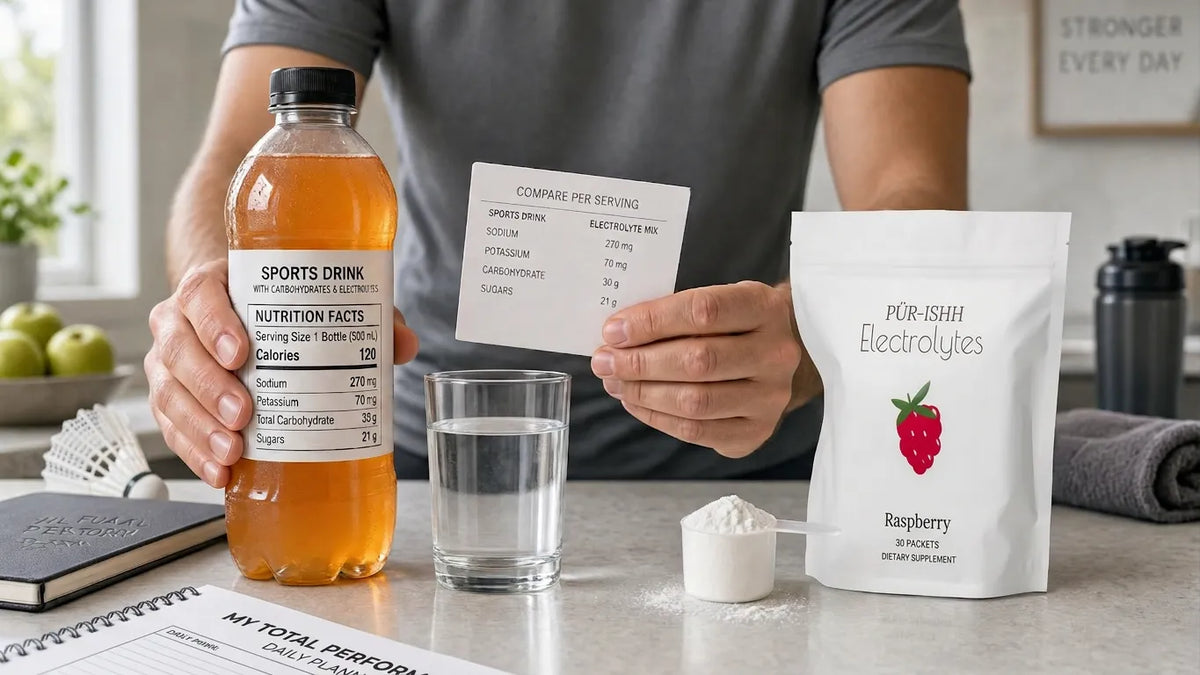
Pick up a bottled sports drink and a packet of electrolyte powder and turn them both around. The labels look similar enough: a serving size, some sodium, a little potassium, maybe some sugar. But the two products are usually built for different jobs, and the numbers on the back tell you which job each one is built for, if you know how to read them.
Most people don't read them. They pick based on the front of the package, which says things like "hydration," "replenish," or "clean electrolytes." None of those words have a set meaning. The back of the package is where the real information is.
This post walks through that label line by line: serving size, sodium, potassium, sugar, magnesium, and the marketing language around them. Along the way we'll set each number against what the major position statements actually recommend. By the end you should be able to look at any hydration product and work out, in a minute or two, whether it fits what you're doing.
A disclosure up front: we sell an electrolyte drink mix, and we don't sell a sports drink. Keep that in mind as you read. We'll point out where a traditional sports drink is the better tool, because sometimes it is.
First, what each product is actually for
The terms get used loosely, so it helps to define them by what they contain rather than what they're called.
A traditional sports drink is a carbohydrate-electrolyte drink. It combines water, sugar, and a moderate amount of sodium, with a little potassium. It's designed to do three things at once during exercise: replace fluid, replace some of the sodium lost in sweat, and supply carbohydrate as fuel.
An electrolyte drink mix, in the way the term is usually used now, is a powder or tablet you add to water. Many of these put more emphasis on sodium and other minerals and contain little or no sugar. They're designed mainly to replace minerals, not to fuel.
Neither design is better in general. Each one suits a different situation, and the label tells you which one you're holding.
Step 1: Normalize the serving size
Before comparing anything, get both products onto the same scale. This is the step most people skip, and it's where most label confusion starts.
A bottled drink might list nutrition per bottle or per a fraction of a bottle. A powder lists nutrition per scoop or per stick, but the amount of water you mix it into is up to you. A powder with 500 milligrams of sodium mixed into 500 milliliters of water is twice as concentrated as the same scoop mixed into a liter.
The cleanest way to compare is to convert everything to milligrams per liter. Research papers usually report electrolyte concentrations in millimoles per liter (mmol/L), so it also helps to know the conversions:
-
1 mmol of sodium = 23 milligrams
-
1 mmol of potassium = about 39 milligrams
So a drink described in a study as containing 21 mmol/L of sodium has about 483 milligrams of sodium per liter. Once you do this conversion, published research and the label on your shelf start speaking the same language.
Step 2: Sodium, the number that matters most
When it comes to electrolytes during exercise, the major position statements focus their guidance on sodium. It's the mineral sweat carries away in the largest amounts that matter for exercise.
How much sodium is in sweat? It varies a lot from person to person. The National Athletic Trainers' Association position statement on fluid replacement (McDermott and colleagues, Journal of Athletic Training, 2017, volume 52, issue 9, pages 877 to 895) gives a range for sweat sodium of 10 to 100 mEq/L. For sodium, that's the same as mmol/L, so it works out to roughly 230 to 2,300 milligrams of sodium per liter of sweat. That's a tenfold spread between individuals.
The joint position statement on nutrition and athletic performance from the Academy of Nutrition and Dietetics, Dietitians of Canada, and the American College of Sports Medicine (Thomas, Erdman, and Burke, Medicine and Science in Sports and Exercise, 2016, volume 48, issue 3, pages 543 to 568) puts the average at about 50 mmol/L, or roughly 1 gram per liter, while noting the wide variation. It recommends that sodium be taken during exercise when large sweat sodium losses occur. It specifically mentions:
-
athletes with high sweat rates
-
athletes with salty sweat
-
prolonged exercise of more than two hours
Now compare that with a typical sports drink. In a well-known 2016 study we'll come back to below, the sports drink tested contained 21 mmol/L of sodium, about 483 milligrams per liter. The 2015 international consensus statement on exercise-associated hyponatremia (Hew-Butler and colleagues, Clinical Journal of Sport Medicine, 2015, volume 25, issue 4, pages 303 to 320) describes sports drinks as generally containing roughly 10 to 38 mmol/L of sodium, or about 230 to 874 milligrams per liter.
The takeaway: a conventional sports drink usually contains less sodium per liter than the average person's sweat does. For a short or moderate session, that doesn't matter. For a long, hot session in someone who sweats heavily or sweats salty, it can mean a drink replaces fluid faster than it replaces sodium.
This is the main gap that higher-sodium electrolyte mixes are designed to fill. When you read a label, the sodium number per liter, set against your own situation, is the first thing to check.
A quick way to estimate your own needs
The NATA statement recommends that physically active people weigh themselves before and after exercise to check how much fluid they've lost. It also says losses should be limited to 2 percent of body mass or less.
A rough version anyone can do: weigh yourself before and after a typical session, accounting for anything you drank. Each kilogram lost is roughly a liter of sweat. If you lose about a liter in an hour and your sweat is near the average concentration, you've lost something on the order of 1 gram of sodium in that hour. If you notice white, salty streaks on your clothes or skin after training, you may be at the saltier end of the range.
This isn't a lab test, but it turns a vague idea ("I sweat a lot") into a number you can compare against a label.
Step 3: Sugar, which is a feature or a bug depending on the job
Sugar is where sports drinks and electrolyte mixes differ most, and it's also where most of the online arguments happen. The honest answer is that carbohydrate in a drink is useful in some situations and unnecessary in others.
When carbohydrate helps. The joint position statement gives clear guidance on carbohydrate during exercise by duration:
-
Under 45 minutes: not needed.
-
45 to 75 minutes: small amounts, including a mouth rinse.
-
1 to 2.5 hours: 30 to 60 grams per hour.
-
More than 2.5 to 3 hours: up to 90 grams per hour.
For long sessions, a carbohydrate-electrolyte drink is one of the most convenient ways to hit those targets, because it delivers fuel and fluid at the same time. This is where traditional sports drinks earn their place.
There's also an absorption angle. The NATA statement notes that the optimal carbohydrate concentration for fluid absorption is between 3 and 8 percent, and that concentrations above 5 to 8 percent may slow absorption. A 6 percent drink contains 60 grams of carbohydrate per liter. In a standard 20-ounce bottle (about 590 milliliters), that's roughly 35 grams.
When carbohydrate is just sugar. The same guidance tells you carbohydrate isn't needed for sessions under 45 minutes. And if you're not exercising at all, sugar in a drink is simply added sugar. For context, the FDA's Daily Value for added sugars is 50 grams. A single bottled sports drink can account for a large share of that.
So on the label, the question is simple. Look at the total carbohydrate and added sugars per serving, and ask whether you're doing something long enough and hard enough to use that fuel. If you are, the sugar is the point. If you aren't, it's a cost with no benefit.
One more thing about sugar-free mixes. If a mix contains little or no carbohydrate, it isn't fueling you. That's fine for daily use, short sessions, or people eating low-carb. But for a two-hour ride or run, you'll need carbohydrate from somewhere else, whether that's food or a separate fuel source, if you want to follow the position stand guidance.
Step 4: The "more hydrating than water" question
Many hydration products imply they hydrate you better than water. There's actually a good study on this, and the results are more nuanced than most marketing suggests.
Maughan and colleagues (American Journal of Clinical Nutrition, 2016, volume 103, pages 717 to 723) developed what they called a beverage hydration index. They gave 72 healthy, active men a liter of different drinks over 30 minutes while at rest, then tracked how much urine they produced over the following four hours. A drink that led to less urine was being retained better. They tested still water against 12 other drinks, including:
-
sparkling water
-
cola and diet cola
-
a sports drink
-
an oral rehydration solution
-
orange juice
-
lager
-
coffee and tea
-
full-fat and skimmed milk
The results:
-
Better retained than water at two hours: full-fat milk, skimmed milk, the oral rehydration solution, and orange juice.
-
No different from water: the sports drink. Total urine output over four hours after drinking it was no different from water.
The composition of those two electrolyte drinks is telling:
|
Sodium |
Potassium |
|
|
Oral rehydration solution |
55 mmol/L (about 1,265 mg per liter) |
20 mmol/L |
|
Sports drink |
21 mmol/L (about 483 mg per liter) |
4 mmol/L |
The drink with substantially more sodium and potassium was retained better than water. The sports drink, with less sodium, was not.
Two cautions keep this from being overstated. First, this was a resting study in men, not a study of exercise or performance. Second, retaining a drink better over a few hours isn't the same as it being healthier to drink all day. But it does suggest that, at rest, an ordinary sports drink doesn't hydrate you more effectively than water, and that sodium content appears to be part of what makes a drink better retained.
Step 5: Potassium and magnesium, the supporting cast
Potassium and magnesium appear on most electrolyte labels, and it's worth knowing how to read those numbers in context.
The FDA Daily Values give a useful reference:
-
Sodium: 2,300 milligrams
-
Chloride: 2,300 milligrams
-
Potassium: 4,700 milligrams
-
Magnesium: 420 milligrams
When a label lists a percent Daily Value next to each mineral, that percentage is calculated against these numbers.
In the Maughan study, the sports drink contained 4 mmol/L of potassium, roughly 156 milligrams per liter. That's a small fraction of the 4,700-milligram Daily Value. That isn't necessarily a flaw, because a drink isn't meant to be your main potassium source. Fruits, vegetables, meat, and dairy are where most potassium comes from. But it's worth knowing that the potassium in a typical hydration product is a modest contribution, not a full day's supply.
For magnesium, look at two things: the amount, and the form. Labels usually name the compound, such as magnesium citrate, glycinate, or malate. The amount listed is normally the elemental magnesium, which is the figure you compare against the 420-milligram Daily Value. If magnesium is only named inside a blend without an amount, you can't tell how much you're getting.
Step 6: Supplement Facts vs. Nutrition Facts
You'll notice that some hydration products have a Nutrition Facts panel and others have a Supplement Facts panel. Bottled sports drinks are typically sold as conventional beverages with Nutrition Facts. Many electrolyte powders and tablets are sold as dietary supplements with Supplement Facts.
Both panels list amounts and percent Daily Values for the minerals, and the FDA uses the same Daily Values for both. The practical difference for you is that a Supplement Facts panel can list ingredients inside a proprietary blend. A blend shows a total weight for the group but not the amount of each ingredient in it.
For an electrolyte product, that matters. You can't check sodium against your sweat losses, or magnesium against the Daily Value, if the amounts are hidden inside a blend. A product that lists each mineral individually, in milligrams, is simply easier to evaluate.
Step 7: Reading the marketing language
The front of the package uses words with no fixed definition, so the back of the package has to do the work.
"Hydration" or "advanced hydration." These words don't tell you anything measurable. Check the sodium per liter and the sugar per serving instead.
"Trace minerals." Many electrolyte products, including ours, use mineral-rich salts like Himalayan or other pink salts as the sodium source. It's worth being honest about what that does and doesn't mean.
A 2020 study by Fayet-Moore and colleagues (Foods, 2020, volume 9, issue 10, article 1490) analyzed 31 samples of pink salt sold in Australia. They found that, apart from sodium, the minerals in pink salt did not meaningfully contribute to nutrient intake. More than 30 grams a day, about six teaspoons, would be needed to make any meaningful contribution. That's an amount of salt far beyond any sensible sodium intake. The pink salt samples averaged somewhat less sodium than the white table salt control (about 395,000 versus 428,000 milligrams per kilogram), but the authors didn't consider that difference meaningful at normal amounts.
So the honest way to describe a pink-salt-based electrolyte is this: it's a sodium source. Any trace minerals are along for the ride in amounts too small to matter. We don't claim our electrolytes deliver meaningful trace minerals, and we'd be skeptical of any product that does.
Testing matters more than the salt's origin. The same study found one pink salt sample, from Peru, with lead at 2.59 milligrams per kilogram. That's above the 2 milligram per kilogram maximum set by Food Standards Australia New Zealand. No other sample exceeded the limits for arsenic, cadmium, or mercury. The lesson isn't that pink salt is dangerous. It's that any mined mineral ingredient should be tested.
For our own electrolytes, both flavors were tested separately for heavy metals:
-
Lemon-lime: 0.051 parts per million lead, 0.024 arsenic, 0.003 cadmium, and 0.005 mercury.
-
Raspberry: 0.095 lead, 0.029 arsenic, 0.004 cadmium, and 0.002 mercury.
What we haven't yet done is independently verify the exact milligram amounts of sodium, potassium, and magnesium in the finished product. The mineral amounts on our label come from the formulation, and we'll say so clearly until that testing is complete.
The safety point most labels don't mention
There's one important thing that no amount of sodium on a label can fix: drinking too much.
Exercise-associated hyponatremia is a dangerous drop in blood sodium during or after exercise. The 2015 international consensus statement is direct about its main cause. It names the overconsumption of hypotonic fluids relative to the body's exchangeable sodium as the primary cause. It also notes that all sports beverages are hypotonic to plasma, meaning they contain less sodium than your blood, which sits at around 140 mmol/L. And it states that sodium supplementation cannot prevent hyponatremia when someone keeps drinking excessive amounts.
In other words, a higher-sodium drink is not a license to drink without limit. The consensus statement recommends using thirst to guide fluid intake as a strategy that should limit drinking in excess. The NATA statement's advice to weigh yourself before and after exercise helps here too. Gaining weight over a session is a sign you've drunk more than you lost.
The other side: sodium in everyday life
Higher-sodium mixes make sense for heavy sweaters and long sessions. But they're often marketed for daily use by everyone, so it's worth putting sodium in context.
According to the FDA, Americans eat on average about 3,400 milligrams of sodium a day. The Dietary Guidelines for Americans recommend that adults limit sodium to less than 2,300 milligrams a day. The FDA also notes that over 70 percent of dietary sodium comes from packaged and prepared foods.
For someone eating a typical diet and not sweating much, a daily high-sodium drink adds to an intake that's likely already above the guideline. For someone who eats mostly unprocessed food, trains hard, sweats heavily, or eats low-carb, the picture can look quite different. We covered this in more detail in our post on whether you need electrolytes every day. The label is the same in both cases. What changes is whether its sodium is filling a gap or adding to a surplus.
Putting it together: which one, when
Here's how the evidence above translates into practical choices.
Exercise under about an hour. The NATA statement says activity lasting less than an hour should require nothing other than water. Neither product is necessary for most people.
Hard sessions of 1 to 2.5 hours. The joint statement recommends 30 to 60 grams of carbohydrate per hour here. A traditional sports drink is a convenient way to get carbohydrate and fluid together. An electrolyte mix works too if you get carbohydrate from food.
Long sessions, heat, heavy or salty sweating. This is where the sodium gap matters. The joint statement recommends sodium during exercise when large sweat sodium losses occur. A higher-sodium mix, or a sports drink with extra sodium from food or another source, makes sense. Carbohydrate needs rise too, up to 90 grams per hour beyond about 2.5 hours.
Daily life, low activity. Water is usually enough. A sports drink mostly adds sugar. A high-sodium mix mostly adds sodium to a diet that probably already has plenty.
Low-carb or fasting. A sugar-free electrolyte mix can make sense here, since these eating patterns can change how the body handles sodium. We've covered why in an earlier post.
Your 60-second label checklist
When you pick up any hydration product, check these in order:
-
Serving size. How much water is the serving meant for? Convert to per liter if you're comparing.
-
Sodium per liter. Compare it with sweat sodium, roughly 230 to 2,300 milligrams per liter with an average around 1 gram. Is it enough for your sessions, or more than your day needs?
-
Total carbohydrate and added sugars. Are you doing something long enough to use the fuel? If not, how much of the 50-gram added sugars Daily Value does it use?
-
Potassium and magnesium. Are amounts listed individually in milligrams, and how do they compare with the Daily Values?
-
Proprietary blends. Are any minerals hidden inside a blend without individual amounts?
-
Testing. Does the company show third-party test results, especially for heavy metals if the product uses mined salts?
-
Front-of-pack claims. Ignore "hydration," "advanced," and "trace minerals" until the numbers on the back back them up.
The honest summary
Sports drinks and electrolyte mixes aren't rivals so much as tools for different jobs.
A traditional sports drink is a carbohydrate-electrolyte drink. Its sugar is genuinely useful during long, hard sessions, where position statements recommend 30 to 60 grams of carbohydrate an hour or more. Its sodium is usually modest, often less per liter than average sweat. At rest, a well-designed study found it hydrated no better than water.
A high-sodium electrolyte mix fills the sodium gap for heavy or salty sweaters and long sessions. It usually doesn't provide fuel. For people who aren't sweating much, it may just add sodium to a diet already above the guideline.
Neither one protects you from drinking too much, and neither one's front label tells you much. The back label does. Convert to milligrams per liter, check sodium against what you're losing, check sugar against what you're doing, and look for individual amounts and real testing. That takes about a minute, and it's the difference between buying a product that fits your day and buying a marketing promise.
References
-
McDermott BP, Anderson SA, Armstrong LE, Casa DJ, Cheuvront SN, Cooper L, Kenney WL, O'Connor FG, Roberts WO. National Athletic Trainers' Association position statement: fluid replacement for the physically active. Journal of Athletic Training. 2017;52(9):877-895. doi:10.4085/1062-6050-52.9.02
-
Thomas DT, Erdman KA, Burke LM. American College of Sports Medicine Joint Position Statement. Nutrition and athletic performance. Medicine and Science in Sports and Exercise. 2016;48(3):543-568. (Published concurrently in the Journal of the Academy of Nutrition and Dietetics and the Canadian Journal of Dietetic Practice and Research.)
-
Hew-Butler T, Rosner MH, Fowkes-Godek S, et al. Statement of the Third International Exercise-Associated Hyponatremia Consensus Development Conference, Carlsbad, California, 2015. Clinical Journal of Sport Medicine. 2015;25(4):303-320.
-
Maughan RJ, Watson P, Cordery PAA, Walsh NP, Oliver SJ, Dolci A, Rodriguez-Sanchez N, Galloway SDR. A randomized trial to assess the potential of different beverages to affect hydration status: development of a beverage hydration index. American Journal of Clinical Nutrition. 2016;103(3):717-723. doi:10.3945/ajcn.115.114769
-
Fayet-Moore F, Wibisono C, Carr P, Duve E, Petocz P, Lancaster G, McMillan J, Marshall S, Blumfield M. An analysis of the mineral composition of pink salt available in Australia. Foods. 2020;9(10):1490. doi:10.3390/foods9101490
-
US Food and Drug Administration. Daily Value on the Nutrition and Supplement Facts Labels.
-
US Food and Drug Administration. Sodium in Your Diet.
These statements have not been evaluated by the Food and Drug Administration. This product is not intended to diagnose, treat, cure, or prevent any disease.