Collagen vs. Whey: Which Protein for Which Goal
Walk down any supplement aisle and you'll see collagen and whey sitting side by side, both labeled "protein," both promising some version of a stronger, better-looking you. It's easy to assume they're interchangeable. Twenty grams is twenty grams, right?
Not quite. Collagen and whey are both proteins in the strict sense, and both count toward the grams on a nutrition label. But they're built from very different amino acids, they behave differently once you swallow them, and they've been studied for very different reasons. Some of the claims attached to each hold up well. Others don't hold up at all.
This post goes goal by goal. For each common reason people buy protein (building muscle, holding on to muscle as you age, skin, joints, digestion, simply hitting a daily target) we'll look at what the research says about whey, what it says about collagen, and how strong that evidence really is.
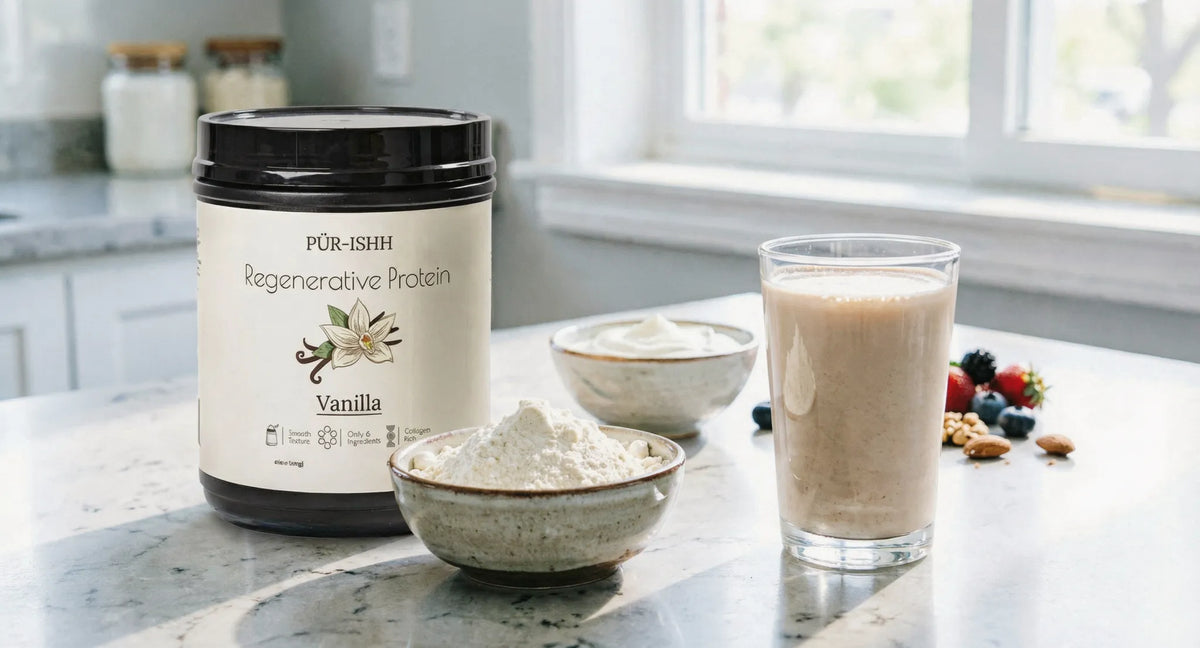
A disclosure before we start. Our protein powder is a blend of grass-fed whey concentrate and grass-fed hydrolyzed collagen, and by proportion it's mostly collagen. We don't sell standalone whey or standalone collagen. So we have a stake in both sides of this comparison, and some of what follows doesn't flatter our own product. We'd rather you hear it from us.
Why "protein" isn't one thing
Protein is made of amino acids. Your body can make some of them itself, but nine of them, the essential amino acids, have to come from food. How useful a protein is depends a lot on how much of each essential amino acid it carries.
For muscle specifically, one essential amino acid matters more than the others: leucine. Leucine acts as a signal that switches on muscle protein synthesis, the process your body uses to build and repair muscle tissue. The International Society of Sports Nutrition's position stand on protein and exercise (Jäger and colleagues, Journal of the International Society of Sports Nutrition, 2017, volume 14, article 20) recommends that a serving of protein contain somewhere between 700 and 3,000 milligrams of leucine, alongside a balanced spread of the other essential amino acids.
That's the lens for everything below. Whey and collagen differ most sharply in exactly these places: leucine and the full essential amino acid set.
What whey is
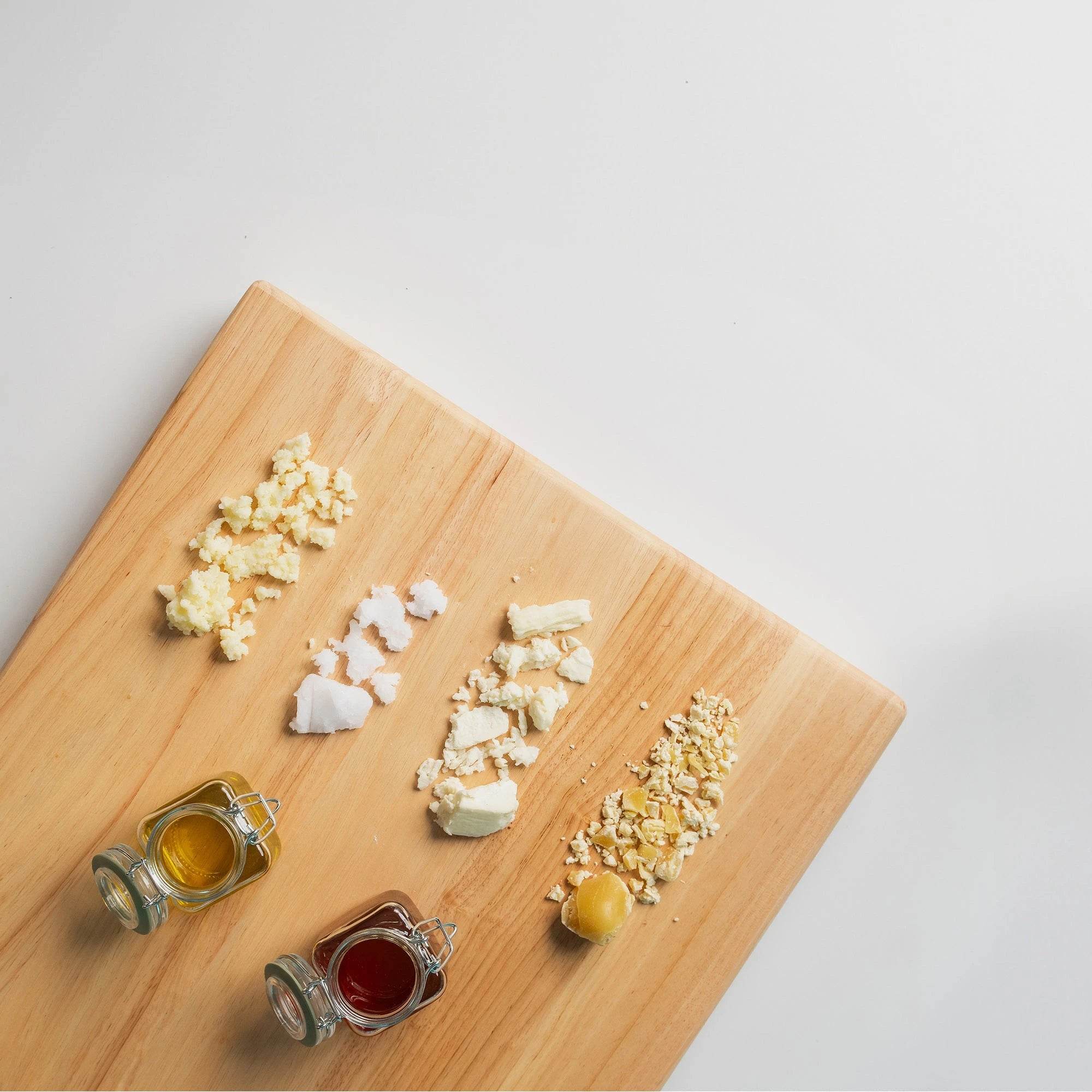
Whey is one of the two main proteins in milk, the other being casein. It's the liquid fraction left over when milk is turned into cheese, filtered and dried into a powder. You'll usually see it sold in three forms:
-
Concentrate keeps a little more of milk's fat and lactose.
-
Isolate is filtered further, so it's higher in protein by weight and lower in lactose.
-
Hydrolysate is partly broken down in advance into smaller pieces.
Across all three, whey is a complete protein. It contains all nine essential amino acids, and it's one of the richest common sources of leucine. It also digests quickly, which means amino acid levels in the blood rise soon after you drink it.
What collagen is
Collagen is the main structural protein in connective tissue. It's what gives skin, tendons, ligaments, and bone their framework. Supplement collagen is usually made from animal hides, bones, or fish skin, then hydrolyzed into small peptides so it dissolves easily and digests well.
Collagen has an unusual amino acid makeup. Its structure is built around a repeating pattern in which glycine appears as roughly every third amino acid, and it's also rich in proline and hydroxyproline. Those amino acids are central to collagen's own structure.
What collagen lacks matters just as much. It contains essentially no tryptophan, which is one of the nine essential amino acids, and it's relatively low in leucine and several others. That makes it an incomplete protein.
This has a formal consequence. Protein quality is often scored with a measure called PDCAAS (protein digestibility corrected amino acid score), which grades a protein by its most limiting essential amino acid. Because collagen is missing tryptophan, its score is zero. Under US food labeling rules, the percent Daily Value for protein, when a label shows one, has to be corrected for protein quality using PDCAAS. So collagen can supply plenty of grams of protein while contributing far less to your essential amino acid needs than those grams suggest.
None of this makes collagen useless. It means collagen and whey aren't doing the same job.
Goal 1: Building muscle
Short answer: whey, clearly.
This is the comparison with the most direct evidence, and the results point one way.
The cleanest recent head-to-head trial comes from van Loon's lab at Maastricht University. Aussieker and colleagues (Medicine and Science in Sports and Exercise, 2023, volume 55, issue 10, pages 1792 to 1802) ran a randomized, double-blind trial in 45 recreational athletes, 30 men and 15 women, with an average age of 25. After a session of resistance exercise, each person drank 30 grams of whey, 30 grams of collagen, or a non-caloric placebo. The researchers then measured muscle protein synthesis directly, using stable isotope tracers and muscle biopsies over five hours of recovery.
The results:
-
Blood amino acids. Whey raised blood levels of leucine and total essential amino acids more than collagen. Collagen raised glycine and proline more.
-
Myofibrillar protein synthesis (the building of contractile muscle tissue, the part that makes muscles bigger and stronger). This was 0.041 percent per hour after whey, 0.036 after collagen, and 0.032 after placebo. Only whey was significantly higher than placebo.
So in young, active people, the same 30 grams of protein did measurably more for muscle when it came from whey.
This fits with the broader picture of protein and training. A widely cited meta-analysis by Morton and colleagues (British Journal of Sports Medicine, 2018, volume 52, issue 6, pages 376 to 384) pooled 49 randomized trials with 1,863 participants. It found that protein supplementation during resistance training increased gains in muscle mass and strength. The benefit for fat-free mass leveled off at a total daily intake of around 1.6 grams of protein per kilogram of body weight. Those trials mostly used complete, high-quality proteins, which is a big part of why the finding shouldn't be assumed to transfer to collagen.
If building muscle is your main goal, total daily protein and consistent training come first. After that, a complete, leucine-rich protein like whey is the better tool per gram.
Goal 2: Holding on to muscle as you get older
Short answer: whey again, and the gap may matter more here.
As people age, muscle tends to respond less strongly to both protein and exercise, a phenomenon often called anabolic resistance. That makes protein quality more important later in life, not less.
The most relevant trial was done at McMaster University. Oikawa and colleagues (American Journal of Clinical Nutrition, 2020, volume 111, issue 3, pages 708 to 718) randomized 22 healthy older women, average age about 69, to take 30 grams of either whey or collagen twice a day for six days. During that time each woman also trained one leg with resistance exercise, so the researchers could compare a trained leg with an untrained one in the same person. They measured both the short-term response and the response over several days.
The findings:
-
Short term, whey. Whey increased muscle protein synthesis in both the rested leg and the trained leg.
-
Short term, collagen. Collagen raised it only in the trained leg.
-
Over the six days, whey. Whey significantly increased muscle protein synthesis in both conditions.
-
Over the six days, collagen. Collagen did not raise it significantly above baseline.
-
Head to head. Whey outperformed collagen in every condition measured.
The authors concluded that whey is the more effective supplement for supporting muscle retention in older women.
For context on how much protein older adults may need, the PROT-AGE study group (Bauer and colleagues, Journal of the American Medical Directors Association, 2013, volume 14, issue 8, pages 542 to 559) recommended an average daily intake of 1.0 to 1.2 grams of protein per kilogram of body weight for healthy adults aged 65 and over. They also suggested spreading it across meals in servings of roughly 25 to 30 grams, with about 2.5 to 2.8 grams of leucine each. Collagen on its own struggles to reach that leucine figure. Whey reaches it comfortably.
Goal 3: Skin
Short answer: the strongest evidence doesn't support collagen here, and whey isn't studied for it.
Skin is where collagen marketing is loudest, so it deserves the most careful look.
The logic sounds intuitive. Skin is full of collagen, and collagen production declines with age, so eating collagen should help. But collagen you eat doesn't travel intact to your skin. It's digested into amino acids and small peptides first, like any other protein. Whether those fragments meaningfully change your skin is an empirical question, and the answer depends heavily on which studies you count.
The most important recent analysis is a 2025 meta-analysis by Myung and Park (American Journal of Medicine, 2025, volume 138, issue 9, pages 1264 to 1277). They pooled 23 randomized controlled trials with 1,474 participants. Taken all together, the trials showed improvements in skin hydration, elasticity, and wrinkles.
Then the authors split the trials two ways, by who funded them and by how well they were designed:
-
Trials funded by companies. These showed significant benefits.
-
Trials without company funding. These showed no significant effect on hydration, elasticity, or wrinkles.
-
High-quality trials. No significant effect on any of the three.
-
Low-quality trials. A significant improvement in elasticity only.
Their conclusion was that there is currently no clinical evidence supporting collagen supplements to prevent or treat skin aging.
It's worth being fair about the limits of that finding. A meta-analysis can only work with the trials that exist, and splitting them into subgroups means each comparison rests on fewer studies. Industry groups have publicly disputed the conclusions. "No good evidence of a benefit" is also not the same as "proven not to work." But if you're buying collagen mainly for your skin, you should know that the effect largely disappears when you look only at the independent and higher-quality research.
We've said this plainly elsewhere and we'll keep saying it: we don't think anyone should buy a protein powder, ours included, expecting it to change how their skin ages.
Goal 4: Joints, tendons, and connective tissue
Short answer: interesting biology, but the evidence is early and the best recent data is underwhelming.
This is where collagen has its most plausible rationale. Tendons and ligaments are mostly collagen. Collagen supplements deliver large amounts of glycine and proline, the amino acids collagen is built from.
There is early supporting work. Shaw and colleagues (American Journal of Clinical Nutrition, 2017, volume 105, issue 1, pages 136 to 143) gave eight healthy young men either a placebo, 5 grams, or 15 grams of vitamin C-enriched gelatin, a form of collagen. They took it an hour before six minutes of rope skipping. The 15-gram dose doubled a blood marker of collagen production (the amino-terminal propeptide of collagen I) compared with placebo. That's a meaningful signal. But it was eight people, it measured a blood marker rather than tendon strength or injury, and it has not settled the question.
The Aussieker trial described above also measured this directly. Alongside muscle-building protein, the researchers tracked synthesis of muscle connective tissue protein, the collagen-rich framework inside muscle. The rates were:
-
0.072 percent per hour after whey
-
0.068 after collagen
-
0.058 after placebo
None of those differences were statistically significant. In the authors' words, neither collagen nor whey further increased muscle connective protein synthesis during the early stages of recovery.
That doesn't rule out a benefit for tendons specifically, over longer periods, or in particular situations like injury rehab. Those questions are still being studied. But right now it isn't accurate to say that eating collagen has been shown to build stronger joints or tendons. The honest grade is "plausible, under investigation, not established."
Goal 5: Digestion and tolerance
Short answer: this is personal, and it's a legitimate reason to choose one over the other.
Some people simply don't do well with whey. Whey concentrate contains some lactose, and people who are sensitive to lactose may notice bloating or discomfort, especially with larger servings. Isolate contains much less lactose, which is why it's often the better whey choice for those people. Whey is a dairy protein, so anyone avoiding dairy will avoid it entirely.
Collagen isn't a dairy product, and hydrolyzed collagen dissolves easily and tends to be well tolerated. For some people, that's the deciding factor. A protein you can drink comfortably every day is worth more than a theoretically superior one that sits in the cupboard.
One caution. You'll see collagen marketed for "gut healing." We aren't aware of good human evidence that collagen supplements repair the gut lining, and we're not going to suggest they do. Choosing collagen because it agrees with you is reasonable. Choosing it to treat a digestive condition is a conversation for a clinician.
Goal 6: Simply hitting a daily protein number
Short answer: both add grams, but they don't count equally.
Many people use a protein powder to close the gap between what they eat and a daily target. Here the important point is that collagen grams and whey grams aren't equivalent.
If someone's diet is already rich in complete proteins like meat, fish, eggs, and dairy, they're likely getting enough of every essential amino acid from food. Adding collagen on top mostly adds glycine and proline, and it's unlikely to cause any shortfall. Your body pools amino acids from everything you eat across the day, so not every single item needs to be a complete protein.
The risk comes when collagen makes up a large share of total protein and the rest of the diet is light. Then you can hit an impressive number on paper while still falling short on leucine and other essential amino acids. This is the scenario the PDCAAS correction on food labels exists to flag.
A practical rule: if a powder is doing a lot of the heavy lifting for your daily protein, make sure most of that protein is complete. If your meals already cover the essentials, collagen grams are a reasonable extra.
Can you take both?
Yes. There's no conflict between them, and many products, including ours, combine them. Combining them makes sense when you want some of the leucine and complete amino acid profile of whey, plus the glycine and proline of collagen, with the tolerance and texture benefits collagen can bring.
The trade-off is simple math. The more of a blend that comes from collagen, the less leucine and complete protein you get per scoop compared with the same amount of pure whey. That isn't hidden or mysterious. It follows directly from the amino acid profiles above.
Where our blend fits, honestly
Since we sell a whey and collagen blend that is mostly collagen, here's how we'd describe it given the research in this post.
What it's suited for:
-
Topping up daily protein for people who already eat complete proteins at meals.
-
People who find large servings of whey hard to digest.
-
People who simply want a protein shake they'll actually drink every day.
What it isn't:
-
The most efficient possible product for maximizing muscle protein synthesis per scoop. If that's your single priority, a pure whey isolate does that job better gram for gram.
-
A skin treatment. The independent evidence doesn't support that.
-
A proven joint or tendon supplement. That evidence isn't there yet.
If you use our blend and muscle is a priority, the practical step is to make sure your meals carry plenty of complete protein too. That way your total leucine intake is covered by the whole day, not by one scoop.
Quick reference: which one for which goal
-
Building muscle with training: whey. Supported by direct head-to-head trials in both younger and older adults.
-
Keeping muscle as you age: whey. Older adults may need more leucine per meal, and collagen struggles to supply it.
-
Skin aging: neither has good independent evidence. Collagen's apparent benefit disappears in unfunded and high-quality trials.
-
Joints and tendons: collagen has a plausible mechanism and early supporting data, but it's not established.
-
Dairy or lactose sensitivity: collagen, or whey isolate if you only need to cut lactose.
-
Topping up daily protein when your diet is already protein-rich: either. Collagen is fine as an extra, not as your main source.
The honest summary
Collagen and whey share a name and a nutrition label line, but they aren't substitutes.
Whey is a complete protein, rich in leucine, and it has the clearest evidence for what most people buy protein for: building and keeping muscle. In head-to-head trials it stimulated muscle protein synthesis better than collagen in both young athletes (Aussieker 2023) and older women (Oikawa 2020).
Collagen is an incomplete protein with a PDCAAS of zero. It's rich in glycine and proline and easy to digest. Its most popular claim, better skin, doesn't hold up in independent or higher-quality trials according to the largest recent meta-analysis (Myung and Park 2025). Its most plausible claim, connective tissue support, rests on early and mixed evidence.
So start with your goal. If it's muscle, choose whey or make sure complete proteins do the main work in your diet. If it's tolerance, convenience, or extra protein on top of an already good diet, collagen or a blend is a reasonable choice. And whatever you buy, be skeptical of any protein that promises to fix your skin.
References
-
Jäger R, Kerksick CM, Campbell BI, et al. International Society of Sports Nutrition Position Stand: protein and exercise. Journal of the International Society of Sports Nutrition. 2017;14:20.
-
Aussieker T, Hilkens L, Holwerda AM, Fuchs CJ, Houben LHP, Senden JM, van Dijk JW, Snijders T, van Loon LJC. Collagen protein ingestion during recovery from exercise does not increase muscle connective protein synthesis rates. Medicine and Science in Sports and Exercise. 2023;55(10):1792-1802. doi:10.1249/MSS.0000000000003214
-
Morton RW, Murphy KT, McKellar SR, et al. A systematic review, meta-analysis and meta-regression of the effect of protein supplementation on resistance training-induced gains in muscle mass and strength in healthy adults. British Journal of Sports Medicine. 2018;52(6):376-384.
-
Oikawa SY, Kamal MJ, Webb EK, McGlory C, Baker SK, Phillips SM. Whey protein but not collagen peptides stimulate acute and longer-term muscle protein synthesis with and without resistance exercise in healthy older women: a randomized controlled trial. American Journal of Clinical Nutrition. 2020;111(3):708-718. doi:10.1093/ajcn/nqz332
-
Bauer J, Biolo G, Cederholm T, et al. Evidence-based recommendations for optimal dietary protein intake in older people: a position paper from the PROT-AGE Study Group. Journal of the American Medical Directors Association. 2013;14(8):542-559.
-
Myung SK, Park Y. Effects of collagen supplements on skin aging: a systematic review and meta-analysis of randomized controlled trials. American Journal of Medicine. 2025;138(9):1264-1277. doi:10.1016/j.amjmed.2025.04.034
-
Shaw G, Lee-Barthel A, Ross ML, Wang B, Baar K. Vitamin C-enriched gelatin supplementation before intermittent activity augments collagen synthesis. American Journal of Clinical Nutrition. 2017;105(1):136-143.
-
US Food and Drug Administration. Food labeling: nutrition labeling of food. 21 CFR 101.9(c)(7).
These statements have not been evaluated by the Food and Drug Administration. This product is not intended to diagnose, treat, cure, or prevent any disease.