Here's an assumption that sounds reasonable and is actually wrong: if you've tested the vanilla, you've basically tested the chocolate too. Same base formula, same factory, same everything except one ingredient swapped in for flavor. Why pay for two full lab reports when one tells you almost the entire story?
We get why that logic is tempting. It's also exactly backwards, and the gap between "sounds reasonable" and "is actually true" is the whole subject of this post. It's also, if we're honest, the kind of shortcut that would be very easy to take quietly, since most customers have no way to know whether a brand tested every flavor or just one, and a lot of brands seem to be betting on exactly that.
It's not really about flavor, it's about ingredients
"Flavor" is a misleading word for what's actually happening when a chocolate version of a product exists alongside a vanilla one. You're not adding a taste, you're adding an entirely different ingredient, with its own sourcing, its own growing conditions, and its own risk profile, layered on top of a base formula that's otherwise the same. Vanilla flavoring and cocoa are about as different, from a contamination-risk standpoint, as two ingredients can be while still ending up in the same category of product.
That distinction gets lost because "flavor" sounds like a finishing touch, something added at the end that doesn't change much. In practice, it's often the single ingredient most likely to shift a product's contaminant profile, because it's frequently the one ingredient in the formula sourced from an entirely different supply chain than everything around it.
Natural doesn't mean uniform
It's worth pausing on something that sounds like good news but actually cuts the other way: real, recognizable flavor sources, actual cocoa, actual fruit extracts, actual botanicals, carry more agricultural variability than synthetic flavor compounds do, not less. A synthetic flavoring molecule, made in a controlled chemical process, tends to be extremely consistent batch to batch, because it isn't grown in soil that varies by season, region, and rainfall. A real ingredient is grown, which means it inherits whatever that specific patch of earth happened to contain that year, for better and occasionally for worse.
That's not an argument for switching to synthetic flavoring, to be clear. It's an argument for being honest about what choosing real ingredients actually obligates a brand to do afterward. A lot of "clean" and "natural" branding in this industry leans entirely on the front half of that sentence, real ingredients, recognizable names, nothing synthetic, while quietly skipping the back half, the testing that real, variable, agriculturally-sourced ingredients actually require to back up the claim that they're safe in the amounts being used. Saying "we use real cocoa" is the easy part. Proving that the specific batch of real cocoa in your specific order came back clean is the part that actually costs something.
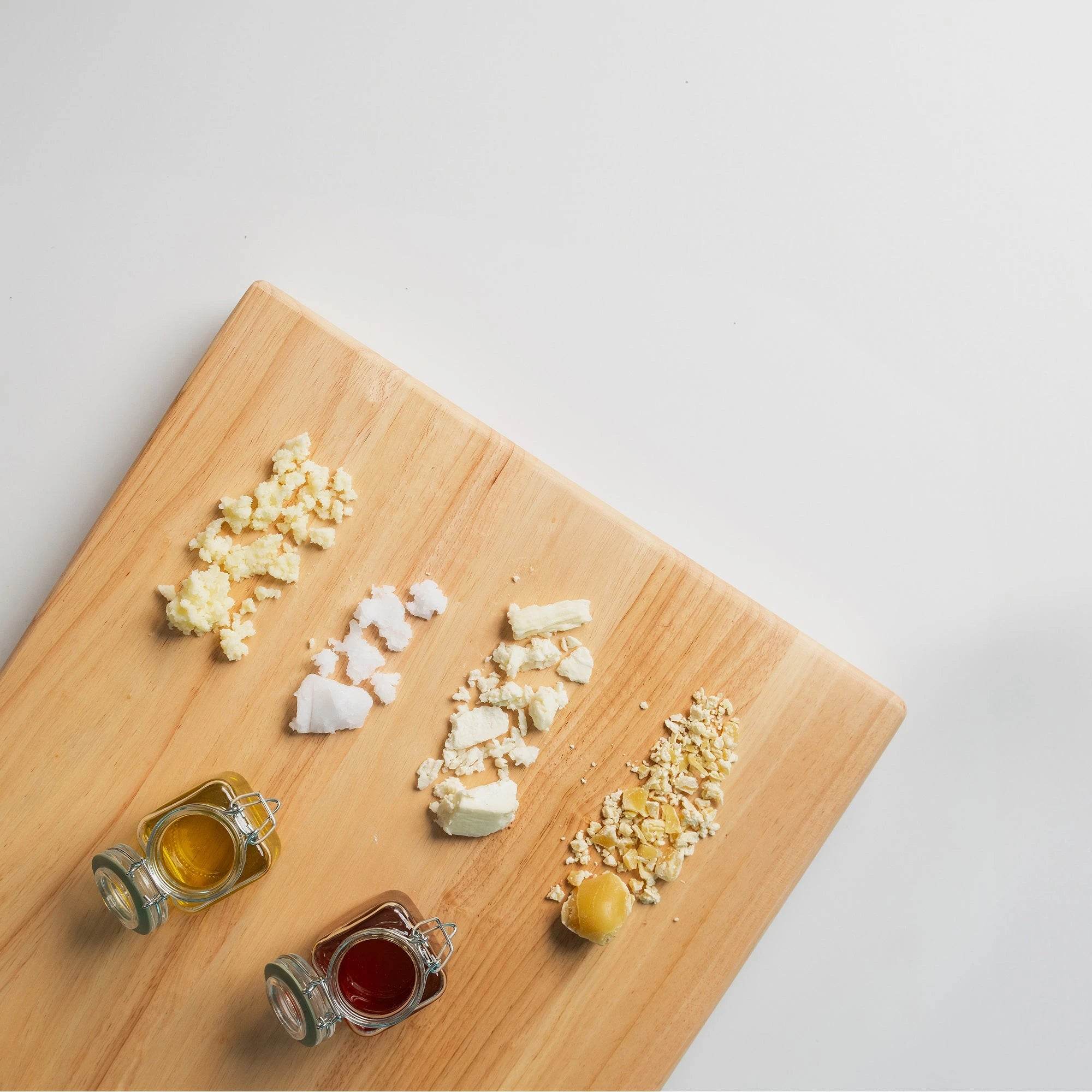
We use real ingredients because we'd rather deal with that variability than swap in something synthetic for the sake of predictability, but it's worth being honest that this choice is exactly why testing each flavor matters more for us than it might for a brand built entirely on synthetic, lab-formulated flavor compounds. The same logic applies to natural color sources, which show up across the catalog in things like our soap, where ingredients like raw honey and lemongrass oil are doing double duty as both scent and a genuinely agricultural ingredient with its own sourcing story. Choosing "real" over "synthetic" is a tradeoff, not a free upgrade, and the testing burden it creates is part of that tradeoff, not a separate inconvenience layered on top of it.
The cocoa example, specifically
Cocoa is the clearest version of this problem, and it's worth understanding why, because it's not a minor or obscure issue. Cacao plants are unusually efficient at pulling cadmium out of soil compared to a lot of other crops, which means cocoa and chocolate products, across the entire industry, not specific to any one brand, tend to carry naturally higher cadmium levels than products without cocoa in them. This isn't a contamination scandal or a manufacturing defect. It's a basic feature of how the plant interacts with the ground it grows in, and it's well documented enough that consumer testing organizations have flagged elevated cadmium and occasionally lead in mainstream dark chocolate bars for years, and it's drawn enough regulatory attention in some markets that chocolate makers have had to pay closer attention to where their cacao is sourced from.
This isn't unique to chocolate, either, it's just the most widely reported example. Different crops accumulate different trace metals at different rates depending on their biology, which is exactly why a flavor swap is never just a flavor swap from a testing standpoint. Rice tends to take up arsenic more readily than most grains. Certain leafy greens concentrate nitrates. None of that makes any of these foods unsafe in normal amounts, it just means the specific thing worth checking for shifts depending on what you're actually testing, and a lab that knows to look for cadmium in a cocoa-containing product is doing something genuinely different than one running a generic panel and calling it equivalent.
None of that makes cocoa dangerous to eat. Soil composition varies enormously by region, and plenty of cocoa sourcing comes back clean. What it does mean is that "we tested the vanilla batch and it was clean" tells you nothing useful about whether the chocolate batch is also clean, because the entire reason a chocolate product might carry different heavy metal levels has nothing to do with the rest of the formula. It's specifically about the one ingredient that isn't in the vanilla version at all. Assuming one flavor's results apply to another isn't just a shortcut, it's testing the wrong variable and calling it equivalent.
What we actually found, flavor by flavor
Here's where this stops being theoretical and starts being our actual lab reports, flavor by flavor, exactly as each one came back rather than smoothed into a single summary.
Our vanilla protein went to Delta Labs of South Florida, and protein content was verified by the Kjeldahl method at 23.0 grams per serving, right on the label. Heavy metals on that batch came back essentially at the floor of what the testing can even detect: lead, arsenic, and mercury all below 0.00003 milligrams per serving, cadmium at 0.000009 milligrams per serving, all comfortably inside the combined heavy metal limit set for that test.
Our chocolate protein went through a separate process entirely, tested at Certified Laboratories rather than assumed to mirror the vanilla results. That batch came back with lead at 0.032 parts per million, arsenic at 0.020, cadmium at 0.096, and mercury not detected at all. Worth being precise about what that test actually was: this particular report was a "report the result" test rather than a pass or fail against a printed numeric limit, which is a different kind of document than the vanilla one, and we're not going to blur that distinction just because both reports use the word "heavy metals." What we can tell you honestly is that these are small numbers, well below the range that's drawn attention in cocoa products generally, on a flavor where we specifically expected cadmium to be the number worth watching given everything explained above. The fact that we were watching for it, and that it came back low, is the entire point of testing it separately in the first place.
Our chocolate collagen protein, a related but distinct batch, went through the same independent process and came back with lead at 0.212 parts per million, arsenic at 0.012, cadmium at 0.044, and mercury not detected. Different lot, different result, run on its own rather than borrowed from anything else in the catalog. The microbiological side of that same batch came back clean too, total plate count and yeast and mold both under 10 colony-forming units per gram, with the full pathogen panel, coliforms, E. coli, Pseudomonas, Staph, Salmonella, and Candida albicans, all coming back absent. Two separate reports, chemical and microbiological, both run specifically on the chocolate batch rather than inherited from anywhere else.
It's not just about cocoa
Electrolytes are a quieter version of the same lesson. Our lemon-lime and raspberry flavors aren't separated by an ingredient as different as cocoa is from vanilla, but they're still built around different flavor and color sources, and we test each one on its own rather than treating "electrolytes" as a single product with two paint jobs.
Lemon-lime came back at 0.051 parts per million lead, 0.024 arsenic, 0.003 cadmium, and 0.005 mercury. Raspberry came back at 0.095 lead, 0.029 arsenic, 0.004 cadmium, and 0.002 mercury. Neither set of numbers is concerning, but notice they're not identical, and they're not supposed to be treated as if they were just because the base electrolyte formula underneath is the same. Microbial testing was run separately too, both flavors checked individually for total plate count, yeast and mold, and the full pathogen panel, all coming back clean on each.
The takeaway isn't that raspberry is somehow worse than lemon-lime, and we'd actively push back on anyone trying to read it that way. It's that even a small difference in flavoring or coloring is still a different ingredient, sourced separately, and "separately sourced" is exactly the phrase that should trigger a separate test, every time, regardless of how minor the difference looks on the label or how silly it might seem to run two full panels on what's essentially the same product with a different fruit note.
What this actually costs us
It would be considerably cheaper to test one flavor per product line and assume the rest follow. Fewer samples shipped, fewer invoices from the lab, fewer batches held up waiting on results that haven't come back yet. Multiply that across every flavor of every product, electrolytes, protein, anything else we add a variant to down the line, and the cost difference between testing everything separately and testing one representative version adds up fast, in dollars and in the time it adds to every single launch. We're not going to pretend that tradeoff doesn't exist, because it does, every single time we launch a new flavor of anything.
There's a logistics cost too, beyond the invoice. Every separate sample is its own shipment, its own intake at the lab, its own place in the queue, its own turnaround time. A flavor launch that could theoretically ship the moment manufacturing finishes instead waits on a result that hasn't come back yet, sometimes for more than a week. That's a real delay, a real cost to moving fast, and a real incentive for a brand under pressure to cut that corner quietly, since almost nobody checking the shelf would ever know the difference.
What that tradeoff buys instead is the ability to say something specific and true about every single product we sell, rather than a true statement about one flavor stretched to cover the others by implication. A brand that tests one flavor and lets the marketing copy imply the rest are equally verified is making a claim it hasn't actually earned. We'd rather spend the extra time and the extra invoice than be that brand, even on the products where the difference between flavors is genuinely small.
How to check whether a brand actually does this
You can't tell from a label alone whether a brand tested every flavor or just one and called it close enough. The label looks identical either way, same claims, same badges, same reassuring language regardless of what actually happened behind it, same confident tone whether the document behind it exists or not. What you can do is ask, directly, for the specific Certificate of Analysis tied to the specific flavor and lot number on the product actually in front of you, not a general "our products are tested" page, and not a single COA posted once and left up indefinitely regardless of which flavor or batch someone happens to be asking about.
A brand that can hand you the exact document for the exact flavor you're holding is doing what we're describing in this post. A brand that hands you one COA and lets you assume it covers everything in the lineup isn't necessarily lying outright, but it's letting you draw a conclusion the paperwork doesn't actually support, which is its own quiet kind of dishonesty even if every individual sentence on the label is technically true. The difference between those two situations is invisible until you ask the specific question, which is exactly why it's worth asking, on our products and on anyone else's.
Where we're still building this out
In the interest of the same honesty we're asking you to extend us elsewhere: heavy metal and microbial safety testing happens independently across our flavors, but full nutritional verification, the kind of Kjeldahl protein test we ran on our vanilla batch, isn't yet something we've run separately on every single flavor variant. That's a gap we're actively closing rather than one we're going to paper over by implying it's already done.
Here's the honest reasoning behind why safety testing came first. If a batch is contaminated or carries a microbial problem, that's a real, immediate risk to anyone who drinks it, regardless of how accurate the protein number on the label happens to be. If a batch is slightly under or over its exact protein claim, that's a labeling accuracy issue, a real one, worth fixing, but not the same category of urgency. We built out the safety testing across every flavor first because it mattered more first, and we're extending the same rigor to potency verification on every variant as the next phase, not because the order doesn't matter, but because it genuinely does, and we'd rather sequence it honestly than claim we'd already finished something we hadn't.
Contamination and microbial safety are the non-negotiable tests that happen on everything, every flavor, every time. Full nutritional-panel verification on every variant is the next standard we're building toward, and we'd rather tell you exactly where that stands today than let "we test every flavor" imply more completeness than currently exists.
The same principle, a different axis
If you've read anything else we've written about testing, you've probably noticed a pattern: we don't trust a single good result to stand in for everything else, ever, on anything. Testing every batch instead of testing once is about time, the same formula drifting slightly from one production run to the next. Testing every flavor instead of testing one is about ingredients, a formula that looks like a small variation but actually introduces a different sourcing chain entirely. They're two different axes of the same underlying refusal to extrapolate from a result that doesn't actually cover what's being claimed.
It's worth naming the third axis too, even though this particular post is mostly about the second one: different product categories entirely, our cosmetics versus our supplements versus anything else we eventually add to the catalog, get held to entirely different testing standards because they're answering entirely different questions. A microbial limit that makes sense for a capsule you swallow isn't automatically the right limit for a soap bar you rinse off and never ingest, and a heavy metal panel built for a dietary supplement isn't the same panel a cosmetic regulation expects, or needs. Batch, flavor, and category are three separate reasons the same word, "tested," can mean wildly different amounts of actual rigor depending on which one a brand is quietly skipping, and most people reading a label have no way of knowing which axis, if any, actually got covered.
As we add new scents or flavors to any line going forward, soap, electrolytes, anything else, the same standard applies before launch, not as an afterthought added once someone asks. A new lemongrass-soap variant, or a new electrolyte flavor, doesn't inherit a pass from whatever scent or flavor came before it. It starts from zero, the same as everything already on the shelf did.
Most shortcuts in this industry look reasonable from a distance. "We tested the formula" sounds complete until you ask which formula, which batch, which flavor, and realize the answer is usually "one of them, a while ago." We'd rather the answer always be "this exact one, recently, on its own," even when that's the slower and more expensive way to run a company.
Why this matters more than it sounds like it should
A cocoa-flavored product carrying a different heavy metal profile than a vanilla one isn't a flaw specific to any single brand. It's a basic fact about how that ingredient interacts with soil, true industry-wide, whether a company chooses to test for it or not. The actual choice a brand makes isn't whether the difference exists, it's whether they're willing to go looking for it.
We'd rather know, batch by batch and flavor by flavor, than assume. That's a slower, costlier way to run a supplement company, and it's also the only version of "tested" that means anything once you understand what a single shared result is actually capable of telling you, and what it isn't.
If there's one thing worth taking away from this beyond our own specific numbers, it's a question worth asking of anything you buy, from us or from anyone else: when a brand says a product is tested, ask which specific version of it actually got tested, how recently, and against what standard. Most of the time, that question has a clear, satisfying answer. Sometimes it doesn't, and the silence that follows is usually more informative than anything printed on the label.
That's really the whole post, stretched out: a label is a promise, and a Certificate of Analysis is the only thing that actually backs that promise up, flavor by flavor, batch by batch, ingredient by ingredient. We'd rather keep producing the second thing than get comfortable resting on the first.