We didn't build this brand because we trusted the wellness industry. We built it because, more than once, it let us down.
A "clean" label that wasn't quite so clean once you read past the front of the bottle. An ingredient list that didn't match what actually showed up when somebody bothered to check. A promise that fell apart the second anyone looked closely. None of that is a conspiracy theory. It's just what happens in an industry where nobody is required to prove a supplement does what the label says before it ends up in your cart.
Here's the part most brands don't lead with: dietary supplements in the U.S. aren't approved by the FDA before they hit the shelf. Not the formula, not the dosages, not the claim on the front of the label. The company making the product is responsible for making sure it's safe and accurately labeled, and the FDA mostly steps in after something has already gone wrong. That's not a loophole a few shady brands are exploiting. That's just how the category works, for every supplement brand you've ever bought from, including, technically, us.
If you're the kind of person who already reads ingredient labels before you buy anything, who's been burned by a "natural" claim that turned out to be marketing language and nothing else, none of this is probably a surprise to you. You already know the industry has a trust problem. What we're trying to do differently isn't pretending that problem doesn't exist. It's handing you the actual paperwork instead of asking you to take our word for it on top of everyone else's.
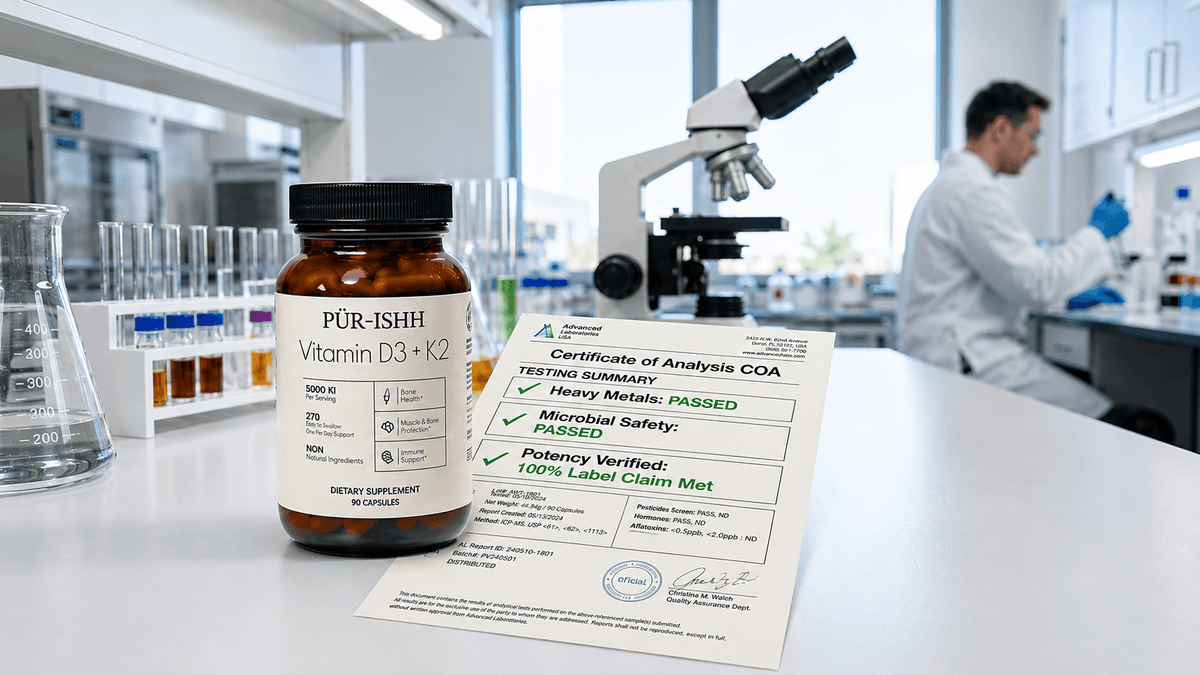
So early on we made a decision that's turned out to be one of the more expensive, more annoying, and more worthwhile things we do. Every batch we make gets checked against a real, signed lab report before it's allowed to ship. Not the first run, then never again. Not a "we tested this once in 2024" claim sitting quietly on an About page. Every batch. We pay for it, we get the results back in writing, and below, we're going to walk you through exactly what's in those reports, because we think you should be able to see this kind of thing instead of just being told to trust it.
"Third-party" is doing a lot of work in that sentence
There's a version of "tested" that means almost nothing: a brand testing its own product, in its own facility, and then telling you it passed. That's not a lab report. That's a brand grading its own homework.
What we actually do, wherever it matters most, is send physical samples of finished product out to labs we don't own and don't control. Our protein powder goes to Delta Labs of South Florida, accredited under ISO/IEC 17025:2017 with a PJLA accreditation number you can look up. Our electrolytes and chocolate protein go through Certified Laboratories, an A2LA ISO 17025 accredited facility that specializes in cosmetics, OTC products, and dietary supplements. Neither of those labs has any stake in whether our products sell. They get a sample, they run it against a method, and they send back a number, whatever that number happens to be.
That's the part that actually matters. A Certificate of Analysis from a lab like that isn't vouching for our brand. It's reporting what was found in one specific sample, against one specific method, on one specific date. That distinction sounds small, but it's the entire difference between a real lab report and the kind of vague "tested" language you'll see on a lot of supplement packaging that turns out to mean nothing in particular.
What we're actually checking for, and why it's not random
"We test everything" is a fine sentence for a label. It's a much more useful sentence once you know what "everything" actually breaks down into. For us, that's three categories, and they're not interchangeable.
Heavy metals: the stuff you can't see, taste, or smell
Lead, arsenic, cadmium, and mercury aren't ingredients anyone adds on purpose. They show up because plants and minerals pull them out of soil and water as they grow or form, which means the risk is highest exactly where you'd expect: anything mineral-heavy, anything plant-derived, anything that started out as dirt and rock before it became a supplement.
Our protein is a good place to see this in practice. The Delta Labs report on our vanilla batch came back with lead, arsenic, and mercury all below 0.00003 milligrams per serving, and cadmium at 0.000009 milligrams per serving. At the level these tests can even detect a difference, there's essentially nothing there. That's not a "trace amounts, don't worry about it" kind of result. It's a number small enough that the lab had to report it in fractions of a microgram just to give you something to read.
Our shilajit gets the same level of scrutiny, for good reason. It's a mineral-rich resin pulled from rock in the Altai Mountains, and heavy metal contamination is one of the most well documented risks in that category, full stop. A lot of cheap shilajit on the market has simply never been checked for it. The contaminant panel behind our current batch came back at 0.67 milligrams per kilogram of lead against a permitted limit of 6, 0.12 against a limit of 1 for cadmium, 0.08 against a limit of 12 for arsenic, and under 0.01 against a limit of 1 for mercury. Every single one sitting well inside the line, not hovering near it.
Microbial safety: the stuff that actually grows
This one isn't about contamination from the environment, it's about contamination over time. Bacteria, yeast, and mold can grow in a product if something went wrong during manufacturing, packaging, or storage, and the risk is higher for anything raw, anything without synthetic preservatives, and anything that touches skin or gets ingested daily. Which describes most of what we make.
Every batch gets checked for total aerobic plate count, yeast and mold, and a specific list of organisms you genuinely don't want to find: E. coli, Salmonella, Staphylococcus aureus, Pseudomonas aeruginosa. Our protein came back at 30 colony-forming units per gram on total aerobic count against a limit of 10,000, and under 10 per gram on yeast and mold against a limit of 1,000. Every pathogen test on it came back negative.
Our electrolytes go through the same standard, in both flavors, tested separately rather than assuming one flavor's results apply to the other. Both came back with total plate counts and yeast and mold under 10 colony-forming units per gram, no growth on enrichment, and every targeted pathogen, including Candida albicans, came back absent. Our tallow soap, shampoo, and conditioner are held to the cosmetic version of the same standard: all three came back under 10 colony-forming units per gram on total bacterial count, comfortably under the 1,000 limit that category is held to, and the same under 10 per gram on mold and yeast, under that category's 100 limit.
We're not telling you this to make you think every supplement on a shelf is secretly contaminated. Most aren't. But "probably fine" isn't a standard, it's a guess, and we'd rather hand you a number than a guess.
Potency and label accuracy: does it actually contain what we say it does
This is the test that should worry you most about the supplement industry in general, and it's the one brands talk about least, because it's the easiest one to fail quietly. A product can pass every safety test and still not contain what the label promises. Underdosed actives, mismatched ratios, "proprietary blends" that exist specifically to hide how little of the expensive ingredient actually made it in. It's a documented, known pattern in this category, not an edge case or a worst-case scenario.
So every batch gets checked against its own label claim, ingredient by ingredient, not just for safety but for whether the dose is actually the dose. Our creatine monohydrate is labeled at 5,000 milligrams per serving. The lab result came back at 4,976 milligrams, comfortably inside the 10 percent tolerance that's standard for this kind of testing, and the sodium content checked out the same way, 39.85 milligrams against a 40 milligram target.
Every ingredient in our magnesium blend gets the same scrutiny, which matters more here than almost anywhere else in the catalog, because it isn't one ingredient, it's seven, and every single one has to land where it's supposed to. The verified potency came back at 250 milligrams of magnesium glycinate, 75 of malate, 100 of citrate, and 75 of L-threonate, plus 5 milligrams of vitamin B6, 10 of zinc gluconate, and 1 of boron aspartate. Every figure on spec. Nothing close to spec, nothing rounded generously in our favor. On spec.
Our shilajit carries one more test most products in its category skip entirely: an authenticity test. Shilajit is one of the most faked ingredients in the ancestral-health space, often cut, often synthetic, often nothing close to what's printed on the jar. Ours came back with a plain, explicit result: authentic. The fulvic acid content, the compound most associated with shilajit's mineral-delivery properties, came back at 72 percent. We didn't pick that number because it sounded impressive for marketing. We picked the source because that's genuinely what it tests at, and we have the paperwork to back it up rather than just the percentage on a label.
What this looks like across the catalog
It's one thing to say "we test everything." It's another to actually walk through it, so here's the unglamorous, specific version.
Both flavors of our protein powder go through the full battery: protein content verified by the Kjeldahl method, which is the actual laboratory standard for measuring protein rather than a number copied from a spec sheet, alongside a full heavy metal panel and a full microbial panel. Our chocolate protein and collagen blend are checked the same way, with their own independent heavy-metal and microbiological reports rather than assuming one flavor's results carry over to the next.
Our electrolytes, lemon-lime and raspberry, each carry their own chemical and microbiological certificate, run independently per flavor. Across both, heavy metals came back somewhere between 0.002 and 0.095 parts per million, and every microbial marker came back clean or absent.
Our tallow soap, shampoo, and conditioner each carry documentation confirming compliance with FDA cosmetic regulation, including the Modernization of Cosmetics Regulation Act of 2022 and Title 21 of the Code of Federal Regulations, alongside the same microbial standard the rest of the lineup is held to. We also check pH on each one, not as a formality, but because it genuinely affects how a product behaves on skin and hair. Our shampoo sits at 5.84 and our conditioner at 5.16, both close to the natural pH range of healthy skin and scalp, which is part of why a product can either leave your hair feeling like itself or strip it raw. Our tallow soap reads higher, at 10.6, which is expected and correct for true soap made the traditional way rather than a defect to worry about.
There's one product we're deliberately not walking through here, even though we have lab data for it. A recent result on it raised a question we haven't fully closed out with the manufacturer yet, and we'd rather hold it back from a piece about transparency than wave a number around before we're sure it means what we think it means. That's not us hiding something. It's the same standard applied to ourselves that we just spent this whole post describing.
What happens when a batch doesn't pass
We'd love to tell you every test has come back perfect from day one. That wouldn't be true, and it's not really the point anyway. The actual point of testing every batch is that some of them don't pass, and when that happens, the product doesn't go out the door with a different label slapped over the problem.
If a result comes back outside spec, on anything, heavy metals, microbial counts, potency, that batch gets held. We go back to the supplier or the manufacturing partner, find out what happened, and either get it corrected and retested or we don't sell it, full stop. Nobody hears about most of this, because the entire point of catching a problem before shipping is that you never have to. That's also exactly why a single clean result from a year ago doesn't mean much on its own. The system only works because it's continuous, batch after batch, not because we got a good grade once and framed it.
This is the unglamorous part of "third-party tested" that never makes it onto packaging anywhere. Testing isn't a stamp you earn once. It's a gate that has to let every single batch through before it's allowed to reach you, and a gate only means something if it's actually capable of saying no.
What this doesn't mean, because we'd rather you knew
Here's where we could oversell this, and we're choosing not to.
Third-party lab testing is not the same thing as organic certification. We don't currently hold USDA Organic certification on these products, and we're not going to imply otherwise just because "organic" and "tested" tend to sit next to each other in a lot of marketing. What we can tell you, honestly, is that these batches have been checked for purity, potency, and safety against real, verifiable lab data. That's a specific, checkable claim. It's a different claim than "certified organic," and we'd rather hand you the accurate one than the more flattering-sounding one.
A passing result also doesn't mean a product is perfect forever, or that every future batch will read identically to this one. It means that specific sample, from that specific batch, came back clean against a real standard, on a specific date. Shilajit pulled from the same mountain range can carry different mineral concentrations depending on rainfall and exactly where it was harvested that season. Raw tallow shifts with what the cattle were grazing on and when it was rendered. Even something as straightforward as whey concentrate can move slightly lot to lot, depending on the herd and the season's feed. None of that makes any of these ingredients unsafe. It does make "we tested it once" close to meaningless as a promise, which is the entire reason batch-level testing exists as a category in the first place. Ingredients vary. Suppliers vary. A clean result from two years ago tells you nothing about what's in the jar on your shelf today, which is exactly why "we test our products," said once and never followed up on, means so little coming from most brands. We're trying to mean something more specific by it.
And we're not claiming to have invented some revolutionary process here. Lab testing isn't exotic, and we didn't discover it. What's actually uncommon is being willing to show you the documents instead of just asking you to take the label's word for it.
How to actually read one of these, if you want to
You don't need a chemistry background to get something useful out of a Certificate of Analysis. A few things are worth knowing how to spot.
Who ran the test. Look for an accreditation, ISO/IEC 17025 is the standard worth recognizing, and an address that isn't the brand's own headquarters. If the lab and the brand are the same company, that's not third-party testing, no matter what the document is titled.
What was actually measured against what. A real report lists a specification, the limit or target, right next to a result, what was actually found. If a document only shows results with nothing to compare them against, you can't tell whether anything passed or failed. You're just looking at numbers with no context.
What's missing. A report that only checks microbial safety will tell you a product is unlikely to make you sick. It won't tell you whether it contains what the label claims. A report that only checks potency won't tell you whether it's safe. The two aren't substitutes for each other, and a brand only showing you one of them is only telling you half the story.
One more thing worth checking: the batch or lot number on the report against the batch or lot number on your actual product. A Certificate of Analysis only speaks for the batch it's named for. A brand that posts one COA permanently on its website, with no batch number, or the same one year after year, isn't really showing you batch-level testing. It's showing you one good result from once, and hoping you'll assume it still applies.
We're planning to walk through one of our own Certificates of Analysis line by line in a future post, the actual document, annotated, so you can learn to read one yourself on anything you buy, from us or from anyone else. It's a useful skill to have regardless of whose name is on the label.
Why we keep doing this, even though it's expensive and slow
Every batch we send out costs us money and time we could spend on plenty of other things. It would be cheaper and faster to test once, frame the result, and never look at it again. Plenty of brands operate exactly that way, and most customers never find out, because nobody ever asks to see the actual documents.
We started this company frustrated with an industry that asks for trust it hasn't earned. We have no interest in quietly becoming the version of that we were trying to get away from. So the standard we hold ourselves to is simple: if we wouldn't hand you the actual lab report, we don't get to make the claim.
That's not a tagline sitting on a page somewhere. It's a folder of real Certificates of Analysis, batch after batch, that we will hand over if you ask, because raw honesty about what's actually in the jar is the entire point of what we're building here. Not a marketing layer sitting on top of it. The thing itself.