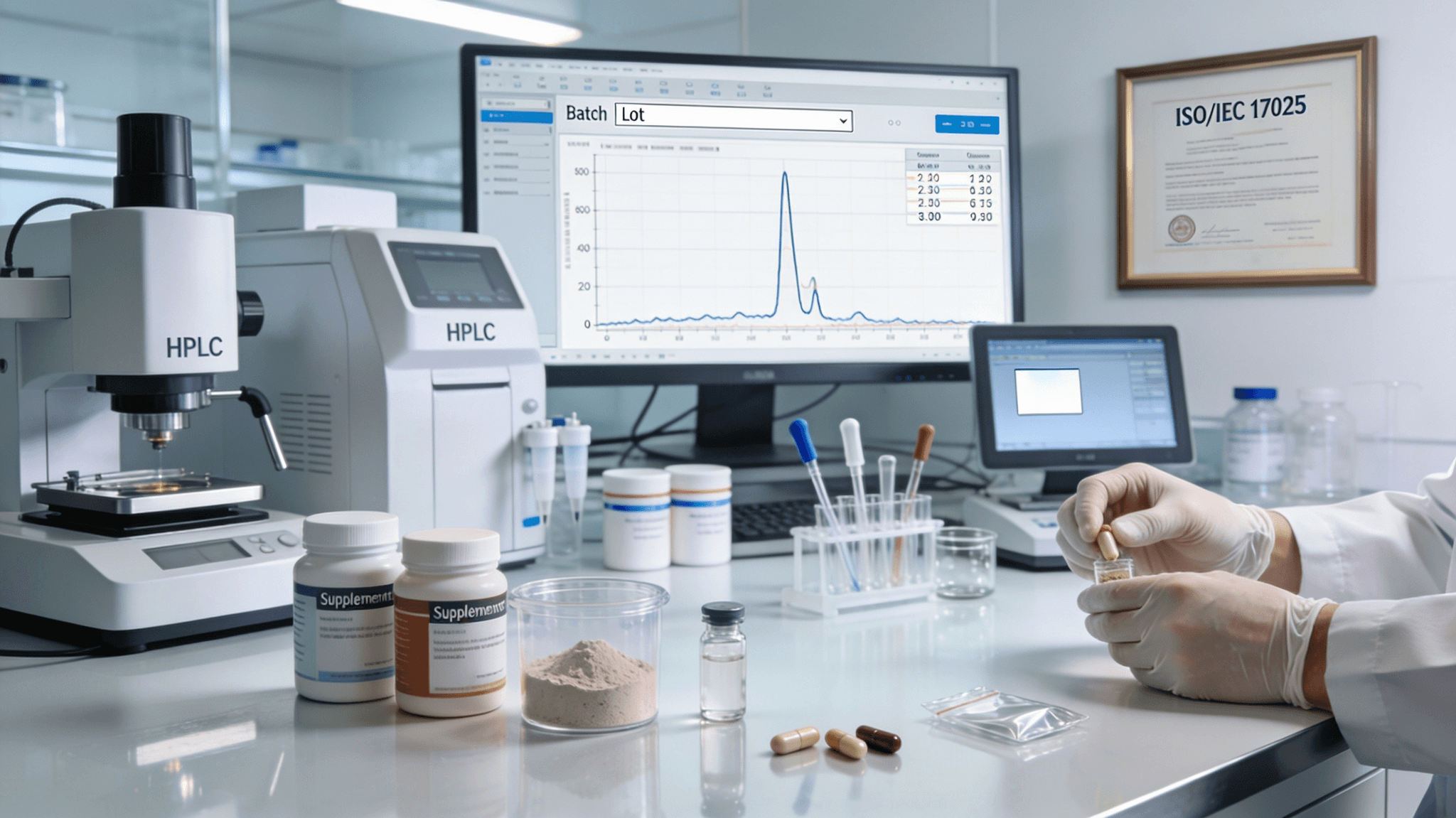
"Third-party tested" is one of the most common and least meaningful phrases in the supplement industry. It shows up on labels, on websites, on social media bios, and in marketing copy as if it's a defined standard with a specific meaning. It isn't. There is no federal requirement governing what a brand must have done before it can call itself third-party tested, no minimum number of tests, no required type of analysis, no specification about which laboratory, no rule about how often testing must happen or whether results need to be published.
The phrase has become a trust signal that a large portion of the industry uses without earning, because using it costs nothing and sounds like something meaningful to a consumer who hasn't looked too closely.
This post is a checklist for what third-party testing should actually mean, built from what the words literally say and what a consumer would reasonably assume they mean. Apply it to us. Apply it to every other brand you buy supplements from. The questions are the same regardless of who you're asking.
Start with what "third party" actually requires
A third party, in any meaningful sense, is an entity with no stake in the outcome. In testing, that means a laboratory that isn't owned by or financially entangled with the brand paying for the test.
This sounds obvious but breaks down quickly in practice. A supplement company can set up an internal testing operation, give it a separate name or brand identity, and call tests run by that operation "third-party." A manufacturer can have its own in-house quality control lab, run whatever analysis it chooses, and describe those results as independent. Neither of these involves a genuinely independent party.
Even when a brand sends samples to an actual external laboratory, the independence is only partial. The brand selects which lab to use, pays for the testing, receives the results, and then decides whether to publish them. If a test comes back showing a product is below its stated potency, or contains an elevated heavy metal, the brand can simply decline to publish that result and run the test again, or switch to a lab more likely to pass the product. There's no mandatory disclosure of failed tests in the supplement industry, which means published certificates of analysis represent a self-selected sample of testing results, not an unfiltered picture of what testing actually found.
The only version of third-party testing that eliminates this selection bias is when the third party buys the product themselves and tests it without the brand's involvement. This is what organizations like ConsumerLab do: they purchase products off retail shelves, the way any consumer would, run analysis, and publish results regardless of outcome. Brands can't choose not to participate, can't select which products get tested, and can't withhold results. That's genuinely third-party testing. Everything else involves some degree of brand control over what gets tested, when, and what gets shown.
The accreditation question
Not all laboratories that call themselves testing labs are equivalent. The recognized international standard for laboratory competence is ISO/IEC 17025 accreditation, which is granted by accrediting bodies that have evaluated the lab's technical competence, equipment calibration, quality management systems, and personnel qualifications.
In the United States, A2LA (the American Association for Laboratory Accreditation) and PJLA (Perry Johnson Laboratory Accreditation) are the two most recognized accrediting bodies for dietary supplement testing labs. An ISO 17025 accredited lab has been externally evaluated and found to meet defined standards for producing reliable results. An unaccredited lab may still run competent testing, but there's no external validation that it does.
When a brand says a product is third-party tested, a basic question to ask is: accredited by whom, to what standard? If the brand can't answer that, or answers with a lab name but no accreditation details, that's an incomplete answer. The information should be on the document itself, not something you have to take the brand's word for.
What type of testing was actually done
This is one of the most common ways the "third-party tested" claim misleads without technically lying. A brand might run microbial testing on a product and then describe it as third-party tested. Microbial testing tells you whether a product is contaminated with bacteria, yeast, or mold. It tells you nothing about whether the product contains what the label says it contains, or whether it's free of heavy metal contamination.
Complete supplement testing should address three separate questions.
Safety. Is the product free of heavy metal contamination and microbial contamination? Heavy metals, specifically lead, arsenic, cadmium, and mercury, are the ones that show up most commonly in contamination issues, and they get into supplements through raw ingredient sourcing rather than manufacturing process. Microbial testing covers bacterial and fungal contamination that can enter through handling and production. These are different tests for different risks, and both matter.
Potency. Does the product actually contain what the label says, in the amounts the label claims? This is a separate analysis from safety testing, and many brands do one without the other. A product can pass heavy metal testing while being significantly underdosed. A product can be microbially clean while containing twice its labeled potency of a nutrient. Independent testing organizations have documented both kinds of failure regularly across the supplement category.
Identity. Is the ingredient actually what it's claimed to be? This is particularly relevant for botanical extracts and specialty ingredients where adulteration is common, including shilajit, certain mushroom supplements, and high-value botanical extracts that can be substituted with cheaper materials.
A brand that has only run microbial testing can truthfully say it's been third-party tested. Most consumers would assume that means something much more comprehensive. The gap between what was done and what a reasonable person would infer is where a lot of the misleading happens.
The batch-specificity requirement
A test result that isn't tied to a specific batch or lot number isn't telling you anything about the product in your hand. Ingredients change. Suppliers change. Manufacturing conditions vary from one production run to the next. A certificate of analysis from 18 months ago on a batch that's long since been sold describes a product that no longer exists on the shelf.
When a brand publishes a certificate of analysis as a permanent webpage or PDF without ever updating it, or uses a single test result across all batches of a product regardless of when they were manufactured, they're representing one data point as ongoing evidence of quality. That's a misrepresentation of what a single test actually establishes.
Batch-specific testing means the certificate references a specific lot number that corresponds to a currently available batch of the product. If you buy a bottle with lot number X printed on the label, the certificate for lot number X should be what's produced when you ask for documentation. If the brand produces a certificate with no lot number, or a lot number that doesn't match yours, or tells you they test "all their products" without producing a current, batch-matched document, the testing program isn't providing what the phrase implies.
The GMP certification confusion
Good Manufacturing Practice certification is a real and meaningful thing, but it doesn't do what many consumers assume it does when they see it on a label.
GMP certification, whether from the NSF or another recognized body, evaluates a manufacturing facility's processes, documentation, cleanliness, equipment, personnel training, and quality management systems. It's essentially an audit of how a facility operates. A GMP-certified facility is one that has been evaluated as running sound manufacturing processes.
What GMP certification does not do: it doesn't require testing the finished product for what it contains or what contaminants might be in it. A GMP-certified facility can produce a supplement that's underdosed, contaminated, or otherwise fails to match its label, and the GMP certification remains intact because GMP evaluates the process, not the specific outcome of each production run.
This is an important distinction because "manufactured in a GMP-certified facility" frequently appears in marketing materials in ways that imply finished product quality assurance that it doesn't actually provide. When a brand responds to questions about testing with "we're GMP certified," that's an incomplete answer to a different question.
The publication question
Publishing test results is voluntary. No federal requirement compels a supplement company to share its certificates of analysis with consumers, even if it runs excellent, comprehensive, accredited testing on every batch. Some brands with genuinely rigorous testing programs don't make results publicly accessible, and some brands with minimal testing make whatever documentation they have very prominently available because it creates the impression of transparency.
The presence of published documentation is a positive signal, not a guarantee that the documentation represents the full picture of what testing found. The absence of published documentation doesn't mean testing wasn't done, though combined with an inability or unwillingness to produce documents on request, it's a reasonable flag.
What publication should look like: accessible, batch-specific certificates from named accredited labs covering heavy metals, microbial safety, and potency for the products claimed to be tested. Ideally updated when new batches are produced rather than relying on old documentation indefinitely.
What we can and can't claim about our own program
We've shared a significant amount of documentation throughout this content series, and this seems like the right place to be precise about where our own testing program meets the checklist above and where it's still being built out.
Our protein, electrolytes, and chocolate collagen products were tested at Delta Labs of South Florida and Certified Laboratories, both ISO 17025 accredited labs with specific accreditation numbers on the certificates. Those results cover heavy metals and microbial safety as separate, documented analyses.
Our magnesium complex and creatine COAs were issued through Manifest Labs. The documentation on those products includes a note that the information is based on certificates received from the ingredient supplier rather than finished-product analysis commissioned independently. That's a different, and weaker, form of documentation than the Delta Labs and Certified Laboratories results.
Our soap, shampoo, and conditioner COAs from Nuvue Labs confirm FDA cosmetic regulatory compliance and microbial safety, but include language noting that some testing was performed in-house or by an approved third-party laboratory, which leaves the independence question partially open.
Our shilajit analysis from VibeMedX is the raw material supplier's own batch documentation, not a test commissioned independently by us on finished product.
The potency verification we have, creatine dose confirmed through HPLC, magnesium forms confirmed at their individual labeled amounts, protein content confirmed by Kjeldahl, represents some of the most directly useful documentation in the catalog. The gap we're actively working to close is extending that finished-product potency verification more comprehensively across the catalog, rather than relying on supplier-provided documentation for those components.
Naming that gap explicitly is the whole point. If the standard we're describing in this post is the right standard, we're obligated to apply it to our own practices honestly, including where we're still building toward it.
The checklist, consolidated
Here's what "third-party tested" should actually mean when a brand uses it. Ask these questions of any supplement company, including us.
Which specific laboratories performed the testing, and what accreditation do they hold? Look for ISO/IEC 17025 accreditation from a recognized accrediting body, and verify that the lab is a genuinely separate entity from the brand and manufacturer.
What types of testing were done? Safety testing (heavy metals, microbial) and potency testing are different analyses. A brand that has done one without the other has answered only part of the question.
Is the documentation batch-specific? The certificate should reference a lot or batch number that corresponds to currently available product. A document with no lot number or an outdated lot number doesn't describe what's currently on the shelf.
Can the actual documents be produced on request? If yes, that's better than marketing language without documentation. If the documents show named accredited labs with specific numeric results against stated specifications for the current batch, that's the complete answer.
Is the brand disclosing what wasn't tested or where documentation comes from supplier data rather than independently commissioned analysis? Transparency about the limits of the testing program is itself a meaningful signal.
None of this makes "third-party tested" a guarantee of anything. Testing is sampling, not certainty, and even a rigorous program represents a data point about a batch rather than a permanent statement about every unit ever produced. But a brand that can answer all of these questions honestly, including the places where they can't yet answer them completely, is doing something meaningfully different from a brand that prints "third-party tested" on the label and calls it handled.