What Heavy Metal Testing Actually Catches (and Why Most Brands Don't Publish It)
Heavy metal testing is the single most important verification available for a dietary supplement, and it's also one of the least frequently published. That combination isn't an accident, and the reasons behind it are worth understanding in detail, because they explain something important about how to read the supplement market generally: the absence of a document isn't always evidence of a problem, but it does mean a question that could have been answered definitively simply wasn't.
This post covers what heavy metal testing actually measures, how the analytical methods work and where their real limits sit, what standards exist and which are genuinely binding, and the specific structural reasons publication remains voluntary and uncommon.
The four metals, and why these four
Heavy metal testing in dietary supplements almost universally focuses on four elements: lead, arsenic, cadmium, and mercury. These are classified as Class 1 elemental impurities under the relevant pharmaceutical standards, a designation reserved for elements considered human toxicants with no established beneficial biological role, which are generally restricted or prohibited in the manufacturing process.
The reason these four dominate testing isn't arbitrary. They share a specific combination of properties that makes them uniquely relevant: they occur naturally in soil and water, meaning plants absorb them during normal growth without any contamination event occurring; they accumulate in the body rather than being efficiently cleared; and they have well-documented toxicity at chronic low-level exposure, not just at acute high doses. That last point matters especially for supplements, since a supplement is by definition something taken repeatedly over long periods, which is precisely the exposure pattern where cumulative low-level intake becomes relevant.
How the testing actually works
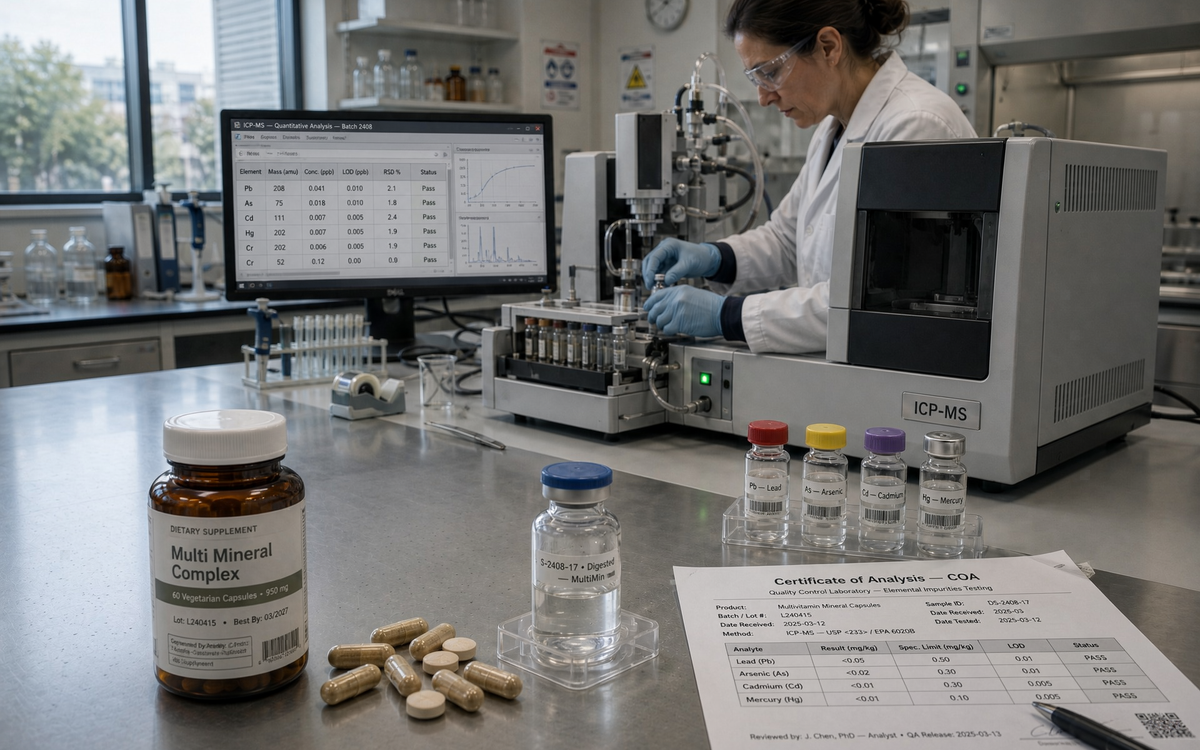
The analytical method that matters most here is inductively coupled plasma mass spectrometry, universally abbreviated ICP-MS, and understanding roughly how it works helps explain both its power and its limitations.
A sample is first digested, typically in strong acid, to break down the organic matrix and release any metals present into solution. That solution is then introduced into an argon plasma operating at extremely high temperature, which atomizes and ionizes the elements present. Those ions are then separated by their mass-to-charge ratio in a mass spectrometer and counted. Because different elements have different atomic masses, the instrument can distinguish and quantify each element in the sample simultaneously.
The sensitivity involved is genuinely remarkable and worth stating concretely. Under the standards governing this testing, ICP-MS is expected to reliably detect elemental impurities at concentrations in the range of nanograms per milliliter, with some applications requiring detection limits as low as 0.01 nanograms per milliliter, a level that remains comfortably within the technique's capability. For perspective, that's a sensitivity level capable of detecting quantities that would be entirely invisible to any less sophisticated method, which is precisely why it replaced older approaches.
That replacement is worth knowing about specifically, because it explains why testing standards changed relatively recently. USP General Chapter 231, the older "Heavy Metals" chapter that governed this area for decades, was determined to be obsolete and was eliminated entirely as of January 1, 2018. It was replaced by a set of modern chapters: General Chapter 232, Elemental Impurities Limits, General Chapter 233, Elemental Impurities Procedures, and General Chapter 2232, Elemental Contaminants in Dietary Supplements. The older method relied on a colorimetric approach that was considerably less sensitive and less specific than modern instrumental analysis, meaning testing conducted under the old standard could genuinely miss contamination that current methods would catch. Any COA referencing the obsolete USP 231 method rather than current chapters is therefore working from a standard that was formally retired, which is a reasonable thing to notice.
The limits, and an important detail about how they're expressed
USP General Chapter 232 establishes permitted daily exposure values, commonly abbreviated PDE, for 24 elemental impurities, classified by both potential toxicity and route of administration.
Here's a detail that changes how these numbers should be read, and it's genuinely important: PDE limits are daily exposure limits, not concentration limits in a raw material. This distinction has real practical consequences. If a supplement delivers 1,500 milligrams of a botanical extract per day across three capsules, the raw material specification for lead has to be tight enough that the total daily dose stays under the applicable exposure limit, which means the acceptable concentration in the raw material depends entirely on how much of that material a person actually consumes daily. A raw material concentration that would be perfectly acceptable in a product taken at 200 milligrams daily could exceed exposure limits in a product taken at 2,000 milligrams daily, from identical starting material.
This is why simply comparing a parts-per-million number on one COA against a parts-per-million number on another, without accounting for serving size, can be genuinely misleading. The meaningful question is always total daily exposure at the recommended serving, not concentration in isolation.
The voluntary nature of all of this
Here's the structural fact that explains most of why publication is uncommon: USP chapters 232 and 233 were written for pharmaceutical products. Dietary supplement manufacturers frequently adopt the same framework voluntarily to demonstrate product quality, and USP 2232 exists specifically to address elemental contaminants in dietary supplements, but adopting these standards is a choice a manufacturer makes rather than a binding requirement enforced through pre-market review.
This follows directly from how dietary supplements are regulated in the US generally. Under the Dietary Supplement Health and Education Act of 1994, supplements are classified as a category of food rather than drugs and do not require pre-market approval. Nobody independently verifies a supplement's contents before it reaches a shelf, which means whether heavy metal testing happens at all, at what rigor, using which method, against which limits, and whether the results are ever shown to anyone outside the company, are all decisions the manufacturer makes internally.
Good Manufacturing Practice regulations, which are mandatory and enforced through FDA inspection, require manufacturers to establish specifications and verify that products meet them, which does create real accountability. But GMP compliance is about having and following a documented process, not about publishing the resulting data. A GMP-compliant manufacturer can run rigorous heavy metal testing on every batch, meet every specification, and share none of it publicly, entirely within the rules.
Why brands don't publish, in order of how honest each reason is
There are several genuinely different reasons a brand might not publish heavy metal testing, and they're worth separating rather than collapsing into a single cynical assumption.
The most benign explanation is that they simply haven't been asked enough to build the process. Publishing batch-specific COAs requires ongoing operational work: getting results from the lab, formatting them for public consumption, updating them as new batches are produced, and maintaining a system where a customer can match the lot number on their bottle to the right document. For a brand not receiving many requests, this is real work with no obvious return, and its absence reflects priorities rather than concealment.
A more substantive reason involves the labs themselves. Testing laboratory reports commonly include language stating the report may not be reproduced, or used in advertising or the sale of any product, without written authorization from the laboratory. This is standard practice protecting the lab from having its name attached to marketing claims it didn't review or endorse. It means a brand generally can't simply post a raw lab PDF as a marketing asset without addressing that permission question, which is part of why summarizing results is more common than publishing complete documents.
A third reason is genuinely about the documents themselves. Many COAs contain information a brand reasonably considers commercially sensitive, including supplier identities, exact formulation details, and manufacturing partner names. Publishing an unredacted COA reveals supply chain relationships that competitors would find useful.
And then there's the least charitable explanation, which is real often enough to warrant mentioning: some brands haven't done the testing at all, or have done it once on a single batch years ago, or have received results they'd rather not display. In a category where nobody checks before a product ships and publication is entirely optional, this is a structurally available choice, and it's precisely why the absence of documentation, while not proof of a problem, is worth noticing as an unanswered question rather than assumed away.
What testing genuinely can't tell you
This is worth being clear about, because overstating what a clean COA proves is its own form of misleading.
A heavy metal test describes the specific sample that was analyzed, from the specific batch it was drawn from, on the specific date it was run. It doesn't describe the batch produced three months later from a different raw material shipment. This is the entire reason batch-specific documentation matters more than a single certificate published once and left indefinitely.
Testing is also sampling, not exhaustive verification. A sample drawn from a batch is assumed representative of the whole, which is a reasonable statistical assumption for a well-blended finished product, but it's an assumption rather than a guarantee, particularly for products where mixing may be less uniform.
A heavy metal panel also only covers the elements actually tested. A standard four-element panel says nothing about pesticide residues, microbial contamination, solvent residues from extraction processes, or whether the product contains what its label claims. These are separate analyses answering separate questions, and a brand pointing to a heavy metal COA when asked about potency is answering a different question than the one being asked.
And detection limits, while extremely low with modern ICP-MS, are not zero. A result reported as "not detected" means below the method's detection limit for that element, which is a meaningfully different statement than absolute absence. A well-constructed COA states the detection limit alongside the result, which is a small detail worth looking for.
What a genuinely useful COA looks like
Pulling this together into what's actually worth checking when you do get a document.
It should name the testing laboratory and, ideally, its accreditation, with ISO/IEC 17025 being the recognized standard for laboratory competence. It should reference a batch or lot number matching the product in hand. It should name the analytical method, with ICP-MS being the expected modern standard, and reference current USP chapters rather than the retired 231. It should report numeric results for each of the four metals individually rather than a combined figure or a bare pass mark, alongside the specification or limit those results are being measured against, and ideally the detection limit for results reported as not detected.
A document meeting all of these is doing something genuinely meaningful. One missing several of them may still reflect real testing, but it's providing less verifiable information than it appears to.
The honest summary
Heavy metal testing via ICP-MS is a mature, extremely sensitive analytical method capable of detecting contamination at concentrations far below any level of practical concern, governed by a modern standards framework that replaced a genuinely obsolete method as recently as 2018. The limits that framework establishes are daily exposure limits rather than raw concentration limits, which means serving size matters as much as the number on the page.
None of this framework is mandatory for dietary supplements in the way it is for pharmaceuticals, and publication of results is entirely voluntary regardless of what testing was performed. Reasons for not publishing range from genuinely benign operational and legal constraints to the simple absence of testing altogether, and from the outside, these look identical.
That's precisely why asking for a batch-specific document, rather than accepting a general assurance, is the single most useful thing a person can do when evaluating a supplement's safety, and why a brand's willingness and ability to produce one quickly tells you something meaningful that no amount of clean-sounding label language can substitute for.