The Complete Guide to Buying Clean Supplements: Organic Labels, Lab Testing, and What Actually Matters
"Clean supplements" is one of the most searched phrases in this entire category, and it has no regulated meaning whatsoever. No agency defines it, no certification verifies it, and any brand can use it freely regardless of what's actually in the bottle. That's the honest starting point for a genuinely useful guide to this topic, because the words people search for and the questions that actually determine a supplement's safety and quality are not the same thing.
This guide pulls together the actual regulatory landscape, what different labels genuinely verify, what real testing should look like, and where the documented risks in this category actually come from, with citations throughout so you can check everything yourself rather than taking any of it on faith.
Why this category needs more scrutiny than most
Before getting into labels and certifications, it's worth understanding the regulatory foundation everything else sits on top of, because it explains why verification matters so much more here than in many other product categories.
Dietary supplements in the United States are regulated under the Dietary Supplement Health and Education Act of 1994, commonly known as DSHEA. This law classifies supplements as a category of food rather than drugs, which has one enormous practical consequence: supplements do not require pre-market approval from the FDA before they're sold. This is a fundamentally different system than pharmaceuticals, where a manufacturer must prove safety and efficacy to the FDA before a product ever reaches a shelf. Under DSHEA, the burden of proof runs the opposite direction. The FDA can only take action against a supplement after it's already on the market, and only by demonstrating that it's unsafe or mislabeled, rather than a manufacturer needing to demonstrate safety beforehand.
There are some guardrails. Ingredients not marketed in the US before October 15, 1994, classified as New Dietary Ingredients, require manufacturers to submit a notification to the FDA with reasonable evidence of safety, though this is a review, not an approval process, and the FDA is not authorized to approve or disapprove a supplement the way it does a drug. Supplement-specific Good Manufacturing Practice regulations were authorized under DSHEA but weren't actually finalized until 2007, and weren't fully enforced until 2010, a meaningful thirteen-to-sixteen-year gap between the law's passage and binding manufacturing standards actually taking effect. Manufacturers are also restricted to specific categories of claims, structure and function claims, nutrient content claims, and qualified health claims, while disease claims are prohibited, since making one would legally reclassify the product as an unapproved drug.
This matters enormously for how you should evaluate any supplement, because it means nobody is independently checking a product's actual contents before you buy it. According to National Health and Nutrition Examination Survey data, 57.6 percent of US adults over 20 use some form of dietary supplement, an enormous population making purchasing decisions in a category with meaningfully less independent, pre-market oversight than most people assume. This is the actual reason verification, rather than trust in labeling alone, matters so much in this specific product category.
What "organic" verifies, and the specific gap that surprises people
USDA Organic certification is one of the few genuinely rigorous, legally enforced standards available in this space, and it's worth understanding precisely what it does and doesn't cover.
It's a production-method standard, verified through an accredited third-party certifying agent, an on-site inspection process, and annual renewal, governing how a crop was grown or an animal was raised: no synthetic pesticides or fertilizers, no genetically modified inputs, no routine antibiotics or growth hormones for livestock. This is a real, enforceable standard with actual civil penalties for false claims, and a public database anyone can use to verify whether a specific certification is genuine and currently active.
Here's the gap that surprises most people encountering it for the first time: organic certification does not require testing the finished product for heavy metal contamination. Not lead, not arsenic, not cadmium, not mercury, at any point in the certification process. Independent testing organizations have documented this gap directly. ConsumerLab, an independent supplement testing service, has found that organic-labeled products don't consistently test lower for heavy metals than conventional ones, and in some categories, cocoa-based products being a documented example, organic versions have tested higher in cadmium than conventional versions, tied to soil conditions in specific growing regions rather than farming method. Organic certification restricts what goes into growing a crop. It doesn't test what comes out the other end for contaminants that occur naturally in soil regardless of how that soil was farmed.
This isn't a reason to dismiss organic certification, which remains genuinely meaningful for what it actually covers, particularly pesticide residue reduction, which has real, consistent supporting evidence. It's a reason to understand that organic and contamination-free are two different claims, answered by two different kinds of verification, and a product can be honestly organic-certified while still needing separate, dedicated testing to answer the safety questions organic certification was never designed to address.
What "grass-fed" and "regenerative" actually mean, and why they're weaker than most people assume
These two terms are worth understanding together, because both carry considerably less regulatory weight than "organic," and the reason why is a genuinely interesting piece of regulatory history.
The USDA once maintained an official, independently verified grass-fed standard, established in 2006. In January 2016, the agency withdrew it entirely, after determining it lacked the statutory authority to verify these claims in the first place, since that authority actually sits with a separate USDA body. Since that withdrawal, there is no independent federal agency actively auditing what "grass-fed" means on a label. Producers can still submit claims for label approval, but without the kind of ongoing, independent audit the old standard required. Some brands voluntarily pursue private certification, the American Grassfed Association and Certified Grassfed by AGW being the two most established, both involving genuine independent audits. Most products using the term don't carry either seal, meaning the claim is typically self-declared rather than independently verified.
"Regenerative," used on its own, currently has no legal definition and no verification requirement whatsoever, a weaker standard than even the diminished state of grass-fed. There's one meaningful exception: Regenerative Organic Certified, a real, audited certification launched in 2018 by the Regenerative Organic Alliance, which requires a farm to already hold active USDA Organic certification before it can even apply, then layers additional, independently verified criteria around soil health, animal welfare, and worker fairness on top. The distinction that matters practically: the bare word "regenerative" verifies nothing, while the specific Regenerative Organic Certified seal, when it actually appears, represents one of the more rigorously audited claims available in this entire space.
What real third-party testing should actually mean
"Third-party tested" is printed on an enormous share of supplement labels, and it has no more of a defined, regulated meaning than "clean" does. A genuinely meaningful answer to this question requires checking several specific things.
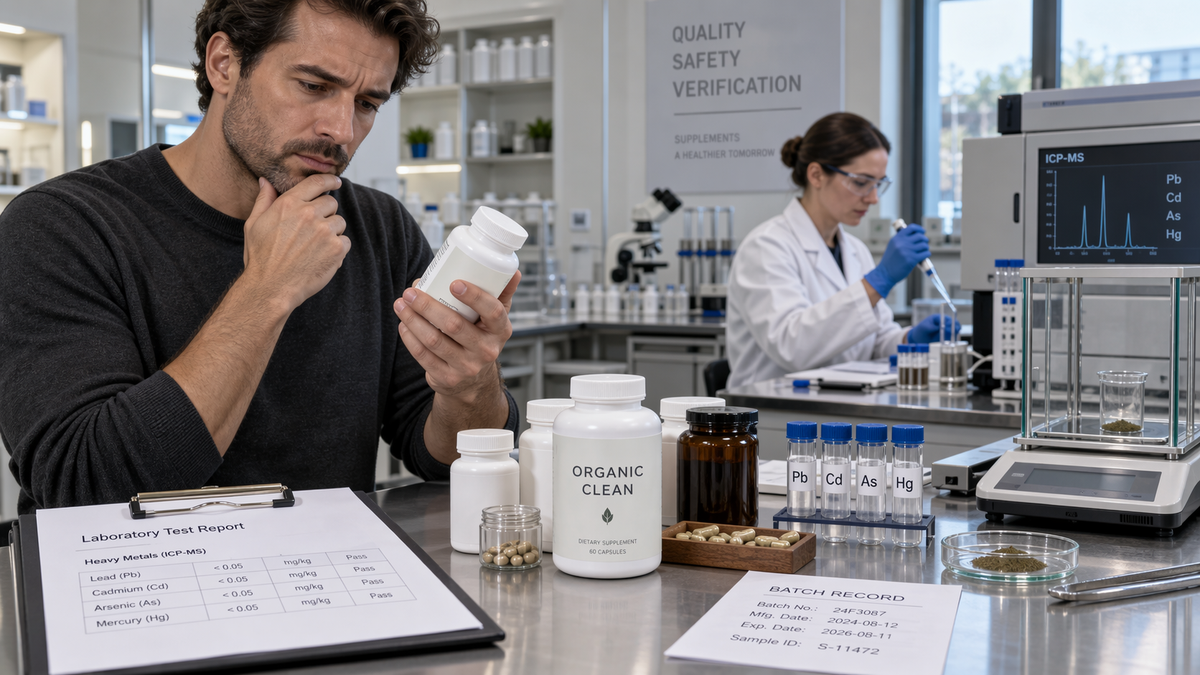
The testing lab needs to be a genuinely independent entity, not an internal quality control operation under a different name, and ideally carries accreditation to ISO/IEC 17025, the internationally recognized standard for laboratory competence, granted by a recognized accrediting body such as A2LA or PJLA in the US. The testing needs to cover the right categories: heavy metal safety, microbial safety, and potency, verifying the product actually contains what the label claims, are three separate analyses, and a brand that's only run one of them can still truthfully claim to be "tested" while leaving meaningful gaps. The documentation needs to be batch-specific, referencing an actual lot number that corresponds to the product currently on the shelf, rather than a single historical certificate published once and left unchanged regardless of which batch is actually being sold.
It's also worth understanding what Good Manufacturing Practice certification does and doesn't cover, since it gets conflated with product testing constantly. GMP certification evaluates a facility's processes, documentation, and manufacturing controls. It does not require testing the finished product for contaminants or verifying label accuracy on every batch, which means a GMP-certified facility can still produce an underdosed or contaminated product without that certification being affected at all. Beyond organic certification and generic third-party claims, a small number of more rigorous, finished-product-focused certifications exist and are worth specifically looking for: USP Verified, widely regarded as the most comprehensive general-purpose mark available for a consumer supplement, testing contents against label claims, screening for contaminants at set limits, and confirming proper manufacturing, and NSF Certified, which covers similar ground through its own accreditation and audit process.
Where the documented contamination risk actually concentrates
This is worth covering specifically, because the risk in this category isn't evenly distributed, and knowing where it concentrates makes evaluating any specific product considerably more efficient.
A pair of studies led by Robert Saper and colleagues at Harvard Medical School, published in JAMA in 2004 and again in 2008, tested Ayurvedic herbal medicine products specifically, finding that roughly 20 percent contained detectable lead, mercury, or arsenic at levels exceeding regulatory daily intake standards. The 2008 study additionally found that rasa shastra preparations, a traditional practice of deliberately combining herbs with metals, carried more than double the contamination rate of herbal-only preparations, 40 percent compared to 17 percent. This research is specifically about Ayurvedic products, not dietary supplements generally, and it's worth being precise about that scope rather than overgeneralizing it. What it does establish clearly is that specific categories of herbal and botanical supplements carry documented, elevated contamination risk tied to how those particular ingredients are sourced and traditionally processed.
More broadly, botanical ingredients that are efficient at drawing minerals, including toxic ones, from the soil they grow in, turmeric, ashwagandha, kelp, and green tea among commonly cited examples, carry a documented tendency toward elevated heavy metal content regardless of organic status, since this reflects plant biology rather than farming practice. This is exactly why heavy metal testing matters more, not less, for supplements built around these specific ingredients, and it's a reasonable place to apply extra scrutiny regardless of how clean or reputable a brand's overall positioning appears.
A consolidated checklist
Pulling all of this together into what's actually worth checking, in order of how much it protects you.
Ask whether independent heavy metal testing exists, with specific numeric results for lead, arsenic, cadmium, and mercury against a stated limit, tied to a batch number that matches the product in front of you. This is the single most important verification available, and it's the one most likely to be missing even from products that otherwise present themselves as rigorously tested.
Verify any organic certification through USDA's public Organic Integrity Database rather than assuming the word on the label is backed by a real certificate. If "grass-fed" or "regenerative" appear, look specifically for a named third-party seal, American Grassfed Association, Certified Grassfed by AGW, or Regenerative Organic Certified, since the bare words alone carry little to no independent verification behind them.
Check for a genuine finished-product certification beyond organic, USP Verified or NSF Certified being the most meaningful options currently available, and understand that GMP certification alone doesn't cover this ground.
If the product includes botanical or herbal ingredients specifically, apply extra scrutiny to heavy metal testing given the documented risk concentration in this category, and don't assume organic status substitutes for that testing.
And throughout all of this, remember the foundational fact this entire guide started with: nothing about a supplement's presence on a shelf means anyone has independently verified its contents before you bought it. That verification, when it exists at all, comes from exactly the specific certifications and testing documentation described above, not from the absence of an FDA warning, which simply reflects how this category is regulated rather than anything specific about the product itself.
The honest bottom line
"Clean" and "organic" and "third-party tested" are words, not verifications, until they're backed by something specific and checkable. USDA Organic certification is real and rigorous for what it covers, agricultural production methods, and doesn't extend to contamination testing on the finished product. Grass-fed and regenerative, absent a specific named seal, carry meaningfully less independent verification than most shoppers assume. Real third-party testing means an accredited, genuinely independent lab, covering safety and potency separately, tied to the specific batch you're holding. And the documented contamination risk in this category concentrates specifically around certain botanical ingredients and traditional herbal preparation categories, which deserve more scrutiny, not less, regardless of how clean a brand's overall presentation looks.
None of this requires distrust as a default position. It requires knowing which specific questions actually separate a genuinely well-verified product from one that simply uses the right words, and asking them, of any brand, including this one.