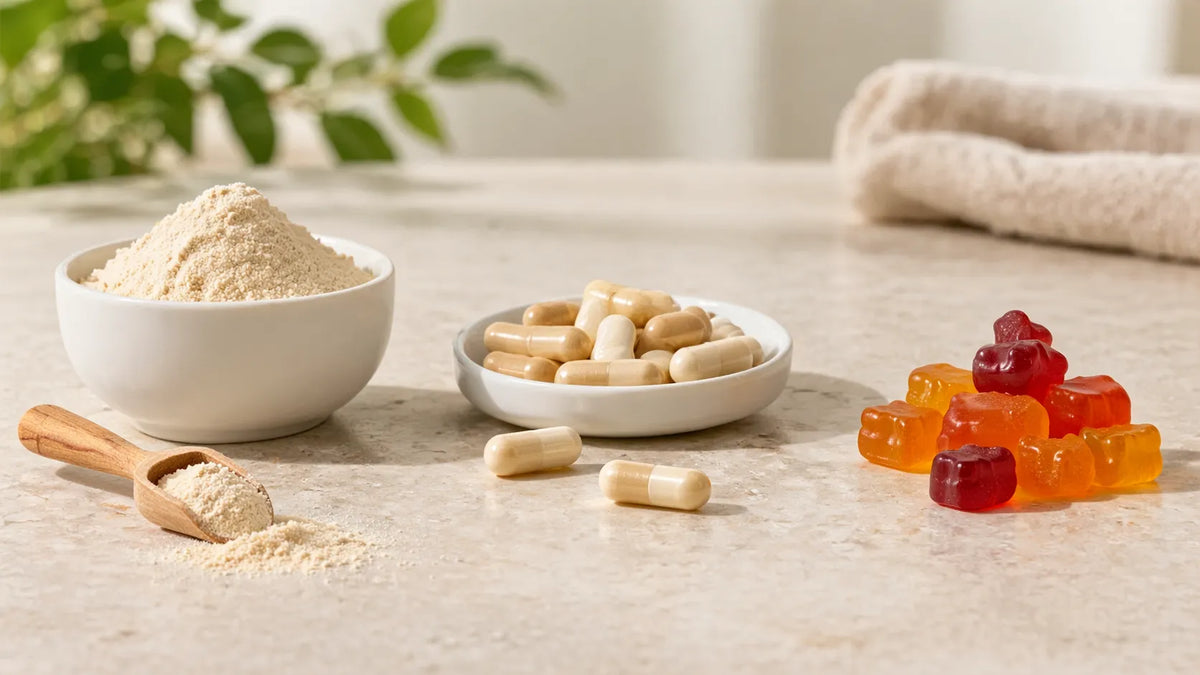
Powder vs. Capsule vs. Gummy: Does Format Change Anything?
The same supplement often comes in three or four forms. You can buy magnesium as a powder, a capsule, or a gummy. Vitamin D comes as tablets, softgels, drops, and gummies. Even creatine, traditionally a plain white powder, now shows up in capsules and chewables.
It's natural to wonder whether the format makes a difference. Is a gummy as good as a capsule? Does a powder absorb faster? Are capsules "cleaner"? Marketing will happily give you an answer for each, usually whichever format the brand happens to sell.
The honest answer is more interesting. For some questions, format barely matters. For others, it matters a lot, but not always for the reasons you'd expect. The biggest differences tend to be practical: how much of an ingredient can physically fit in one serving, what else has to be added to make the format work, how accurate the label is, and whether you'll actually take it consistently.
This post goes through each format, what the research says about absorption, and where the real trade-offs are. A disclosure first: we sell powders (protein, creatine, and electrolytes), capsules (our magnesium), and a resin (shilajit). We don't sell any gummies. So we have no stake in the gummy side of this, though we do have one in powders and capsules.
First, what "format" actually changes
A supplement's format is the vehicle that delivers the active ingredient. Changing the vehicle can affect five things:
-
Dose capacity: how much of the ingredient fits in one serving.
-
Other ingredients: what has to be added to hold the format together, such as sugars, gelling agents, or flow agents.
-
Absorption: how much of the ingredient gets into your bloodstream, and how fast.
-
Accuracy and stability: whether the amount on the label is what's in the product, and whether it stays that way over time.
-
Adherence: whether you'll actually keep taking it.
Absorption gets most of the attention, but for many supplements the other four matter more. We'll come back to each.
One regulatory point applies to every format. According to the FDA, under the Dietary Supplement Health and Education Act (DSHEA), the agency does not have the authority to approve dietary supplements before they're marketed. Manufacturers are responsible for making sure their products aren't adulterated or misbranded, and they must follow current good manufacturing practices. That's true whether the product is a powder, capsule, gummy, softgel, or liquid. Format doesn't change who's responsible for what's in the bottle.
Powders
What they're good at
Powders are the only practical format for supplements taken in gram amounts. Protein is the obvious example. Studies and position stands typically discuss protein in servings of 20 to 40 grams, and no capsule or gummy can deliver that. Creatine is another. The International Society of Sports Nutrition's 2017 position stand (Kreider and colleagues) describes a standard dose of 3 to 5 grams a day, which is easy to take as one scoop of powder.
Powders also let you adjust the dose. You can take half a scoop or a scoop and a half, which is harder with a fixed-dose capsule. And because they're dissolved or mixed into liquid, they suit people who don't like swallowing pills.
Their trade-offs
Powders depend on the scoop. A scoop measures volume, not weight, so how tightly the powder is packed, how much it settles, and how you fill the scoop can all shift the amount slightly. For most supplements that variation doesn't matter. If you need precision, a small kitchen scale removes the guesswork.
Taste and mixing are the other issues. Unflavored powders can taste chalky or bitter. Flavored ones need sweeteners and flavorings, which add ingredients. Some powders, protein blends in particular, don't dissolve completely. That's normal, but it can be off-putting.
Powders also take more effort. You have to measure and mix them, which is less convenient when traveling or at work. That's why single-serving stick packs exist: the same powder, pre-measured.
Capsules and tablets
What they're good at
Capsules and tablets deliver a fixed, pre-measured dose with no taste and no mixing. For ingredients taken in milligram or microgram amounts, such as vitamin D, many minerals, and herbal extracts, they're often the simplest option.
Capsules come in two main shell types. Gelatin capsules are made from animal collagen; ours, for example, use beef gelatin. Plant-based capsules are usually made from a cellulose derivative called HPMC (hydroxypropyl methylcellulose). Both are designed to dissolve in the stomach. Some people choose one or the other for dietary or ethical reasons.
There's also a quality standard for how well capsules and tablets break down. The United States Pharmacopeia (USP) publishes a general chapter, <2040>, that sets disintegration and dissolution tests for dietary supplements. A product tested to that standard has been checked to make sure it actually breaks apart in conditions that mimic digestion. Not every product is tested this way, but it's a useful thing to look for on a label or a certificate of analysis.
Their trade-offs
The main limit is capacity. A capsule can only hold so much powder, typically well under a gram. That's fine for vitamin D, but it becomes a problem for larger doses. A 5-gram dose of creatine, for example, would take several large capsules. Magnesium is a middle case: reaching a meaningful dose of elemental magnesium can take two or more capsules, depending on the form used.
Swallowing is the other big one, and it's more common than most people assume. A study by Schiele and colleagues (European Journal of Clinical Pharmacology, 2013, volume 69, issue 4, pages 937 to 948) surveyed 1,051 patients in 11 general practices. It found:
-
Overall: 37.4 percent reported difficulty swallowing tablets and capsules.
-
Frequent difficulty: about one in 11 had frequent difficulty.
-
Changing their medication: of those with difficulties, 58.8 percent had already modified their medication, for example by crushing or splitting it, in ways that could alter its safety or effectiveness.
-
Who was affected: difficulties were more common in women and younger people.
The authors noted that doctors grossly underestimated these problems. If you find pills hard to swallow, a different format isn't a compromise. It may be the format you'll actually take.
Capsules and tablets also need some extra ingredients to work. Tablets need binders to hold them together. Capsule powders often need flow agents so the machinery can fill them evenly. These are usually present in small amounts, and they'll be listed under "other ingredients." Read that line if you want to know exactly what you're taking.
Gummies
What they're good at
Gummies are easy to take and pleasant to eat, and for many people that's the whole point. For anyone who struggles with pills, or who simply forgets to take supplements they don't enjoy, a gummy can be the difference between taking something and not.
Gummies can also deliver some vitamins well. A 2019 study by Wagner and colleagues (Nutrients, 2019, volume 11, issue 5, article 1023) compared a single 20,000 IU dose of vitamin D3 given as gummies or as tablets in healthy adults aged 18 to 45, using a crossover design. In the main study of 31 people, the gummies produced substantially higher blood levels of vitamin D3:
|
Measure |
Gummies |
Tablets |
|
Total exposure (AUC) |
1,474 ng·h/mL |
774 ng·h/mL |
|
Peak level |
47.3 ng/mL |
23.4 ng/mL |
That's a striking result, and it's worth being careful about what it shows. It compared one specific gummy with one specific tablet. A poorly dissolving tablet and a well-made gummy would produce exactly this kind of gap, so the result says as much about those two products as about the formats in general. It measured vitamin D3 in the blood over 48 hours after a single large dose, not long-term vitamin D status. And it's one study. It's a good reason not to dismiss gummies out of hand. It isn't proof that gummies are better for every nutrient.
Their trade-offs
Gummies have three real limitations.
Capacity. A gummy is small, and most of it is the gummy itself: sugars or sugar alcohols, gelling agents like gelatin or pectin, flavor, and color. That leaves limited room for the active ingredient. Ingredients needed in larger amounts, like creatine, protein, or meaningful doses of some minerals, are hard to fit, which can mean many gummies per day. We'll look at creatine specifically in a separate post.
Added sugar and other ingredients. Many gummies contain added sugar. Others use sugar alcohols, which can cause digestive upset in some people when eaten in larger amounts. It's worth checking the label for added sugars per serving, especially if you take several gummy supplements a day.
Accuracy. Gummies are harder to manufacture precisely than powders or capsules, and the clearest data on this comes from melatonin. A 2023 study by Cohen and colleagues in JAMA tested 25 melatonin gummy products sold in the US. It found:
-
Mislabeled: 22 of the 25 (88 percent) were inaccurately labeled.
-
Accurate: only 3 contained within 10 percent of the declared amount.
-
Range: actual melatonin content ran from 74 percent to 347 percent of the labeled quantity.
That doesn't mean every gummy is inaccurate. It does show that gummy manufacturing leaves real room for error, and that independent testing matters more for this format, not less.
A safety note: gummies look like candy
Because gummies taste and look like sweets, they carry a specific risk in homes with children. A CDC report (Lelak and colleagues, Morbidity and Mortality Weekly Report, 2022, volume 71, pages 725 to 729) tracked melatonin ingestions among people aged 19 and under reported to US poison centers. It found:
-
Total reports: 260,435 ingestions between 2012 and 2021.
-
Rise: a 530 percent increase in annual reports over that period.
-
Serious outcomes: 4,097 children were hospitalized.
The report called for safe storage and suggested child-resistant packaging be considered. Melatonin is just one example. Any supplement that looks like candy should be stored like a medicine.
Softgels and liquids, briefly
Softgels and liquid drops are common for fat-soluble nutrients like vitamins D and K, which are often dissolved in oil. That reflects how these nutrients behave. They dissolve in fat, not water.
But the fat in your meal may matter as much as the fat in the capsule. A study by Dawson-Hughes and colleagues in the Journal of the Academy of Nutrition and Dietetics gave 50 healthy older adults a single 50,000 IU dose of vitamin D3 with either a fat-free meal or a meal with 30 percent of its calories from fat. Peak blood vitamin D3 was 32 percent higher when the dose was taken with the fat-containing meal.
So for fat-soluble vitamins, taking them with a meal that contains some fat is a simple, evidence-based habit. It probably matters more than whether the vitamin comes in a softgel or a tablet.
So does format change absorption?
Pulling the evidence together, here's the honest picture.
For some nutrients, formulation clearly affects absorption. The vitamin D gummy study shows that two products with the same labeled dose can produce very different blood levels. But the key word is formulation, not format. A well-made tablet and a poorly made gummy could reverse that result.
Taking supplements with food can matter as much as format. For fat-soluble vitamins, taking them with a fat-containing meal raised peak vitamin D3 by about a third.
For many supplements, format mainly affects practicality, not absorption. Creatine is a good example. What matters for creatine is reaching and maintaining muscle saturation with a daily dose, as covered in the ISSN position stand. A powder is simply the easiest way to get 3 to 5 grams consistently.
The biggest differences between formats are usually the practical ones: dose capacity, added ingredients, label accuracy, and whether you'll take it.
Side by side
Best for
-
Powder: gram-sized doses like protein, creatine, and electrolytes.
-
Capsule or tablet: milligram and microgram doses like vitamins, minerals, and extracts.
-
Gummy: people who won't or can't take pills, and low-dose nutrients.
Dose capacity
-
Powder: high.
-
Capsule or tablet: limited, usually well under a gram each.
-
Gummy: low, because much of each gummy is the gummy itself.
Added ingredients
-
Powder: few if unflavored. Flavorings and sweeteners if flavored.
-
Capsule or tablet: the capsule shell, plus binders or flow agents.
-
Gummy: sugars or sugar alcohols, gelling agents, flavors, and colors.
Dose precision
-
Powder: depends on the scoop. A scale helps.
-
Capsule or tablet: pre-measured.
-
Gummy: pre-measured, but manufacturing accuracy can vary.
Swallowing
-
Powder: not needed.
-
Capsule or tablet: a problem for many people. 37.4 percent in one survey.
-
Gummy: chewed.
Convenience
-
Powder: needs mixing. Stick packs help.
-
Capsule or tablet: very convenient.
-
Gummy: very convenient.
Specific cautions
-
Powder: taste and mixing.
-
Capsule or tablet: pill fatigue and swallowing.
-
Gummy: sugar, accuracy, and appeal to children.
How to choose
Rather than picking a favorite format, choose the right one for each supplement.
Start with the dose. If you need grams of something, powder is the practical choice. If you need milligrams or micrograms, capsules, tablets, or gummies can all work.
Then think about adherence. The most effective supplement is one you actually take. If you struggle with pills, choose a powder, liquid, or gummy. If you hate mixing drinks, choose capsules.
Read the "other ingredients" line. Every format adds something. Decide whether you're comfortable with what's added, whether that's sugar in a gummy, sweeteners in a flavored powder, or flow agents in a capsule.
Look for testing, especially for gummies. Given the accuracy issues documented for melatonin gummies, third-party testing matters for every format, and most of all for gummies. Look for batch-specific results, not just a logo.
Take fat-soluble vitamins with a meal. Whatever the format, vitamins D, E, K, and A are better absorbed with some dietary fat.
Store anything that looks like candy out of reach. Gummy supplements should be kept away from children, like medicine.
Where our own products sit
Since we sell several formats, here's why each of ours is the format it is.
-
Powders: our protein, creatine, and electrolytes are powders because their useful doses are measured in grams. No capsule or gummy could deliver them practically. Our electrolytes also come in stick packs for convenience.
-
Capsules: our magnesium is in beef-gelatin capsules because its dose is measured in milligrams, and a capsule delivers it without taste or mixing.
-
Resin: our shilajit is a resin because that's its natural form. A small amount is dissolved in warm water or taken directly.
None of these choices makes our products absorb "better" than a well-made alternative in another format. They're the formats that make the most practical sense for the dose of each ingredient. That's the honest reason, and it's the same logic we'd suggest you use when choosing any supplement.
The honest summary
Format matters, just usually not in the way marketing suggests.
The clearest differences are practical. Powders are the only realistic way to take gram-sized doses like protein and creatine. Capsules deliver small, precise doses without taste, but more than a third of people in one large survey reported trouble swallowing pills. Gummies are easy to take but hold less, often add sugar, and have documented accuracy problems: in one study, 22 of 25 melatonin gummy products were mislabeled.
On absorption, formulation can matter a lot. One study found a vitamin D3 gummy produced roughly double the blood levels of a vitamin D3 tablet, though that reflects those specific products as much as the formats. Taking fat-soluble vitamins with a fat-containing meal raised peak vitamin D3 by about a third, which may matter more than the format itself.
So choose the format that fits the dose, check what else is in it, look for real testing, and pick the one you'll actually take every day. That last point probably matters more than any of the others.
References
-
US Food and Drug Administration. Questions and Answers on Dietary Supplements.
-
Kreider RB, Kalman DS, Antonio J, et al. International Society of Sports Nutrition position stand: safety and efficacy of creatine supplementation in exercise, sport, and medicine. Journal of the International Society of Sports Nutrition. 2017;14:18.
-
United States Pharmacopeia. General Chapter <2040> Disintegration and Dissolution of Dietary Supplements.
-
Schiele JT, Quinzler R, Klimm HD, Pruszydlo MG, Haefeli WE. Difficulties swallowing solid oral dosage forms in a general practice population: prevalence, causes, and relationship to dosage forms. European Journal of Clinical Pharmacology. 2013;69(4):937-948. doi:10.1007/s00228-012-1417-0
-
Wagner CL, Shary JR, Nietert PJ, Wahlquist AE, Ebeling MD, Hollis BW. Bioequivalence studies of vitamin D gummies and tablets in healthy adults: results of a cross-over study. Nutrients. 2019;11(5):1023. doi:10.3390/nu11051023
-
Cohen PA, Avula B, Wang YH, Katragunta K, Khan I. Quantity of melatonin and CBD in melatonin gummies sold in the US. JAMA. 2023;329(16):1401-1402.
-
Lelak K, Vohra V, Neuman MI, Toce MS, Sethuraman U. Pediatric melatonin ingestions: United States, 2012–2021. Morbidity and Mortality Weekly Report. 2022;71(22):725-729. doi:10.15585/mmwr.mm7122a1
-
Dawson-Hughes B, Harris SS, Lichtenstein AH, Dolnikowski G, Palermo NJ, Rasmussen H. Dietary fat increases vitamin D-3 absorption. Journal of the Academy of Nutrition and Dietetics. 2015;115(2):225-230.
These statements have not been evaluated by the Food and Drug Administration. This product is not intended to diagnose, treat, cure, or prevent any disease.