The honest answer is: it depends far more on where your shilajit came from and how it was processed than on anything inherent to shilajit itself. That's not a hedge, it's the actual finding that emerges once you look past the marketing and into the safety literature, which splits cleanly into two very different stories. One is about shilajit as a substance, tested in a controlled setting, which looks reasonably favorable. The other is about the broader category of traditional Indian herbal products shilajit belongs to, which has a well-documented and serious contamination problem that anyone taking this daily should understand clearly.
This post covers both, with the actual studies behind each claim, so you can evaluate the real risk rather than either brand reassurance or alarmist headlines.
What the controlled human research actually shows
The most relevant human safety data comes from the same trial most commonly cited for shilajit's other effects. Pandit and colleagues, in a study published in Andrologia in 2016, gave 45 healthy men aged 45 to 55 either 250 milligrams of purified shilajit twice daily or a placebo for 90 days, in a randomized, double-blind, placebo-controlled design. Alongside the hormonal outcomes the study is usually cited for, the trial monitored safety throughout, and no serious adverse effects were reported in the treatment group over that period.
This is genuinely useful information, and it's worth being precise about what it does and doesn't establish. It tells you that purified shilajit, at 500 milligrams daily, was well tolerated by a specific population, healthy middle-aged men, over a specific and fairly short window, three months. It doesn't tell you what happens with daily use over one year, five years, or a lifetime, because that research doesn't exist yet in a controlled format. This is a common and important limitation across supplement research generally, not something specific to shilajit, but it's worth naming directly rather than letting "the research says it's safe" imply more duration than any study has actually covered.
Beyond the Pandit trial, other smaller studies looking at shilajit for fatigue and general vitality markers have similarly reported good tolerability over their study periods, typically a few weeks to a few months, without significant reported adverse events in the treatment groups. The consistent pattern across the controlled research: shilajit itself, when purified and properly sourced, has not shown meaningful safety signals in the trials that have been run. The honest caveat is that those trials are shorter than "every day" implies for most people considering long-term use.
The real safety issue, and it isn't shilajit's chemistry
Here's where the conversation needs to shift, because the most substantiated safety concern in this category has almost nothing to do with shilajit's own properties and everything to do with contamination and quality control across the broader category of traditional herbal products it's sold within.
In 2004, Robert Saper and colleagues at Harvard Medical School published a study in JAMA titled "Heavy Metal Content of Ayurvedic Herbal Medicine Products." They tested 70 Ayurvedic herbal products purchased from stores in the Boston area and found that 14 of them, 20 percent, contained detectable lead, mercury, or arsenic at concentrations that, taken as directed, would exceed regulatory daily intake standards. The lead concentrations found ranged as high as 37,000 micrograms per gram in the most contaminated products.
Saper's team followed up in 2008 with a larger study in the same journal, this time testing 193 Ayurvedic products purchased online from both US and Indian manufacturers. The finding was consistent: 20.7 percent contained detectable lead, mercury, or arsenic. An important detail from that study is worth understanding, because it changes how the risk applies to shilajit specifically. Ayurvedic products fall into two broad categories: herbal-only preparations, and rasa shastra preparations, a traditional practice of deliberately combining herbs with metals like lead, mercury, and gold based on the belief that this combination confers therapeutic benefit. Rasa shastra products were more than twice as likely to contain detectable metals as herbal-only products, 40 percent compared to 17 percent. Shilajit, as a mineral-rich resin taken on its own rather than intentionally combined with added metals, falls into the lower-risk herbal-only category by nature, though 17 percent is still a meaningful contamination rate, not a negligible one.
This isn't a theoretical concern raised only by researchers. The FDA maintains an active public warning about heavy metal poisoning associated with unapproved Ayurvedic drug products, and the medical literature contains numerous individual case reports of confirmed heavy metal toxicity traced to Ayurvedic product use, including cases in both children and adults with blood lead levels dramatically above safe reference ranges, some requiring chelation therapy to treat. These are real, published, peer-reviewed case reports, not anecdotes.
Shilajit specifically has also been directly tested. An academic analysis of shilajit samples collected from Gilgit and Chellas in Pakistan, regions where shilajit is commonly sourced and sold, found detectable iron, zinc, chromium, manganese, cobalt, and lead in the tested material. Some of these, iron, zinc, manganese, and cobalt, are trace minerals genuinely present in authentic shilajit as part of its natural composition, and their presence at reasonable levels isn't itself a safety problem. Lead is a different category entirely, a contaminant with no beneficial role and a well-established toxicity profile at elevated exposure.
What this actually means for daily use
Put together, the picture is this: shilajit as a chemical entity, properly purified and free of contamination, has not shown concerning safety signals in the controlled research that exists. The real risk in taking shilajit daily is the same risk that runs through this entire category of unregulated, variably sourced traditional herbal products, that a meaningful share of what's actually sold doesn't match that description.
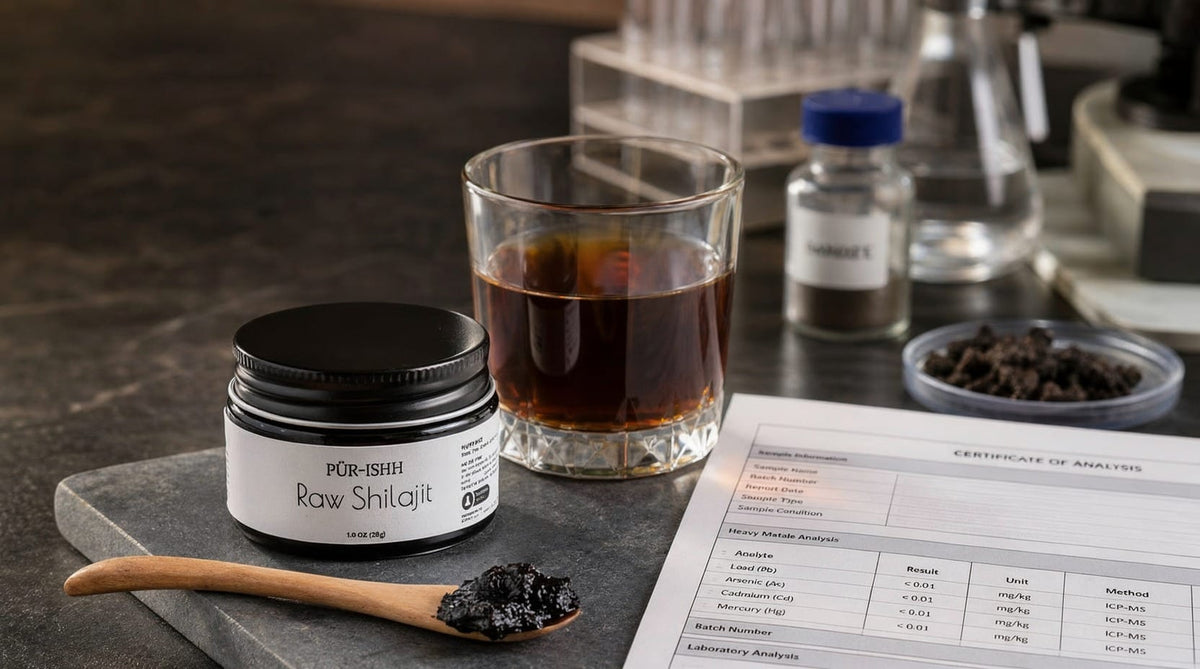
This is why purification and independent testing matter so much more for this specific ingredient than for most things in a typical supplement routine. A product's Certificate of Analysis showing tested, verified levels of lead, arsenic, cadmium, and mercury against defined safety limits isn't a formality here. Given what the Saper research found across this product category broadly, it's the single most important piece of information standing between a genuinely low-risk daily supplement and a genuinely risky one, and it's not something you can assess by looking at the resin itself, tasting it, or trusting a brand's general assurances.
Who should be more cautious, or talk to a doctor first
A few specific situations are worth flagging directly, separate from the contamination question, because they relate to shilajit's actual composition rather than to sourcing risk.
Shilajit contains meaningful iron content as part of its natural mineral profile. For most people, this isn't a concern and may even be a modest nutritional contribution. For people with hereditary hemochromatosis or other iron overload conditions, where the body already accumulates excess iron, adding a daily iron-containing supplement is generally something to discuss with a physician first, following the same logic that applies to any iron-containing product for someone managing that specific condition.
Pregnancy and breastfeeding are situations where the standard, conservative recommendation applies: shilajit hasn't been studied in pregnant or breastfeeding populations in controlled trials, and in the absence of that safety data, the reasonable default is to avoid it or discuss it with an obstetric provider first, the same guidance that applies to most supplements without dedicated safety research in these populations.
Shilajit's proposed effects on insulin sensitivity and hormonal markers, while generally framed positively in the research discussed elsewhere in our content, are exactly the kind of physiological activity that's worth flagging to a doctor if you're on medications for diabetes, blood thinners, or hormone-related therapies. This isn't because there's documented evidence of a dangerous interaction, there isn't specific research on this, but because a compound with plausible effects on these systems deserves that conversation before being added to a daily routine alongside prescription medications managing the same systems.
What "purified" actually needs to mean
Given that contamination, not the substance itself, is the dominant safety issue here, it's worth being specific about what separates a genuinely low-risk product from a risky one.
Authentic, properly processed shilajit goes through purification specifically designed to remove or reduce contaminants and free-radical-generating compounds from the raw resin before it's sold. This isn't the same as the belief embedded in some traditional rasa shastra preparation methods, that a specific preparation process converts toxic metals into a non-toxic or even beneficial form, a claim that researchers including Saper's own team have specifically pushed back on given the documented toxicity cases that continue regardless of traditional preparation claims. For a plain mineral resin like shilajit, the safety case rests on removing contamination, not transforming it.
What this looks like in an actual Certificate of Analysis: specific, numeric results for lead, arsenic, cadmium, and mercury, each measured against a defined permissible limit, on the actual batch you're buying rather than a generic claim. A fulvic acid percentage in the range associated with genuine, well-processed material, generally in the 60 to 80 percent range, is also a reasonable quality signal, since heavily diluted or adulterated products tend to test well below that range. Radionuclide screening is relevant specifically if the material is sourced from certain regions with documented historical radioactive contamination concerns, worth asking about depending on origin.
The honest bottom line
Is shilajit safe to take every day? For a product that's been independently tested, batch by batch, and confirmed free of heavy metal contamination at levels within established safety limits, the available research on shilajit itself, while limited to shorter trial durations than "daily, indefinitely" technically implies, hasn't shown safety concerns. For a product without that testing, the honest answer changes considerably, because the documented risk in this category isn't hypothetical. Roughly one in five Ayurvedic herbal products tested in the two most rigorous studies on this question contained detectable heavy metals at levels exceeding safety standards, and shilajit's own direct testing has confirmed the same contamination risk is real for this specific material.
This isn't a reason to avoid shilajit. It's a reason to treat the sourcing and testing question as the actual safety question, rather than asking whether shilajit as a concept is safe, which is a different and less useful question than the one that actually determines your risk. Ask for the specific batch's heavy metal results before you ask anything else. That single piece of paperwork tells you more about whether daily use is a reasonable choice for you than anything else available.