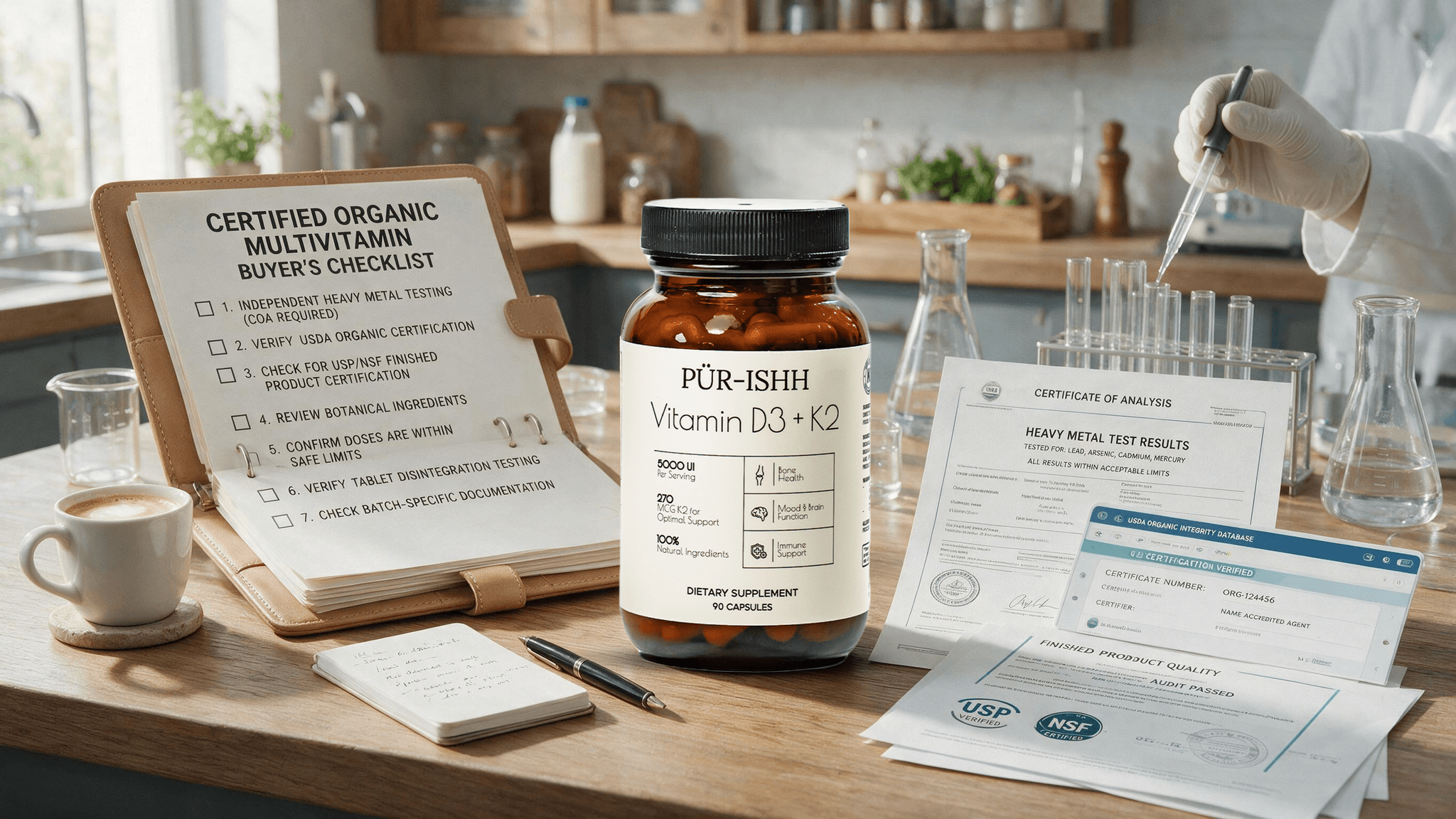
Here's the fact that changes everything about how most people shop for a certified organic multivitamin: the USDA Organic seal does not require any testing for heavy metal contamination. Not for lead. Not for arsenic, cadmium, or mercury. Not at any point in the certification process, at any level of the standard. You can hold a certified organic multivitamin and have no idea whether it passed any kind of safety test at all, because organic certification was never built to answer that question.
This isn't a loophole or a technicality. It's a structural feature of what organic certification actually is, which is a production-method standard. It governs how ingredients were grown or raised, what inputs went into the soil, what the livestock were fed. It doesn't follow the ingredient into the processing facility, the extraction equipment, the encapsulation line, or the finished bottle. And for a product as complex as a multivitamin, which might contain fifteen to thirty separate ingredients each with their own sourcing chain, that gap between "how this was grown" and "what's actually in this capsule" is the gap that matters most.
The good news is there are real, concrete things to check that tell you far more than the organic label does. Here's the checklist, ordered by what actually protects you.
First: understand what's actually going wrong out there
Before the checklist, it's worth knowing what problems independent testing has actually documented, because "supplement quality issues" sounds abstract until you see what it looks like in practice.
ConsumerLab, an independent supplement testing service that buys products off shelves the way an ordinary customer would, has found multivitamins containing as little as 12 percent of their labeled vitamin A. Other products have come back with four times their labeled folate and zinc, or double their labeled vitamin D, not because the company is trying to mislead anyone, but because manufacturing a product this complex to exact specifications is genuinely difficult and isn't federally required to be verified before anything ships. Some tested products exceeded Tolerable Upper Intake Levels for niacin or zinc, the threshold above which the risk of adverse effects starts climbing. A few came back with detectable lead, in at least one documented case at a level more than ten times the threshold California requires a warning label for.
There's also a failure mode most people have never considered: tablet disintegration. A tablet that doesn't actually break apart in your digestive system in a reasonable timeframe can pass through you largely intact, meaning however precisely it was dosed, none of it ever becomes available to your body. You'd never know from looking at the bottle.
None of this is rare. Across one round of ConsumerLab testing, roughly a third of products failed to meet their own quality standards. And none of these failures have anything to do with whether the ingredients were grown organically.
On heavy metals specifically: ConsumerLab has found that organic products don't consistently test lower than conventional ones for contamination. In some categories, notably cocoa-based products, organic versions have come back with higher cadmium levels than conventional, likely because of the soil conditions in specific growing regions rather than anything related to farming method. Botanical ingredients that commonly appear in enhanced multivitamin formulas, turmeric root, ashwagandha root, kelp, green tea leaf, tend to accumulate heavy metals from soil regardless of how the crop was grown, because that's a function of plant biology, not farming practice.
The FDA has not established a legal limit on heavy metals in dietary supplements, leaving that decision to individual manufacturers. California is the one state with its own warning-label requirement, which is why the same product can have different disclosure requirements depending on where it's sold, a disparity that says something meaningful about how uneven this landscape actually is.
The checklist, in order of what actually matters
One. Ask whether the product has been independently tested for heavy metals, and ask for the document.
This is the single most important question on this list. A real answer looks like a Certificate of Analysis showing specific, numeric results for lead, arsenic, cadmium, and mercury against a stated limit, tied to a specific batch or lot number. Not a "we test all our products" badge, not a general quality statement, not a press release. An actual document with actual numbers from a lab that isn't the same company selling you the product.
If a brand can't produce this on request, that's the whole answer right there, regardless of whatever else the label says. The specificity is the signal. Brands with real testing can usually produce the document quickly and without hedging, because there's nothing to hedge around.
Two. Verify any organic certification rather than assuming it.
A genuine USDA Organic certification is traceable to a named, accredited certifying agent and checkable through USDA's public Organic Integrity Database. You can search by company name and confirm the certification is active, not expired or revoked, and covers the actual products being sold.
If "organic" appears on a label with no certifying body named, no way to look it up, and no certificate number anywhere, that's the casual marketing use of the word rather than the certified, legal one. These are genuinely different claims, and treating them as equivalent is exactly what brands relying on vague organic language are counting on you to do.
Also worth knowing: there are three certification tiers with meaningfully different requirements. "100% Organic" means every ingredient qualifies. "Organic" means at least 95 percent. "Made With Organic Ingredients" means only 70 percent, so up to 30 percent of the formula could be entirely conventional and the product still qualifies for that specific phrasing, which sounds close to organic in casual reading but describes something considerably less so.
Three. Look for an additional quality certification that addresses finished-product contents.
Organic certification is a farm-level standard. What you also want is something that addresses the finished product in the bottle. USP Verified is the most rigorous general-purpose mark for a consumer supplement: it specifically confirms that a product contains what its label claims, is free of specified contaminants, was manufactured properly, and disintegrates correctly. NSF Certified covers similar ground with its own audit process.
These aren't the same as organic certification and they don't conflict with it. The ideal is a product with both, where organic addresses the farming inputs and a finished-product certification addresses what actually ended up in the capsule. Most products that are genuinely rigorous carry at least one of these alongside their organic claim.
ConsumerLab is worth knowing about too, though it works differently. Rather than certifying brands, ConsumerLab buys products off shelves and publishes independent pass or fail results. Because brands can't influence or purchase favorable coverage, its reports function more like Consumer Reports for supplements than a certification. If a product has passed ConsumerLab testing, that's genuinely meaningful information.
Four. Look carefully at any botanical ingredients in the formula.
A basic multivitamin covering vitamins and minerals is one thing. A formula with added botanicals, turmeric, ashwagandha, spirulina, kelp, echinacea, green tea, is a different product from a contamination standpoint, because those specific plants are well-documented accumulators of heavy metals from soil regardless of organic status. Their presence isn't a reason to automatically avoid a product, but it is a reason to specifically confirm that heavy metal testing was done on the actual finished formula, not inferred from organic growing practices on the raw ingredients.
Five. Check whether doses push toward or past tolerable upper limits.
A multivitamin delivering several times the standard recommended intake of any given nutrient isn't automatically dangerous, but it's worth knowing whether that's a deliberate formulation choice explained somewhere in the brand's own materials, or simply what showed up when someone actually tested the product. Niacin, certain forms of vitamin A, zinc, and folate are the specific nutrients with established Tolerable Upper Intake Levels where chronic excess does carry documented risk. If a formula's doses look unusually high for any of these, it's worth understanding why rather than assuming more is automatically better.
Six. For tablets, ask whether disintegration has been tested.
This is the least glamorous check on the list and genuinely one of the most practically important. Capsules generally don't have this problem. Tablets vary, and a tablet that fails to break down properly within a reasonable timeframe means whatever it contains never actually reaches your bloodstream regardless of how well it was formulated.
Legitimate manufacturers know this and either test against a standard pharmacopeial method or choose encapsulation formats that sidestep the issue. If this isn't mentioned anywhere and you're looking at a tablet, it's a reasonable question to ask directly.
Seven. Confirm the document is batch-specific, not a one-time legacy test.
A Certificate of Analysis posted once on a website and never updated doesn't tell you what's in the batch you're currently buying. Ingredients and suppliers change, manufacturing conditions vary, and a clean result from a year and a half ago says nothing about what's in the jar in your hand right now.
Brands with real batch-level testing can point you to a current document with a lot number that matches what's on the product. This is worth confirming, and the difference between a brand that publishes ongoing batch records and one that posted a single document years ago is significant.
What a real answer looks like versus a vague one
If you ask a brand directly about heavy metal testing, you'll hear a range of responses. Some will point you immediately to a specific document with specific numbers. Others will respond with language that sounds confident but contains nothing checkable: "we hold our suppliers to the highest standards," "our products are manufactured in a GMP-certified facility," "our ingredients are carefully sourced."
GMP certification, for what it's worth, governs manufacturing processes and record-keeping. It's a real and meaningful standard for facility operations. It does not require testing the finished product for heavy metals or verifying that it contains what the label says. A GMP-certified facility producing an untested product is a real and common situation.
The distinction between a specific, documented answer and a confident, general one is the clearest signal available in this category. Confidence without a document behind it is just marketing.
Where the organic certification still earns its place
None of this is meant to talk you out of choosing organic ingredients in a multivitamin, and we want to be direct about that. If a product genuinely carries USDA Organic certification from a named, verifiable certifying body, that is a meaningful statement about the farming inputs that went into those ingredients: no synthetic pesticides or fertilizers, no GMOs, no routine antibiotics for livestock-sourced components. For people who specifically want to minimize pesticide exposure from their supplements, that matters, and the research supporting lower pesticide residues in certified organic produce is real.
The point isn't that organic certification is worthless. It's that it was built to answer one specific question, and the questions that matter most for a finished, manufactured supplement, what's actually in this capsule, how much of each thing, are questions it was never designed to answer. Both questions deserve real answers. Treating the first one as a substitute for the second is where people end up with a bottle that's honestly organic and quietly untested for the things that most directly affect their safety.
The honest bottom line
A certified organic multivitamin is making a real, verifiable, legally meaningful claim about production methods. It is not making a claim about heavy metal content, potency accuracy, or whether the tablet you're about to swallow will actually break down in your body. Those are separate claims, requiring separate kinds of testing, and a product that can back all of them with real documentation is something meaningfully different from one that can only back the first.
The checklist above is just the discipline of asking for all three kinds of assurance rather than one. Take a daily supplement seriously enough to know what's actually in it, not just how it was grown.