Creatine has a marketing problem, and it's not the kind you'd expect. It isn't expensive enough. It isn't rare enough. It doesn't have a discovery story involving a remote mountain range or a forgotten ancestral practice. It's a small molecule your own liver, kidneys, and pancreas already make, found naturally in red meat and fish, and it's been sitting on supplement shelves, mostly unchanged, since before a lot of you reading this were even buying supplements.
Which is exactly why we don't have to oversell it.
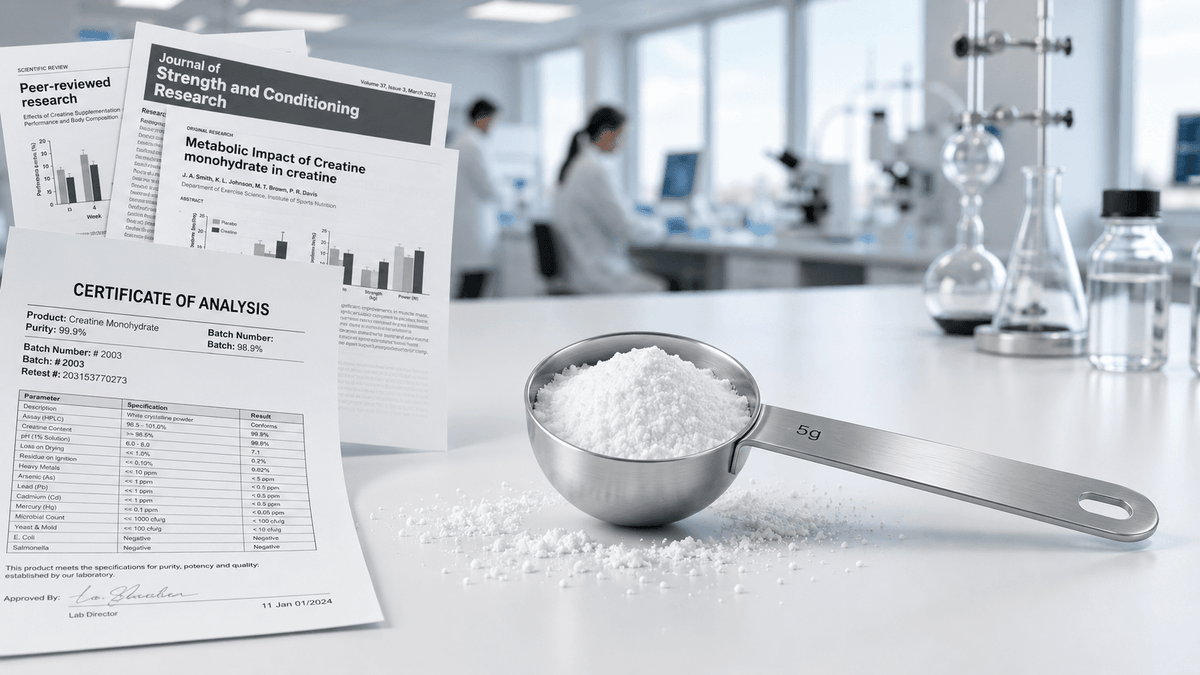
Creatine monohydrate is, without much competition, the most studied ingredient in our entire catalog, and one of the most studied ingredients in the supplement industry, period. More than three decades of research, going back to the early 1990s, have looked at what it does, how much you need, and what happens to people who take it for years at a time. That's not a claim we're making up to sound impressive. It's the reason creatine has survived every supplement trend cycle since grunge was popular, while plenty of louder, more expensive ingredients have quietly disappeared from the shelf next to it.
So this post isn't really a sales pitch. It's closer to a status report: here's what the research actually says, here's what's really in the tub, and here's the part that should matter most to you, the lab-verified numbers behind the batch we're currently shipping. No invented urgency, no countdown timer on a "limited drop." Just the same molecule, the same dose, checked the same way, every single time.
The least exciting supplement with the most evidence behind it
Here's the short version of how creatine ended up this thoroughly researched. Your muscles store a compound called phosphocreatine, which works as a kind of reserve battery for short, intense bursts of effort, the few seconds of output you need for a heavy lift, a sprint, a sudden hard push. Researchers figured out decades ago that taking creatine as a supplement increases how much of that reserve your muscles can hold, which means more available fuel for that specific kind of effort.
Interest exploded in the early 1990s, around the same time a handful of elite sprinters' creatine use became public knowledge after the 1992 Olympics. That kind of attention tends to produce two outcomes in sports science: a wave of marketing hype, and a wave of actual research trying to find out if the hype was justified. With creatine, the research won out. Exercise physiologists ran trial after trial through the rest of that decade, then into the 2000s, expanding from strength and power output into recovery, body composition, and longer-term safety data from people taking it continuously for months and years rather than just a few weeks for a study.
That's the part that separates creatine from most of what shows up on a supplement shelf with a research citation attached. A single promising study is easy to find for almost any ingredient. What's rare is decades of follow-up, in different populations, from different research groups, none of whom have any reason to agree with each other unless the underlying finding is actually solid.
Once that mechanism was understood, the research didn't stop. It kept going, into how much creatine actually changes strength and power output, how it affects recovery between sets and between sessions, what happens to lean mass over months and years of consistent use, and eventually into questions further from the gym entirely, like how creatine availability affects the brain's energy demands during sleep deprivation or mental fatigue. That last piece is newer and still developing, and we're not going to oversell it here, but it's part of why creatine keeps showing up in research that has nothing to do with athletic performance.
What you're left with, after three decades of that, is a remarkably boring safety and efficacy profile. Boring is underrated. In an industry full of ingredients riding a single small study and a good story, creatine has the opposite issue: it's been studied so many times, in so many populations, taken for so many years by so many people, that there's very little drama left to find. That's not a weakness. That's the whole point.
What it's actually doing in your muscles
Without turning this into a physiology lecture: your muscle cells use a molecule called ATP for energy, and ATP runs out fast during hard effort. Phosphocreatine is what helps regenerate ATP quickly, so you can keep producing force for those last few reps instead of running out of gas early. Creatine supplementation raises the amount of phosphocreatine your muscles can store, which means a slightly bigger reserve to draw on during exactly the kind of effort that depletes it fastest.
That's the entire mechanism, and it's also why creatine's benefits show up most clearly in short, intense, repeated efforts, heavy sets, sprints, anything that asks your muscles for a quick burst rather than a long, steady output. It's not a stimulant. It's not going to make you feel anything when you take it. It just makes a specific energy system in your muscles slightly more capable, which is a strange thing to market and a genuinely useful thing to take. There's no rush, no tingle, no signal that it's "working" the way a stimulant gives you. The only honest evidence it's doing anything is the kind you'd see weeks later, in the numbers on a bar or a stopwatch, not the kind you feel thirty minutes after a scoop.
The myths that won't die
Creatine has been around long enough to collect a few persistent myths, and most of them are worth addressing directly rather than dancing around.
It damages your kidneys. This is the one people bring up first, and it's also one of the most thoroughly tested claims in all of sports nutrition. Across decades of research in healthy individuals taking standard doses, creatine hasn't been shown to harm kidney function. Part of where the myth comes from is a simple mix-up: creatine supplementation raises a marker called creatinine, which is also a marker doctors use to estimate kidney function, so a healthy person taking creatine can show a blood test result that looks elevated even though nothing is actually wrong. If you have an existing kidney condition, that's a conversation for your doctor, not for a blog post, but for the general population, this myth has had three decades to hold up under research and it hasn't.
It makes you bloated. This one is half true, in a way that matters. Creatine pulls water into your muscle cells, which is intracellular water retention, not the kind of puffy, under-the-skin bloating people usually picture. Some people notice a small amount of water weight when they first start taking it, especially if they jump straight into a loading phase. That's a different thing entirely from looking or feeling bloated, and for most people taking a steady daily dose, it's not something you'll notice at all.
It's only for bodybuilders. Creatine's research base goes well beyond people trying to add muscle. It's been studied in older adults for maintaining strength and muscle mass as a normal part of aging, in general fitness contexts for recovery and output, and increasingly in contexts having nothing to do with lifting at all. If your only association with creatine is a tub sitting next to someone's protein powder at a gym, that's an outdated picture of who the research has actually been done on.
You have to load it. More on this below, but the short answer is no, loading just gets you to full saturation faster. It's a convenience, not a requirement.
Does it cause hair loss? The evidence here is thinner than the kidney myth, and we're not going to pretend otherwise just because it would make for a cleaner list. One small, older study found a hormone marker associated with hair loss increased in a group of young male rugby players taking creatine. No study since has directly shown creatine supplementation causes hair loss in a broader population, and the research on this question is genuinely limited rather than reassuring. If you're someone already concerned about hereditary hair loss, that's worth knowing as it actually stands: unsettled, not settled in either direction. We'd rather say that plainly than borrow false confidence from the kidney research and apply it somewhere it doesn't belong.
There's also no need to cycle off creatine the way some people do with other supplements. Studies running several years haven't turned up a reason to take scheduled breaks from it. If you do stop, your muscle stores gradually drift back down toward baseline over a few weeks, nothing dramatic happens in either direction.
Who actually benefits most
The gym is where creatine gets talked about most, but it's not where the research is most interesting.
People who eat little or no meat tend to start with lower baseline creatine stores, since meat and fish are the main dietary sources and the body only makes a modest amount on its own. That means vegetarians and vegans, in a fair amount of research, see a more noticeable response when they start supplementing, simply because they're filling a bigger gap than someone already eating creatine through food every day. If that's you, this isn't a niche or secondary use case, it's arguably the population with the most to gain from a steady daily dose.
Older adults are the other group worth paying attention to here. Strength and muscle mass decline gradually with age, in a process researchers call sarcopenia, and maintaining both is one of the more reliable predictors of staying mobile, independent, and resilient later in life. Creatine, paired with resistance training, has a meaningful research base in older adults specifically for supporting strength and lean mass as part of healthy aging. This isn't a supplement that ages out of relevance once you're past your twenties. If anything, the case for it gets stronger as the years add up, because the muscle you're trying to maintain becomes harder to hold onto without some help.
And then there's everyone in between, people lifting a few times a week, people doing any kind of repeated high-effort activity, people just trying to recover a little faster between sessions. You don't need to be chasing a personal record for creatine to do something useful. You just need muscles that occasionally ask for more than they can produce on their own, which describes almost everyone who moves with any intensity at all.
What's actually in every scoop
Here's where we stop talking about creatine in general and start talking about ours specifically.
Creatine is a strange ingredient to get wrong, because the right answer has been published and re-published for thirty years. There's no ambiguity about what an effective daily dose looks like, which makes it almost more frustrating when independent testing on the broader market occasionally turns up products with less creatine in them than the label claims, or with fillers making up the difference. It's not the norm, but it happens often enough that "5,000 milligrams per serving" printed on a label is worth checking rather than just trusting.
Our creatine monohydrate is labeled at 5,000 milligrams per serving. The Certificate of Analysis on the batch we're currently shipping, lot 341125, came back at 4,976 milligrams, comfortably inside the 10 percent tolerance that's the standard for this kind of testing. That's not us rounding generously or hoping you don't check the math. That's the actual lab result, on the actual batch, tested against the actual label claim.
The sodium content gets checked the same way. We're not adding meaningful sodium on purpose, it's a small, expected trace from processing, and the lab confirmed it at 39.85 milligrams against a 40 milligram specification. Microbial testing came back clean across the board: total plate count, yeast and mold, E. coli, and Salmonella all within standard limits, with no growth detected on the pathogen panel.
A word on "micronized," since it shows up on our label and a lot of others without much explanation. It doesn't mean a chemically different product, it's still plain creatine monohydrate. What it means is that the particle size has been mechanically reduced, so the powder dissolves more easily and doesn't leave that gritty residue at the bottom of a glass that older, coarser creatine was known for. It's a manufacturing detail, not a marketing claim, and it's worth knowing the difference between a real process improvement and a relabeled version of the same thing with a new name and a higher price tag, which happens constantly in this category.
How much, how often, and whether you actually need to load
The research here is about as settled as supplement research gets. A daily dose in the 3 to 5 gram range is what most of the literature points to for maintaining elevated muscle creatine stores over time. You don't need to cycle off it, and you don't need to take more than that range to get the benefit, more isn't doing extra work once your muscles are saturated.
Loading is the part people overthink. A loading phase, typically a higher dose for five to seven days before dropping to a normal daily amount, gets your muscles to full saturation faster, within about a week instead of three to four weeks. That's the entire benefit. If you're not in a hurry, skipping the loading phase and just taking a steady 3 to 5 grams a day gets you to the same place, just slower. Neither approach is more "correct." It's a tradeoff between speed and simplicity, not a safety decision.
Timing matters less than the industry around pre- and post-workout supplements would like you to believe. What the research consistently points to is that consistency, taking it daily, regardless of when, matters far more than whether you take it before or after training. If mixing it into your morning routine means you'll actually remember to take it every day, that's a better choice than a perfectly timed post-workout dose you forget half the week.
A few practical notes, since "explain the chemistry but skip the useful part" is its own kind of unhelpful, and we'd rather not write a post that does that. A standard scoop sized for 5 grams mixes easily into water, juice, or whatever you're already drinking, it doesn't need to go in your protein shake specifically, despite how often the two get marketed as a pair. Some people notice slightly better mixing or digestion taking it alongside a meal rather than on an empty stomach, though the research doesn't show this changes how much your body actually uses. And because creatine pulls water into your muscle cells, staying reasonably hydrated while you're taking it consistently is a sensible habit, not a strict requirement.
Why we didn't reach for a fancier form
If you've spent any time near a supplement shelf, you've probably seen creatine HCl, creatine ethyl ester, buffered creatine, and a handful of other variations, usually priced higher than plain monohydrate and usually marketed as some kind of upgrade. We looked at this category closely before deciding what to put in our own tub, and the honest conclusion is that monohydrate remains the most heavily researched, most consistently effective, and most cost-efficient form available. The newer forms generally haven't out-performed it in head-to-head research, they've just out-marketed it.
That's a pattern worth recognizing well beyond creatine. A lot of "advanced" or "next-generation" ingredient forms in this industry exist primarily to justify a price increase on something that already worked fine. We'd rather give you the version with three decades of evidence behind it than a newer version with a better story and a thinner research base, even if the newer version photographs better on packaging.
The same thinking is why you won't find caffeine, stimulant blends, or a long list of "performance enhancing" extras mixed into our tub. A lot of creatine products on the market quietly bundle in a stimulant so you feel something when you take it, which has nothing to do with what creatine itself is doing and everything to do with making an inherently undramatic ingredient feel more exciting on first use. Plain creatine monohydrate is undramatic by design. It's not supposed to give you a jolt. It's supposed to quietly do the same well-documented thing, batch after batch, without needing anything else along for the ride to convince you it's working, and without needing you to feel a buzz to believe the receipt is real.
The part that actually matters
We didn't pick creatine because it's trendy. We picked it because it's one of the only things in this entire industry that doesn't need a story to work. It's cheap to make honestly, it's been studied to death, and the only real way to get it wrong is to underdose it, cut it with filler, or skip the testing that confirms it's actually what the label says it is.
So we test it, every batch, against the label claim, not just for safety but for whether the dose is the dose. The numbers above aren't projected averages or supplier promises. They're what came back on the batch behind the tub you'd actually be opening. If that sounds like a low bar, you'd be surprised how many supplement brands don't clear it, on an ingredient with this much research telling everyone exactly what the right number should be in the first place.
There's a version of this industry that needs you to believe something new and complicated is always better than something old and proven. Creatine is the clearest counterexample we know of. Thirty years of people trying to find a flaw in it, and the flaw they keep finding instead is in the brands that won't show you what's actually in the tub, not in the molecule itself.