Creatine and Cognitive Function: What the Newest Research Shows
Creatine's reputation has expanded rapidly over the past few years from a well-established muscle supplement into something marketed as a brain supplement, and the shift happened faster than the evidence did. The actual research picture here is one of the more instructive cases in nutrition science right now, not because the answer is simple in either direction, but because it involves a widely publicized positive meta-analysis, a serious published statistical challenge to that meta-analysis, a second meta-analysis facing the same criticism, and a formal regulatory assessment that reached a conclusion most consumers have never heard.
It's also a case where one of the researchers behind the positive findings has said publicly that it's too early to draw the conclusion his own work is frequently cited to support. That's worth taking seriously.
The mechanism is real, and worth understanding first
The biological rationale connecting creatine to cognition isn't invented marketing. It rests on genuine, well-documented brain physiology.
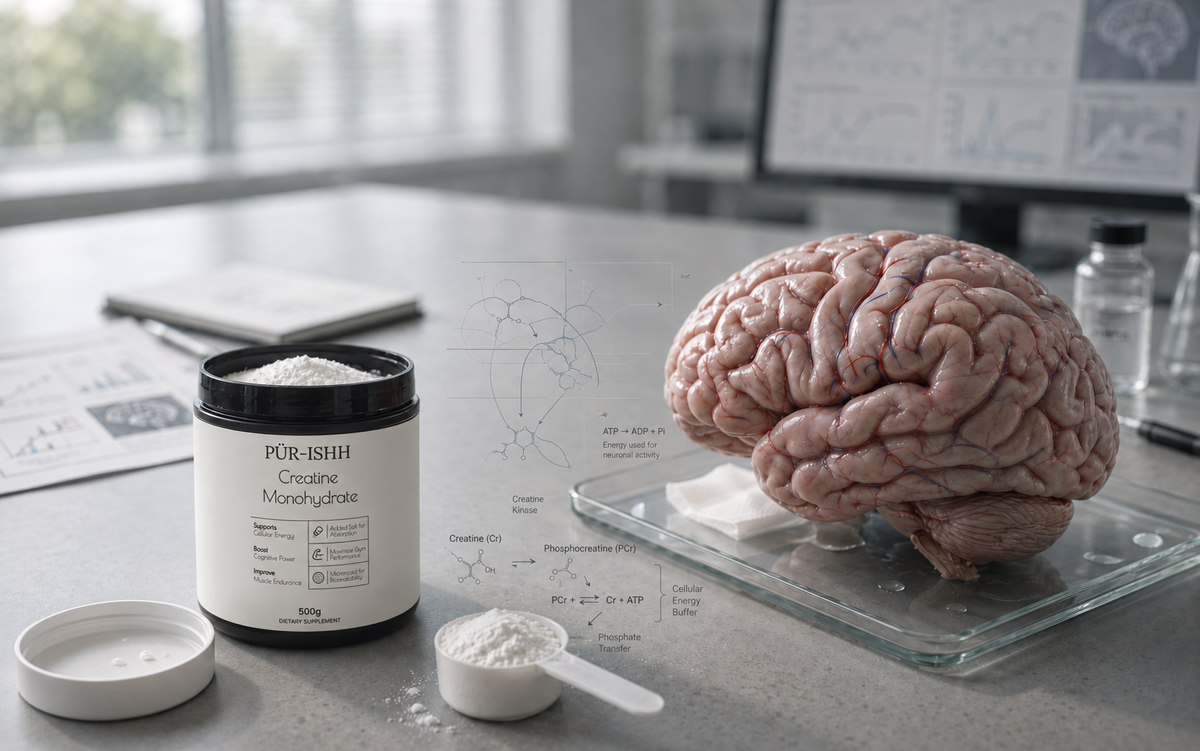
The brain is metabolically expensive. Despite representing a small fraction of body weight, it consumes a disproportionate share of the body's energy, and that energy is delivered as adenosine triphosphate, or ATP. Creatine's central biological role, the same one that underlies its muscle benefits, is participating in the phosphocreatine system, which allows rapid regeneration of ATP from ADP during periods of high demand. This system operates in brain tissue as well as muscle, and creatine kinase, the enzyme driving it, is present in tissues with high and fluctuating energy demands, which describes the brain accurately.
From there, the hypothesis is straightforward: if supplementation can increase brain creatine stores, and if brain energy availability constrains cognitive performance under certain conditions, then supplementation might improve cognitive performance, particularly under conditions of metabolic stress. That's a coherent chain of reasoning, and it's why serious researchers have pursued this question rather than dismissing it.
The critical qualifier is that each link in that chain requires evidence, and the evidence weakens considerably as you move along it. Notably, research examining whether short-term supplementation actually raises brain creatine content has produced mixed results, with at least one study finding that a seven-day protocol did not elicit improvements in brain creatine content or cognitive performance in healthy young people, suggesting this population may rely primarily on the brain's own creatine synthesis rather than dietary or supplemental intake to maintain brain creatine levels.
The meta-analysis that drove the popular claim
Most of the confident public messaging about creatine and cognition traces back to a specific 2023 paper: Prokopidis, Giannos, Triantafyllidis, Kechagias, Forbes, and Candow, "Effects of creatine supplementation on memory in healthy individuals: a systematic review and meta-analysis of randomized controlled trials," published in Nutrition Reviews, volume 81, issue 4, pages 416 to 427.
The methodology was reasonable on its face. The authors searched PubMed, Web of Science, the Cochrane Library, and Scopus from inception through September 2021, identified 23 eligible randomized controlled trials, narrowed to 10 meeting inclusion criteria for the systematic review, and included 8 in the meta-analysis itself.
The headline result: creatine supplementation improved measures of memory compared with placebo, with a standardized mean difference of 0.29, a 95 percent confidence interval of 0.04 to 0.53, heterogeneity of 66 percent, and a p-value of 0.02. The authors concluded that creatine enhanced memory performance in healthy individuals, especially in older adults aged 66 to 76.
Those specific numbers deserve a closer read than they usually get. A standardized mean difference of 0.29 is a small effect by conventional interpretation. The confidence interval's lower bound of 0.04 sits very close to zero, meaning the finding is statistically significant but only barely, and a modest shift in the underlying data could move it to non-significance. And an I-squared value of 66 percent indicates substantial heterogeneity, meaning the individual studies pooled together disagreed with each other considerably, which weakens confidence that they're all measuring the same underlying effect.
None of that makes the paper wrong. It makes the finding modest and fragile rather than robust, which is a meaningfully different thing than how it's typically represented.
The statistical challenge
Later in 2023, Nutrition Reviews published a letter to the editor by Eckert and Pascher, in volume 81, issue 11, pages 1495 to 1496, titled directly: "Double-counting due to inadequate statistics leads to false-positive findings."
Their criticism concerns a specific and consequential methodological problem. Several of the individual studies included in the meta-analysis reported multiple memory subtests from the same participants. When each of those subtests is entered into a pooled analysis as if it were an independent observation, the total number of observations exceeds the number of unique randomized participants. This violates the statistical assumption that observations are independent of one another, and the documented consequence is that it artificially inflates precision and statistical power, which increases the risk of a false-positive finding.
The authors of the original meta-analysis published a reply, and the exchange is available in the same journal for anyone wanting to evaluate both positions directly rather than taking either side's characterization on faith. What matters for a reader trying to assess this evidence is that the central positive finding driving most public claims about creatine and memory has faced a specific, published, methodological challenge from other researchers, and that challenge concerns the statistical foundation of the result rather than a matter of interpretation.
The second meta-analysis, and the same problem
A subsequent meta-analysis by Xu, Bi, Zhang, and Luo, "The effects of creatine supplementation on cognitive function in adults," was published in Frontiers in Nutrition in July 2024, volume 11, article 1424972, following PRISMA 2020 guidelines and covering randomized controlled trials published between 1993 and 2024.
Two things happened to this paper worth knowing about. First, it required a formal corrigendum, published in Frontiers in Nutrition in February 2025, correcting an error in the results section on attention that the authors attributed to a translation error from Chinese to English. Corrigenda are a normal and healthy part of scientific publishing, and their existence isn't itself damning, but a correction to a results section is more consequential than a typographical fix.
Second, and more substantively, a commentary published in Frontiers in Nutrition in 2026 by Citherlet raised the same double-counting criticism against this meta-analysis that Eckert and Pascher raised against Prokopidis. The commentary identified specific examples: in the memory analysis, the Alves 2013 studies each contributed at least seven memory subtests, McMorris 2006 contributed four, McMorris 2007b four, and Pires 2020 four, meaning the number of pooled observations again exceeded the number of unique randomized participants.
So the two most cited meta-analyses supporting creatine's cognitive benefits have both faced published criticism for the same specific statistical problem, from independent commentators, in peer-reviewed venues.
The regulatory assessment almost nobody cites
In November 2024, the European Food Safety Authority's Panel on Nutrition, Novel Foods and Food Allergens published a formal scientific opinion evaluating a health claim application linking creatine supplementation to improved cognitive function. The opinion appears in the EFSA Journal, volume 22, issue 11, article e9100, authored by Turck and colleagues. The application had been filed by Alzchem Trostberg GmbH, a major creatine manufacturer, through Austria's competent authority.
This matters because a regulatory health claim evaluation is a different kind of exercise than a meta-analysis. The applicant has a direct commercial incentive to present the strongest available case, submits the evidence they consider most compelling, and can respond to additional data requests, which EFSA issued twice during this evaluation. The panel then assesses whether the totality of that evidence establishes a cause-and-effect relationship.
The panel evaluated 21 human intervention studies identified by the applicant, plus two additional studies identified through a meta-analysis reference list, plus a systematic review and meta-analysis of 16 randomized controlled trials submitted in response to an additional data request.
Their conclusion, stated directly: a cause-and-effect relationship has not been established between creatine supplementation and an improvement in cognitive function in one or more of its domains.
What EFSA specifically found
The reasoning behind that conclusion is more informative than the conclusion alone.
On dosing, the panel noted that acute effects on working memory were observed at daily doses of 20 grams per day, but these effects were not observed at lower doses, nor with continuous supplementation at 5 grams per day for six weeks. This is a genuinely important detail. Twenty grams per day is a loading-phase dose, roughly four times the standard maintenance dose most people take, and the effects that appeared at that level did not persist at the doses actually used in typical daily supplementation.
On consistency, the panel observed that an effect on response inhibition at 20 grams per day for seven days was an isolated finding among ten intervention studies in healthy individuals, with no effects observed on other cognitive domains. A single positive result across ten studies, in one domain only, is the kind of pattern that could easily reflect chance rather than a genuine effect.
On clinical populations, the three intervention studies conducted in diseased individuals did not support an effect of creatine supplementation on cognition.
On mechanism, the panel considered the available evidence for a mechanism by which creatine could exert the claimed effect to be weak, notwithstanding the plausible theoretical reasoning described earlier in this post.
The panel also revisited three older studies, McMorris 2006, McMorris 2007, and Rae 2003, which it had previously evaluated in a 2011 opinion on creatine and memory. Its assessment of their methodological quality was blunt: lack of information on randomization procedures, inadequate adjustment for baseline differences, multiple uncorrected pairwise comparisons or an inappropriate significance level, and insufficient detail on the statistical models used to allow scientific assessment. The panel concluded no conclusions could be drawn from those studies for substantiating the claim. Notably, several of those same studies appear in the meta-analyses discussed above.
The practical consequence is that health claims linking creatine to cognitive benefits cannot be used on products marketed in the European Union.
What a researcher behind the positive findings said
The most striking element of this whole picture comes from Darren Candow, a co-author on the Prokopidis meta-analysis and one of the more prolific creatine researchers working today.
Responding to the EFSA decision, Candow said it was justified based on the current body of research, which he described as very small. He noted that when you look closely at the studies, most of the results relate to a metabolic stressor, or the dosages used were very inconsistent. He also pointed out that no study has given creatine to individuals and then measured whether cognition remained improved after creatine withdrawal, that individual studies are underpowered, that current meta-analyses are inconsistent, and that no dosing studies using magnetic resonance spectroscopy have been performed. His summary: in his opinion, it's way too early to conclude that creatine improves cognition overall.
When a researcher who co-authored a positive meta-analysis publicly agrees that a regulator was right to reject the claim his work is cited to support, that's about as clear a signal as this field produces about where the evidence actually stands.
Where the signals, such as they are, appear strongest
None of this means the hypothesis is dead, and the honest version includes where the more promising signals cluster.
Older adults appear repeatedly as the population where effects, when detected, are most often found, which is consistent with the Prokopidis finding specifically highlighting adults aged 66 to 76. A systematic review of creatine and cognition in aging published in Nutrition Reviews in 2026 continues examining this population specifically, while noting contradictory findings across the literature and the need for further clinical studies exploring mechanism.
Vegetarians are a mechanistically interesting group, since dietary creatine comes primarily from meat and fish, meaning vegetarians typically have lower baseline creatine stores and therefore more theoretical room for supplementation to matter. Research by Rae and colleagues in 45 young adult vegetarian participants reported positive effects on working memory and intelligence measures, though this study is among those EFSA specifically criticized on methodological grounds.
Conditions of metabolic stress, particularly sleep deprivation, recur as a context where effects have been observed, consistent with Candow's observation that most positive results relate to a metabolic stressor rather than to baseline cognitive performance in rested, well-nourished individuals.
The pattern suggests that if creatine does affect cognition, it may do so specifically by relieving a constraint in people who have one, whether from age, diet, or acute stress, rather than by enhancing performance in people who don't. That's a considerably narrower claim than "creatine improves brain function," and it's still not established.
The contrast worth drawing
There's a useful comparison sitting right next to this one. In 2016, EFSA approved an Article 13(5) health claim for creatine in combination with resistance training to improve muscle strength in adults over the age of 55. Same regulator, same evidentiary standard, same compound, entirely different outcome.
That contrast is the most useful thing to take from all of this. Creatine's effects on muscle performance and strength are supported by decades of consistent research and have cleared one of the more demanding regulatory bars in the world. Its effects on cognition rest on a smaller body of literature, with two prominent meta-analyses facing published statistical criticism, isolated findings at loading doses that don't persist at normal doses, and a formal regulatory determination that causation has not been established.
Both facts are about the same supplement. Holding them simultaneously, rather than letting the strength of one carry the other, is what accuracy requires here.
The honest summary
The mechanism connecting creatine to brain energy metabolism is real and plausible. The clinical evidence that supplementation improves cognitive function in healthy adults at typical doses is weak, contested, and formally judged insufficient to establish causation by EFSA in November 2024 after reviewing 21 human intervention studies. The two most-cited meta-analyses supporting cognitive benefits have both been challenged in peer-reviewed commentary for double-counting non-independent outcomes, a statistical problem known to inflate false-positive findings. One of the authors of the more prominent of those meta-analyses has publicly stated it's too early to conclude creatine improves cognition.
If you take creatine, the reasons to do so remain well supported: strength, power output, recovery, and lean mass maintenance, particularly with resistance training and particularly as you age. Cognitive benefit is an interesting hypothesis with some suggestive signals in specific populations, not an established outcome, and anyone telling you otherwise is ahead of the evidence.
That may change. Larger, better-powered trials with proper statistical handling, MRS-based dosing studies, and research specifically designed around the populations where signals cluster could all shift this picture. Until they do, the accurate answer is that this remains an open question, and the newest research has made the case weaker rather than stronger.