The word "organic" does a lot of work in the supplement aisle. It implies clean, wholesome, and somehow more natural than the alternative, and for fresh produce it maps onto something real. But when people type "best organic supplements for energy" into a search engine, they're usually asking the wrong question, not because they care about the wrong things, but because they've accepted a framework that doesn't apply to this particular category.
Here's the issue. The supplements that actually move the needle on energy, whether you define that as sustained physical output, better recovery, cellular energy metabolism, or just fewer 2pm crashes, are mostly synthesized molecules, geological minerals, or compounds your body already produces naturally. None of them grew in a field. Most of them couldn't be certified organic if you tried, because the certification standard was built for agricultural products and has no coherent meaning applied to a molecule like creatine or a mineral like magnesium.
What does matter for energy supplements, and matters considerably, is whether they're actually dosed correctly, tested for what they claim to contain, and free of contamination. That's the right filter, and it's different from organic.
This post covers the supplements with the most credible research behind them for real, sustained energy, explains the mechanism behind each one, and is straight about what the evidence does and doesn't support.
What "natural sustained energy" actually means
It's worth distinguishing upfront between stimulant-based energy and genuine metabolic energy support, because they get conflated constantly and behave completely differently.
Caffeine, the most consumed stimulant on the planet, produces energy by blocking adenosine receptors, the neurochemical signal your brain reads as fatigue. It doesn't give your cells more fuel. It temporarily prevents you from feeling how fatigued you already are. When the caffeine clears and the blocked adenosine floods back in, the crash is real, because the fatigue that was waiting underneath hasn't gone anywhere.
Genuine metabolic energy support works differently. It either increases the efficiency of your cells' energy production machinery, maintains the conditions those systems need to operate well, or provides substrates that directly participate in the biochemical pathways that generate ATP, the actual currency of cellular energy. Effects are slower to build and less dramatic to feel, because you're not blocking a signal, you're improving the underlying system. But they also tend to be more durable and don't carry the same boom-and-crash pattern.
The supplements worth discussing here operate on that second model.
Creatine: the most evidence-backed energy supplement that exists
Creatine is not typically marketed as an energy supplement in the way that label gets applied to green tea extract blends with dramatic packaging. It's marketed as a performance supplement for people lifting weights. But the underlying mechanism is directly relevant to energy in the most literal sense, at the cellular level.
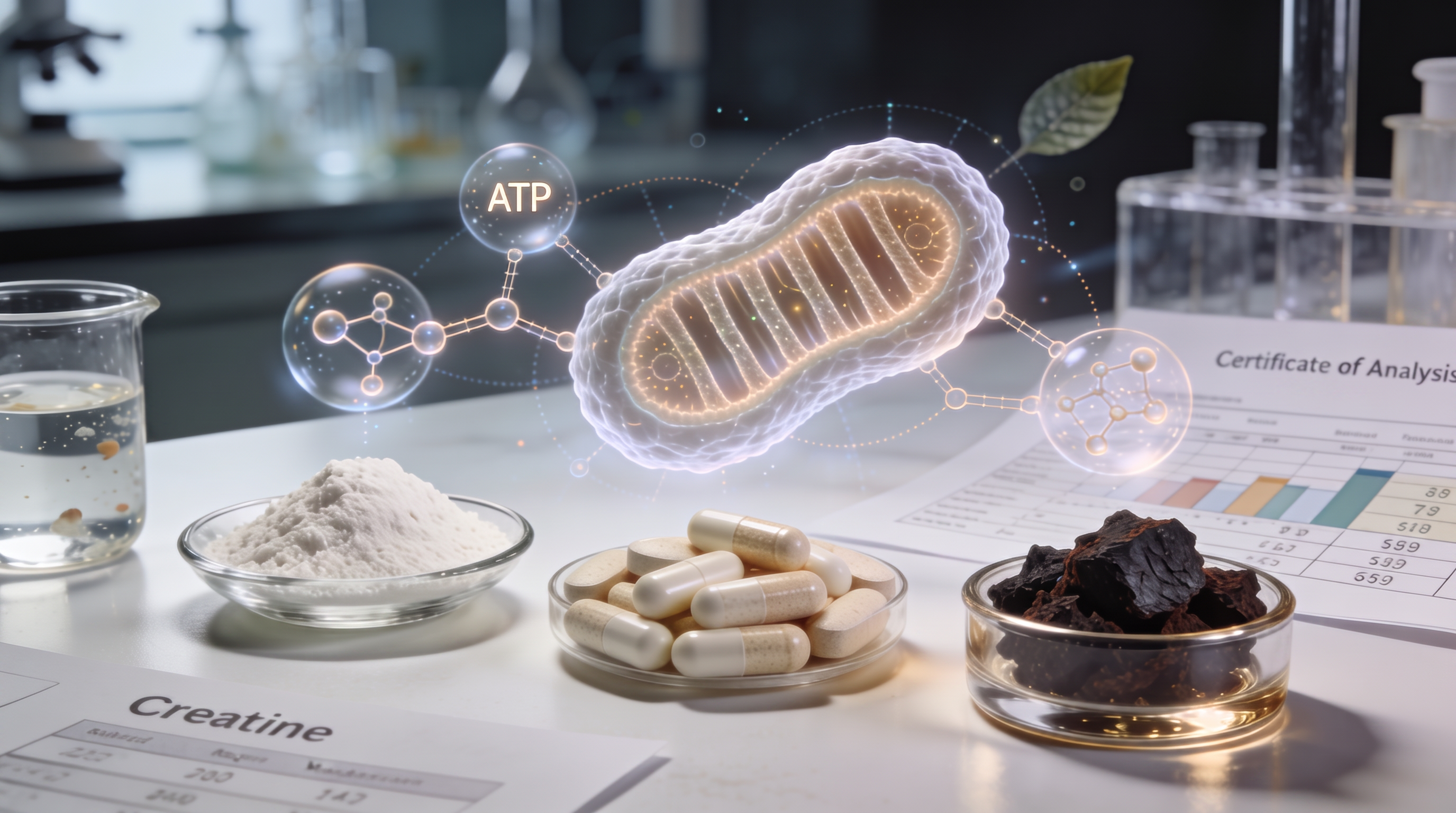
Your muscles use ATP as their immediate energy source, and ATP depletes rapidly during any kind of high-intensity effort. Phosphocreatine, the stored form of creatine in muscle tissue, is what lets your cells regenerate ATP quickly enough to sustain output beyond the first few seconds of an effort. Supplementing creatine increases how much phosphocreatine your muscles can hold, which translates to more available energy for sustained high-intensity work, faster recovery between efforts, and less fatigue accumulating across a training session or a physically demanding day.
The research on this is deep, decades of it, across a range of populations and contexts. Creatine is one of the most studied supplements in existence, and the evidence for its role in supporting physical energy output and reducing fatigue under load is genuinely strong. It's not a stimulant. You won't feel it arrive thirty minutes after taking it. What you notice over weeks of consistent use is the difference in how you feel at the end of a hard workout compared to how you felt before, which is exactly the kind of sustained, structural improvement in energy capacity that separates this category from a can of something carbonated.
It's also synthesized. Creatine is produced through a chemical reaction between glycine and arginine, then methylated by the body. It's not extracted from anything agricultural, and there's nothing coherent about labeling it organic, because the molecule is the same regardless of how it was produced. What matters for creatine quality is purity and verified dose, both of which are what a proper Certificate of Analysis addresses.
Our creatine lot came back at 4,976 milligrams against a 5,000 milligram label claim on Kjeldahl testing, with a clean microbial panel across the board. That's the relevant verification for this ingredient, not a seal describing how a crop was grown.
Magnesium: energy at the cellular machinery level
Magnesium doesn't get marketed as an energy supplement either, probably because "supports 300 enzymatic reactions" is harder to put on packaging than "boost your energy naturally." But its role in cellular energy production is as fundamental as it gets.
Magnesium is a required cofactor for ATP synthase, the enzyme that produces ATP from ADP in the mitochondria. Every molecule of ATP your cells produce requires magnesium to work properly. Low magnesium doesn't just affect sleep or muscle function, it impairs the very machinery your cells use to generate energy in the first place, which is why fatigue is one of the most consistent signs of inadequate magnesium status and why restoring adequate levels in people who were deficient consistently shows up as improved energy in the research.
The magnesium and energy connection extends into the Krebs cycle, the metabolic process that extracts energy from food and feeds into ATP production. Several steps in that cycle depend on magnesium-dependent enzymes. A diet that chronically under-delivers magnesium isn't just missing a mineral, it's running its cellular energy systems at reduced efficiency.
What form of magnesium matters here: glycinate for general repletion and tolerability, malate specifically because malic acid is a Krebs cycle intermediate with some evidence for energy support in fatigue contexts, and L-threonate for the brain-specific magnesium elevation that may support mental energy and cognitive clarity alongside the physical side. Our magnesium complex includes all four forms, each verified against its labeled amount in the batch COA, because a supplement with seven active ingredients is only as reliable as its least-tested component.
The same point applies here as with creatine: magnesium is a mineral. It doesn't come from a certified organic farm. The relevant questions are whether the form is bioavailable, whether the dose is on spec, and whether the batch is free of contamination. Those are what batch testing addresses.
Shilajit: the energy mechanism that's genuinely interesting, sized honestly
Shilajit is the ingredient in our catalog where the energy claims require the most careful calibration, because the research is real but early, and the market is full of poorly sourced products that make the category harder to evaluate.
The most relevant mechanism for energy is shilajit's interaction with mitochondrial function. Fulvic acid, the primary active compound in quality shilajit, appears to support electron transport chain activity and ATP production, based on in vitro research and a small number of animal studies. The hypothesis is that fulvic acid enhances the efficiency of mitochondrial energy production rather than stimulating it acutely, which would be consistent with the kind of gradual improvement in perceived energy and reduced fatigue that people report with consistent use.
For the human research, the clearest signal comes from a small trial showing reduced fatigue scores in people taking shilajit compared to placebo, and the testosterone study we've referenced elsewhere that found improved vitality markers alongside hormonal changes in men aged 45 to 55. These are real findings, not fabricated, but they're also small studies that haven't been replicated at scale, which means they're promising signals rather than established facts.
What shilajit is not is a stimulant, and it's not something that produces noticeable acute energy changes the way caffeine does. It's a slow-building, long-term input for cellular efficiency, if the mechanism that the early research suggests is real and holds up in larger studies. The honest framing is that this is one of the more mechanistically interesting ingredients for sustained energy support, backed by preliminary evidence and a genuinely plausible pathway, but not the kind of established, deeply replicated evidence that creatine and magnesium carry.
Quality matters enormously here, more than in almost any other supplement category. Raw shilajit carries contamination risk, and the difference between a properly sourced, authentically tested batch and the cheap alternatives is the difference between taking something that resembles what was studied and taking an unknown substance. Our shilajit COA covers authenticity, heavy metals across lead, arsenic, cadmium, and mercury at levels well below limits, full radionuclide screening, and a 72 percent fulvic acid content that puts it firmly in the quality range meaningful research has used. That's the filter that matters for this ingredient, not whether it grew in an organically certified field, which it didn't, because it formed in mountain rock over centuries.
Electrolytes: the missing ingredient in sustained output
Electrolytes don't get called energy supplements either, but they belong in this conversation because their absence is one of the most common and most overlooked reasons for fatigue that isn't caused by sleep deprivation or caloric deficit.
Sodium, potassium, and magnesium all play roles in how your muscles contract and relax, how your nerves fire signals, and how efficiently your cardiovascular system delivers oxygen and nutrients to working tissue. When electrolytes fall below adequate levels through sweat loss, inadequate dietary intake, or the sodium-excretion effect that comes with low-carb or carnivore eating, the first signs are often fatigue, reduced output, and difficulty maintaining intensity, symptoms that look a lot like general low energy but respond specifically to electrolyte replacement rather than sleep or calories.
For people eating low-carb or following a carnivore approach, this matters more than for most. The mechanism is specific: lower insulin leads to more sodium excretion, and a whole-food diet that cuts processed food often cuts the sodium load that was inadvertently covering the gap. The result can be genuine functional fatigue that resolves when electrolytes are replaced, which is different from the kind of tired that needs more sleep.
The "organic electrolytes" framing, when it appears, doesn't describe anything meaningful about sodium, potassium, or magnesium, all minerals rather than agricultural products. What matters is the dose and the purity, both of which are what independent testing addresses on a batch-by-batch basis.
Why the organic filter fails this category specifically
Pulling back to the framework question: why is "organic" the wrong filter for energy supplements when it does describe something real for produce?
Three reasons, applied concretely.
First, most of the supplements in this category aren't agricultural to begin with. Creatine is synthesized. Magnesium and electrolytes are minerals. Shilajit formed in geological processes over centuries. The organic standard was designed for farming, and applying it to these ingredients is like asking whether water is organic, the question doesn't map onto the thing it's describing.
Second, for the few ingredients in the energy supplement space that are agricultural, being organic doesn't verify the things that actually matter for safety and efficacy: potency, contamination, and finished-product composition. An organically grown botanical can still carry heavy metal contamination because the soil it grew in contained heavy metals, and organic certification doesn't test for that. An organic supplement blend can still be underdosed, because that's a manufacturing issue rather than a farming one.
Third, a lot of people asking "what are the best organic energy supplements" are actually asking something else: what are the cleanest, most trustworthy energy supplements that don't come with a list of unknown additives and poorly sourced ingredients. That's a completely reasonable question. The honest answer is that what they're describing is answered better by batch-level testing transparency than by an organic seal, especially for the ingredients in this specific category.
The filter that actually works
If organic isn't the right frame, what is?
Ask whether the dose matches what was used in the research. Creatine needs roughly 3 to 5 grams daily to build and maintain the saturation that produces its benefits. Magnesium needs to be in a bioavailable form at a dose that closes whatever gap exists in your diet. Shilajit needs to be high in fulvic acid and verified for authenticity, not just labeled with a vague "standardized extract" description.
Ask whether there's independent testing on the finished batch. Not a "we test all our products" badge, but an actual Certificate of Analysis tied to a specific lot number with specific numbers rather than just a pass or fail summary.
Ask whether the contamination question has been answered. Heavy metals in supplements aren't rare, and the categories most relevant to energy, botanical ingredients especially, carry specific contamination risks that should be checked directly rather than inferred from a production method.
These questions don't map onto organic certification. They map onto what we've spent this whole content series building the case for: that what's in the bottle, verified specifically and transparently, is the thing that matters most, regardless of what the farming method was three steps upstream.
That's not a less rigorous standard than organic. It's a more directly relevant one for the specific questions this category raises.